हिंदी
सी.आई.एस.सी.ई.आईसीएसई ICSE Class 6

Describe a Simple Experiment with the Help of a Diagram to Show that Air Occupies Space

Advertisements
Advertisements

प्रश्न

Describe a simple experiment with the help of a diagram to show that Air occupies space

संक्षेप में उत्तर
आकृति
Advertisements

उत्तर

Air occupies space
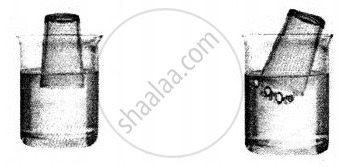
  • Press an inverted glass
  • Tilt the tumbler to one side, tumbler over the water.

Observation: On tilting the tumbler, bubbles of air are seen coming out. Water slowly enters the tumbler to take place of the trapped air in the tumbler.

Conclusion: Air occupies space (the space in the tumbler was occupied by air).

shaalaa.com
  क्या इस प्रश्न या उत्तर में कोई त्रुटि है?
अध्याय 6: Air and Atmosphere - Additional Questions For Practice

APPEARS IN

एस पी सिंग Concise Chemistry [English] Class 6 ICSE
अध्याय 6 Air and Atmosphere
Additional Questions For Practice | Q 5.1

संबंधित प्रश्न

What was the ancient belief regarding the nature of matter ?


Match the statements in Column A, with those in Column B.

Column A Column B
1. Largest Constituent of air, which dilutes the activity of oxygen.

(a) Oxygen

2. A gas used for filling weather observation balloons. (b) carbon acid
3. An acid formed by the dissolution of sulphur dioxide gas in water. (c) Sulphur acid
4. An acid formed by the dissolution of carbon dioxide in water. (d) Helium
5. A gas vital for respiration. (e) Nitrogen

Why can’t we see air?


How is air useful to windmills?


Name the following.

Gases that are harmful to the ozone layer


Draw a neat labelled diagram for the following experiment.

To study the presence of carbon dioxide in air.


Draw a neat labelled diagram for the following experiment.

To demonstrate the burning of sulphur in a jar of oxygen.


Take a squeezable bottle. Make a hole on the lid and close the bottle tightly. Bring the bottle near your face and press the bottle. What do you feel?


In the boxes of Column, I the letters of some words got jumbled. Arrange them in proper form in the boxes given in Column II

Column I Column II
(a) \[\boxed{\text{D}}\]\[\boxed{\text{I}}\]\[\boxed{\text{L}}\]\[\boxed{\text{L}}\]\[\boxed{\text{M}}\]\[\boxed{\text{W}}\]\[\boxed{\text{I}}\]\[\boxed{\text{N}}\] (a)  `squaresquaresquaresquaresquaresquaresquare  square`
(b) \[\boxed{\text{Y}}\]\[\boxed{\text{N}}\]\[\boxed{\text{O}}\]\[\boxed{\text{G}}\]\[\boxed{\text{X}}\]\[\boxed{\text{E}}\] (b) `squaresquaresquaresquaresquare  square`
(c) \[\boxed{\text{M}}\]\[\boxed{\text{E}}\]\[\boxed{\text{S}}\]\[\boxed{\text{K}}\]\[\boxed{\text{O}}\] (c) `squaresquaresquaresquaresquare`
(d) \[\boxed{\text{T}}\]\[\boxed{\text{U}}\]\[\boxed{\text{D}}\]\[\boxed{\text{S}}\] (d) `squaresquaresquare`

Paheli kept some water in a beaker for heating. She observed that tiny bubbles appeared before the water started to boil. She boiled the water for about 5 minutes and filled it in a bottle up to the brim and kept the bottle air tight till it cooled down to room temperature.

Do you think tiny bubbles will appear on heating the water taken out from the bottle? Justify your answer.


Share
Notifications

Englishहिंदीमराठी


      Forgot password?
Use app×