हिंदी

D Y D X = X 2 E X - Mathematics

Advertisements
Advertisements

प्रश्न

\[\frac{dy}{dx} = x^2 e^x\]

योग
Advertisements

उत्तर

We have,

\[\frac{dy}{dx} = x^2 e^x \]

\[ \Rightarrow dy = x^2 e^x dx\]

Integrating both sides, we get
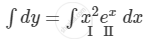
\[ \Rightarrow \int dy = x^2 \int e^x dx - \int\left( \frac{d}{dx}\left( x^2 \right)\int e^x dx \right)dx\]

\[ \Rightarrow y = x^2 e^x - 2\int x e^x dx\]

\[ \Rightarrow y = x^2 e^x - 2x\int e^x dx + 2\int\left( \frac{d}{dx}\left( x \right)\int e^x dx \right)dx\]

\[ \Rightarrow y = x^2 e^x - 2x e^x + 2 e^x + C\]

\[ \Rightarrow y = \left( x^2 - 2x + 2 \right) e^x + C\]

shaalaa.com
  क्या इस प्रश्न या उत्तर में कोई त्रुटि है?
अध्याय 22: Differential Equations - Revision Exercise [पृष्ठ १४५]

APPEARS IN

आरडी शर्मा Mathematics [English] Class 12
अध्याय 22 Differential Equations
Revision Exercise | Q 22 | पृष्ठ १४५

वीडियो ट्यूटोरियलVIEW ALL [2]

संबंधित प्रश्न

Form a differential equation representing the given family of curves by eliminating arbitrary constants a and b.

`x/a + y/b = 1`


Form a differential equation representing the given family of curves by eliminating arbitrary constants a and b.

y = a e3x + b e– 2x


Form a differential equation representing the given family of curves by eliminating arbitrary constants a and b.

y = e2x (a + bx)


Form a differential equation representing the given family of curves by eliminating arbitrary constants a and b.

y = ex (a cos x + b sin x)


Find the particular solution of the differential equation (1 + e2x) dy + (1 + y2) ex dx = 0, given that y = 1 when x = 0.


Solve the differential equation  `ye^(x/y) dx = (xe^(x/y) + y^2)dy, (y != 0)`


The general solution of the differential equation `(y dx - x dy)/y = 0` is ______.


The general solution of a differential equation of the type  `dx/dy + P_1 x = Q_1` is ______.


Find the differential equation of all the circles which pass through the origin and whose centres lie on y-axis.


Find the differential equation of all the circles which pass through the origin and whose centres lie on x-axis.


Form the differential equation having \[y = \left( \sin^{- 1} x \right)^2 + A \cos^{- 1} x + B\], where A and B are arbitrary constants, as its general solution.


Show that y2 − x2 − xy = a is a solution of the differential equation \[\left( x - 2y \right)\frac{dy}{dx} + 2x + y = 0.\]


Verify that y = A cos x + sin x satisfies the differential equation \[\cos x\frac{dy}{dx} + \left( \sin x \right)y=1.\]


Show that the differential equation of all parabolas which have their axes parallel to y-axis is \[\frac{d^3 y}{d x^3} = 0.\]


From x2 + y2 + 2ax + 2by + c = 0, derive a differential equation not containing a, b and c.


\[\frac{dy}{dx} = \sin^3 x \cos^4 x + x\sqrt{x + 1}\]


\[\frac{dy}{dx} + 4x = e^x\]


\[(\tan^2 x + 2\tan x + 5)\frac{dy}{dx} = 2(1+\tan x)\sec^2x\]


tan y dx + tan x dy = 0


(1 + xy dx + (1 + yx dy = 0


x cos2 y dx = y cos2 x dy


Find the general solution of the differential equation `"dy"/"dx" = y/x`.


A solution of the differential equation `("dy"/"dx")^2 - x "dy"/"dx" + y` = 0 is ______.


Solve the differential equation:

cosec3 x dy − cosec y dx = 0


General solution of tan 5θ = cot 2θ is


The number of arbitrary constant in the general solution of a differential equation of fourth order are


The general solution of the differential equation `(dy)/(dx) = e^(x + y)` is


The general solution of the differential equation `(ydx - xdy)/y` = 0


Find the general solution of differential equation `(dy)/(dx) = (1 - cosx)/(1 + cosx)`


What is the general solution of differential equation `(dy)/(dx) = sqrt(4 - y^2)  (-2 < y < 2)`


Solve the differential equation: y dx + (x – y2)dy = 0


The general solution of the differential equation ydx – xdy = 0; (Given x, y > 0), is of the form

(Where 'c' is an arbitrary positive constant of integration)


Share
Notifications

Englishहिंदीमराठी


      Forgot password?
Use app×