Advertisements
Advertisements
प्रश्न
Consider the two idealized systems: (i) a parallel plate capacitor with large plates and small separation and (ii) a long solenoid of length L >> R, radius of cross-section. In (i) E is ideally treated as a constant between plates and zero outside. In (ii) magnetic field is constant inside the solenoid and zero outside. These idealised assumptions, however, contradict fundamental laws as below:
विकल्प
case (i) contradicts Gauss’s law for electrostatic fields.
case (ii) contradicts Gauss’s law for magnetic fields.
case (i) agrees with `oint E.dl = 0`
case (ii) contradicts `oint H.dl = I_(en)`
Advertisements
उत्तर
case (ii) contradicts Gauss’s law for magnetic fields.
Explanation:
The electrostatic field lines, do not form a continuous closed path (this follows from the conservative nature of electric field) while the magnetic field lines form the closed paths.
According to Gauss's law of electrostatic field `oint_s E.ds = q/ε_0`. so it does not contradict for electrostatic field as the electric field lines do not form continuous path.
According to Gauss's law of magnetic field `oint_s B.ds = 0`. It contradicts for magnetic field, because there is magnetic field inside the solenoid and no field outside the solenoid marrying current, but the magnetic field lines from the closed paths.
This implies that number of magnetic field lines entering the Gaussian surface is equal to the number of magnetic field lines leaving it.
APPEARS IN
संबंधित प्रश्न
State Gauss’s law in electrostatics. A cube which each side ‘a’ is kept is an electric field given by `vecE` = C × l. (as is shown in the figure where C is a positive dimensional constant. Find out
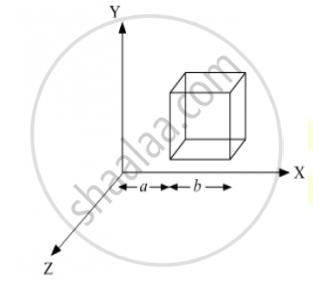
(i) The electric flux through the cube, and
(ii) The net charge inside the cube.
Verify the Gauss’s law for magnetic field of a point dipole of dipole moment m at the origin for the surface which is a sphere of radius R.
A magnet is suspended horizontally in the earth's magnetic field. When it is displaced and then released it oscillates is a horizontal plane with a period T. If a piece of wood of same moment of inertia (about the axis of rotation) as the magnet is attached to the magnet, what would the new period of oscillation of the system become?
A short magnet produces a deflection of 30° when placed at certain distance in tanA position of magnetometer. If another short magnet of double the length and thrice the pole strength is placed at the same distance in tanB position of the magnetometer, the deflection produced will be:
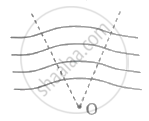
If the magnetic lines of force are shaped like arcs of concentric circles with their centre at point O in a certain section of a magnetic field ______.
How do magnetic field lines entering and leaving a closed surface contribute to its net magnetic flux?
Which observation is reflected by Gauss’s law for magnetism?
After whom is the topic of Gauss’s law named?
In electrostatics, what determines the net electric flux through a closed surface?
What is magnetic flux?
What is a Gaussian surface?
What is the total outward magnetic flux through a closed surface?
Why can a closed surface not enclose a net magnetic “charge” in the way it can enclose electric charge?
Does a bar magnet experience torque on itself due to its own field?
Can a wire element exert force on itself?
What creates magnetic moments in a system whose charges are moving in loops?
Which example has current loops and magnetic dipole moments even though the atom as a whole is neutral?
