Advertisements
Advertisements
प्रश्न
Consider the situation shown in the following figure. Suppose a small electric field E exists in the space in the vertically charge Q on its top surface. The friction coefficient between the two blocks is μ but the floor is smooth. What maximum horizontal force F can be applied without disturbing the equilibrium?
[Hint: The force on a charge Q bye the electric field E is F = QE in the direction of E.]
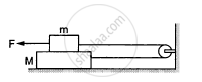
Advertisements
उत्तर
From the free body diagram: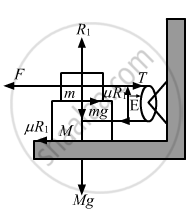
R1 + QE − mg = 0
where
R1 is the normal reaction force
Q is the charge
E is the small electric field
⇒ R1 = mg − QE (1)
F − T − μR1 = 0
F − T = μR1
where F is the maximum horizontal force required
From Equation (1),
F − T − μ(mg − QE) = 0
F − T = μ(mg − QE)
⇒ F − T − μmg + μQE = 0 (2)
T − μR1 = 0
⇒ T = μR1 = μ (mg − QE) (3)
From Equation (2),
F − μmg + μ QE − μmg + μQE = 0
⇒ F − 2 μmg + 2μQE = 0
⇒ F = 2μmg − 2μQE
⇒ F = 2μ (mg − QE)
Therefore, the maximum horizontal force that can be applied is 2μ (mg − QE).
