Advertisements
Advertisements
प्रश्न
Consider a two-slit interference arrangement (Figure) such that the distance of the screen from the slits is half the distance between the slits. Obtain the value of D in terms of λ such that the first minima on the screen falls at a distance D from the centre O.

Advertisements
उत्तर
Young's experiment to show interference of light passing through two slits. A pattern of bright and dark areas appears on the screen (as shown in figure (i)).


The condition for destructive interference is `Δx = S_2P - S_1P +- ((2n - 1)/2)lambda` where n = 1, 2, ...
For nth minima to be formed on the screen path difference (Δx) between the rays coming from S1 and S2 must be `((2n - 1)/2)lambda`
The minima will occur when `Δx = S_2P - S_1P = ((2n - 1)/2)lambda` ......(i)
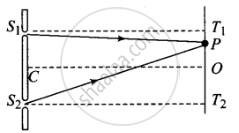
From the given figure,
`S_1P = sqrt((S_1T_1)^2 + (PT_1)^2) = sqrt(D^2 + (D - x)^2)`
And `S_2P = sqrt((S_2T_2)^2 + (T_2P^2)) = sqrt(D^2 + (D + x)^2)`
`T_2P = T_2O + OP = D + x`
And `T_1P = T_1O - OP = D - x`
Hence, `[D^2 + (D + x)^2]^(-1/2) - [D^2 + (D - x)^2]^(1/2) = lambda/2` ......[For first minima n = 1]
If `x = D`
We can write, `[D^2 + 4D^2]^(-1/2) - [D^2 + 0]^(1/2) = lambda/2`
⇒ `[5D^2]^(1/2) - [D^2 + 0]^(1/2) = lambda/2`
⇒ `sqrt(5)D - D = lambda/2` or `D = lambda/(2sqrt(5) - 1)` = 0.404 λ
APPEARS IN
संबंधित प्रश्न
Find the intensity at a point on a screen in Young's double slit experiment where the interfering waves have a path difference of (i) λ/6, and (ii) λ/2.
Write three characteristic features to distinguish between the interference fringes in Young's double slit experiment and the diffraction pattern obtained due to a narrow single slit.
The intensity at the central maxima in Young’s double slit experimental set-up is I0. Show that the intensity at a point where the path difference is λ/3 is I0/4.
If Young's double slit experiment is performed in water, _________________ .
If the source of light used in a Young's double slit experiment is changed from red to violet, ___________ .
A source emitting light of wavelengths 480 nm and 600 nm is used in a double-slit interference experiment. The separation between the slits is 0.25 mm and the interference is observed on a screen placed at 150 cm from the slits. Find the linear separation between the first maximum (next to the central maximum) corresponding to the two wavelengths.
A Young's double slit apparatus has slits separated by 0⋅28 mm and a screen 48 cm away from the slits. The whole apparatus is immersed in water and the slits are illuminated by red light \[\left( \lambda = 700\text{ nm in vacuum} \right).\] Find the fringe-width of the pattern formed on the screen.
A parallel beam of monochromatic light is used in a Young's double slit experiment. The slits are separated by a distance d and the screen is placed parallel to the plane of the slits. Slow that if the incident beam makes an angle \[\theta = \sin^{- 1} \left( \frac{\lambda}{2d} \right)\] with the normal to the plane of the slits, there will be a dark fringe at the centre P0 of the pattern.
In a Young's double slit interference experiment, the fringe pattern is observed on a screen placed at a distance D from the slits. The slits are separated by a distance d and are illuminated by monochromatic light of wavelength \[\lambda.\] Find the distance from the central point where the intensity falls to (a) half the maximum, (b) one-fourth the maximum.
Wavefront is ______.
A thin circular ring of mass M and radius R is rotating about its axis with a constant angular velocity ω. Two objects each of mass m are attached gently to the opposite ends of diameter of the ring. The ring will now rotate with an angular velocity:
The Young's double slit experiment is performed with blue and with green light of wavelengths 4360Å and 5460Å respectively. If x is the distance of 4th maxima from the central one, then:
How will the interference pattern in Young's double-slit experiment be affected if the phase difference between the light waves emanating from the two slits S1 and S2 changes from 0 to π and remains constant?
In Young's double slit experiment using light of wavelength 600 nm, the slit separation is 0.8 mm and the screen is kept 1.6 m from the plane of the slits. Calculate
- the fringe width
- the distance of (a) third minimum and (b) fifth maximum, from the central maximum.
A beam of light consisting of two wavelengths 600 nm and 500 nm is used in Young's double slit experiment. The silt separation is 1.0 mm and the screen is kept 0.60 m away from the plane of the slits. Calculate:
- the distance of the second bright fringe from the central maximum for wavelength 500 nm, and
- the least distance from the central maximum where the bright fringes due to both wavelengths coincide.
What is the consequence of random phase variation for ordinary light sources?
Why do the two narrow slits in Young's experiment act as coherent sources?
For small angles, what is the approximate path difference at a point a distance \(x\) from the central bright fringe?
What is the angular fringe width \(\alpha\)?
