Advertisements
Advertisements
प्रश्न
Complete the following table.
| Atomic number | Mass number | Number of Neutrons | Number of protons | Number of electrons | Name of the Atomic species |
| 9 | - | 10 | - | - | - |
| 16 | 32 | - | - | - | Sulphur |
| - | 24 | - | 12 | - | - |
| - | 2 | - | 1 | - | - |
| - | 1 | 0 | 1 | 0 | - |
Advertisements
उत्तर
| Mass number | Mass number | Number of Neutrons | Number of protons | Number of electrons | Name of the Atomic species |
| 9 | 19 | 10 | 9 | 9 | Fluorine |
| 16 | 32 | 16 | 16 | 16 | Sulphur |
| 12 | 24 | 12 | 12 | 12 | Magnesium |
| 1 | 2 | 1 | 1 | 1 | Deuterium |
| 1 | 1 | 0 | 1 | 0 | Hydrogen ion |
Explanation:
- First Row (Fluorine):
- Mass Number: 19 = Atomic number (9) + Number of neutrons (10)
- Number of Protons: Atomic number = 9
- Number of Electrons: Atomic number = 9
- Name of the Species: Fluorine (F)
- Second Row (Sulphur):
- Number of Neutrons: 32 - Atomic number (16) = 16
- Number of Protons: Atomic number = 16
- Number of Electrons: Atomic number = 16
- Name of the Species: Sulphur (S)
- Third Row (Magnesium):
- Number of Protons: Atomic number = 12
- Number of Neutrons: 24 - Atomic number (12) = 12
- Number of Electrons: Atomic number = 12
- Name of the Species: Magnesium (Mg)
- Fourth Row (Deuterium):
- Number of Protons: Atomic number = 1
- Number of Neutrons: 2 - Atomic number (1) = 1
- Number of Electrons: Atomic number = 1
- Name of the Species: Deuterium (D)
- Fifth Row (Hydrogen Ion):
- Number of Protons: Atomic number = 1
- Number of Electrons: 0
- Name of the Species: Protium Ion or Hydrogen Ion (H⁺)
संबंधित प्रश्न
What are the atomic numbers of elements whose outermost electrons is represented by 3p5?
Fill in the blanks.
Isotopes are the atoms of ______ element having the ______ atomic number but ______ mass number.
The mass number of an element is 23 and it contains 11 electrons. What is the number of protons and neutrons in it? What is the atomic number of the element?
Elements X, Y and Z have atomic numbers 6, 9 and 12 respectively. Which one:
- Forms an anion
- Forms a cation
- Has four electrons in its valence shell?
Draw the atomic diagram of the following element showing the distribution of – protons, neutrons and the electrons in the various shell of the atom.
Carbon – \[\ce{^12_6C}\]
[The upper number represent the – mass number and the lower number represent the – atomic number e.g. calcium – mass number = 40, atomic number = 20]
The diagram represents an isotope of hydrogen [H]. Answer the following:
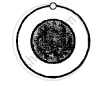
Atomic no. = 1
Mass no. = 1
Are isotopes atoms of the same element or different elements.
Draw the structure of the following atoms showing the nucleus containing – protons, neutrons and the orbits with the respective electron:
Isotopes of hydrogen [11H, 21H, 31H]
Atomic number : ______ :: Mass number : Number of protons and neutrons.
The Atomic number of an element is 20. It has ______ valence electrons.
An element has 2 electrons in its N shell.
- What is its atomic number?
- State its position in the periodic table.
- Is it a metal or a non-metal?
- State the name assigned to this group.
- What is the valency of this element?
