Advertisements
Advertisements
प्रश्न
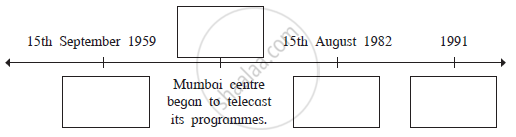
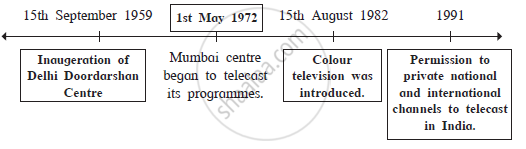
Complete the following timeline showing the history of television.
Advertisements
उत्तर
APPEARS IN
संबंधित प्रश्न
Choose the correct alternative and write the complete statement.
The newspaper _______________was started by Bhau Mahajan.
The first English newspaper in India was started by _______.
Explain the following sentence with its reasons.
Knowledge of history is essential for newspaper articles.
Answer the following question in 25-30 words.
How is history helpful in the planning of Akashavani programmes.
Read the following extract and answer the questions.
|
Radio: ‘Indian Broadcasting Company’ (IBC), a private radio company, was the first one to broadcast daily programmes. Later the same company was taken over by the British Government and named as, ‘Indian State Broadcasting Service (ISBS). On 8th June 1936 it was renamed, as ‘All India Radio (AIR)’. After Independence, AIR became an integral part of the Ministry of Information and Broadcasting (India). Initially, it broadcasted Governmental programmes and schemes. It was named as ‘Akashvani’ on the suggestion of the famous poet Pandit Narendra Sharma. Akashvani broadcasts various entertainment, awareness-creating and literary programmes. It also broadcasts special programmes for farmers, workers, the youth and women. The ‘Vividh Bharati’ programmes are broadcasted in 24 regional languages as well as 146 dialects of Indian languages. Lately, various new channels like ‘Radio Mirchi’ are providing radio services. |
- Akashavani (AIR) is an integral part of which ministry?
- What was the new name of IBC?
- In how many regional languages and local dialects are ‘Vividh Bharati’ programmes broadcasted?
- How AIR was named ‘Akashavani’?
The first English newspaper in India was started by ______.
Complete the following historical timeline of Indian Television.

Newspapers became the first mass medium of circulating information and knowledge among people.
How does History be essential in planning radio programs?
Write in detail ‘History of Akashwani’.
