Advertisements
Advertisements
प्रश्न
Compare the chemistry of actinoids with that of the lanthanoids with special reference to chemical reactivity.
Advertisements
उत्तर १
Generally, the initial members of the series are very reactive, like calcium, in their chemical behaviour, but as the atomic number increases, they behave like aluminium.
The value of E° for the half-reaction \[\ce{Ln^{3+}_{ (aq)} + 3e- -> Ln_{(s)}}\] is in the range of −2.2 V to −2.4 V. For Eu, the value of E° is −2.0 V. Of course, there is a slight variation in the value. These metals react with hydrogen when gently heated in a hydrogen atmosphere. On heating these metals with carbon, the carbides Ln3C, Ln2C3 and LnC2 are formed. These metals liberate hydrogen gas from dilute acids and, when burned in a halogen atmosphere, form halides. These form oxide M2O3 and hydroxide M(OH)3. Hydroxides are definite compounds and not just hydrated oxides. They are basic, like the oxides and hydroxides of alkaline earth metals. Their general reactions are shown in the figure.
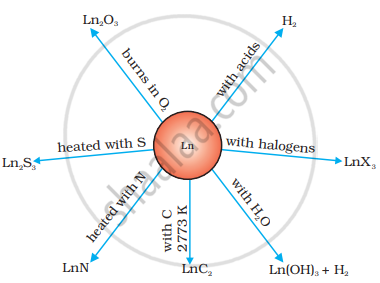
Actinoids are very reactive metals, especially when they are finely divided. The action of boiling water on them gives a mixture of oxide and hydride, and combines with most non-metals at normal temperatures. Hydrochloric acid affects all metals, but most metals are little affected by nitric acid. The reason is that a protective oxide surface forms on these metals. Alkalis have no effect on these metals.
उत्तर २
Actinoids are far more reactive than lanthanoids. They interact with nonmetals at moderate temperatures. In contrast, lanthanoids react at high temperatures. The majority of actinoids are attacked by HNO3 has a small effect on HCl, although the creation of a protective layer of oxide. Alkalies cause no reaction. Lanthanoids extract hydrogen from dilute. Acids and halogens burn together to generate halides.
APPEARS IN
संबंधित प्रश्न
Define lanthanoid contraction.
Which among the following pairs of elements is 'not' an example of chemical twins?
Compare the chemistry of actinoids with that of the lanthanoids with special reference to oxidation state.
Account for the following:
Zn, Cd and Hg are soft metals.
Explain the cause of Lanthanoids contraction.
Name an element of lanthanoid series which is well knwon to shown +4 oxidation state. Is it a strong oxidising agent or reducing agent?
What is meant by Lanthanide contraction? Write the general electronic configuration of inner transition elements.
General electronic configuration of actinoids is `(n-2)f^(1-14)(n - 1)d^(0-2)ns^2`.Which of the following actinoids have one electron in 6d orbital?
(i) U (Atomic no. 92)
(ii) Np (Atomic no.93)
(iii) Pu (Atomic no. 94)
(iv) Am (Atomic no. 95)
On the basis of Lanthanoid contraction, explain the following:
Nature of bonding in \[\ce{La2O3}\] and \[\ce{Lu2O3}\] .
On the basis of Lanthanoid contraction, explain the following:
Trends in the stability of oxo salts of lanthanoids from \[\ce{La}\] to \[\ce{Lu}\].
On the basis of Lanthanoid contraction, explain the following:
Stability of the complexes of lanthanoids.
How would you account for the following:
There is a greater range of oxidation states among the actinoids than among the lanthanides.
Which of the following pairs has the same ionic size?
Zr (Z = 40) and Hf (Z = 72) have similar atomic and ionic radii because of ______.
The lathanide ion that would show colour is ______.
Why is Mn2+ ion more stable than Fe2+ ion?
(Atomic numbers of Mn = 25 and Fe = 26)
Trivalent Lanthanoid ions such as La3+ (Z = 57) and Lu3+ (Z = 71) do not show any colour in their solution. Give a reason.
