Advertisements
Advertisements
प्रश्न
Choose the Odd One Out
विकल्प
Leptotene
Zygotene
Pachytene
Diplotene
Telophase
Advertisements
उत्तर
Telophase
संबंधित प्रश्न
The diagram below represents a stage during cell division. Study the same and then answer the questions that follow:

- Name the parts labelled 1, 2, and 3.
- Identify the above stage and give a reason to support your answer.
- Mention where in the body this type of cell division occurs.
- Name the stage prior to this stage and draw a diagram to represent the same.
All chromosomes are arranged parallel to equatorial plane of cell in ______ phase of mitosis.
With the help of suitable diagrams, explain the five stages of prophase-I of meiosis.
Define the following:
Karyokinesis
Fill in the blank:
______ is the indirect cell division.
The fig given alongside shows a certain stage in a cell division in a cell with four chromosomes.
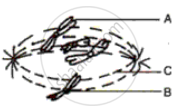
(i) Name the parts of the chromosome labeled A and B.
(ii) Name the structure C. what is its function?
(iii) Name the type of division . Give a reason.
(iv) Name the stage of division.
(v) Name the stages before and after the stage shown in diagram.
Choose the correct answer:
Nuclear membrane reappears in ____________
Differentiate between centrosome and centromere.
Draw a labeled schematic representation of mitosis cell division.
Explain the Term Cell Diakinesis
Name the following:
The kind of division normally seen at the tip of the root and shoot system.
Name the Following
The stage when chromosomes arrange at the equator.
Give Technical Terms
The stage in mitosis when the nucleolus starts disappearing.
Give Technical Terms
The stage at which spindle fibres begin to be formed.
Give the sequence of the events occurring during the prophase of mitosis.
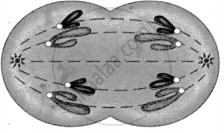
Identify the stage of mitosis from the below picture. List the chromosomal events in this stage.
Match List - I with List - II.
| List - I | List - II |
| A. Centromere | I. Mitochondrion |
| B. Cilium | II. Cell division |
| C. Cristae | III. Сell movement |
| D. Cell membrane | IV. Phospholipid Bilayer |
Choose the correct answer from the options given below:
What is the main function of the spindle fibres during mitosis?
