Advertisements
Advertisements
प्रश्न
Calculate potential energy of a point charge – q placed along the axis due to a charge +Q uniformly distributed along a ring of radius R. Sketch P.E. as a function of axial distance z from the centre of the ring. Looking at graph, can you see what would happen if – q is displaced slightly from the centre of the ring (along the axis)?
Advertisements
उत्तर
The potential energy (U) of a point charge q placed at-potential V, U = qV In our case a negative charged particle is placed at the axis of a ring having charge Q. Let the ring has radius a, the electric potential at an axial distance z from the centre of the ring is
`V = 1/(4piε_0) Q/sqrt(z^2 + a^2)`
Hence potential energy of a point charge – q is
`U = qV = (-q)[1/(4piε_0) Q/sqrt(z^2 + a^2)]`
⇒ `U = - 1/(4piε_0) (Qq)/sqrt(z^2 + a^2) = 1/(4piε_0) (-Qq)/sqrt(1 + (z/a)^2`
At z = 0, U = `- 1/(4piε_0) (Qq)/a`
At z → `oo`, U → 0
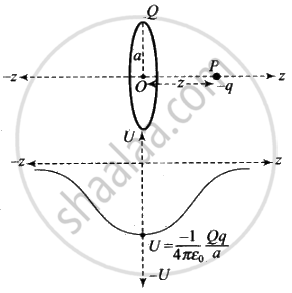
The variation of potential energy with z is shown in the figure. The charge – q displaced would perform oscillations. Nothing can be concluded just by looking at the graph.
APPEARS IN
संबंधित प्रश्न
Find out the amount of the work done to separate the charges at infinite distance.
A point charge Q is placed at point 'O' as shown in the figure. Is the potential at point A, i.e. VA, greater, smaller or equal to potential, VB, at point B, when Q is (i) positive, and (ii) negative charge?
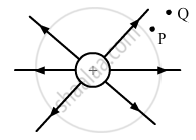
Figure shows the field lines due to a positive point charge. Give the sign of potential energy difference of a small negative charge between the points Q and P.
1 volt is equivalent to ______.
The work done in bringing a unit positive charge from infinite distance to a point at distance x from a positive charge Q is W. Then the potential at that point is ______.
- Assertion (A): An electron has a high potential energy when it is at a location associated with a more negative value of potential, and a low potential energy when at a location associated with a more positive potential.
- Reason (R): Electrons move from a region of higher potential to region of lower potential.
Select the most appropriate answer from the options given below:
In the circuit shown in figure initially, key K1 is closed and key K2 is open. Then K1 is opened and K2 is closed (order is important). [Take Q1′ and Q2′ as charges on C1 and C2 and V1 and V2 as voltage respectively.]

Then
- charge on C1 gets redistributed such that V1 = V2
- charge on C1 gets redistributed such that Q1′ = Q2′
- charge on C1 gets redistributed such that C1V1 + C2V2 = C1E
- charge on C1 gets redistributed such that Q1′ + Q2′ = Q
- In a quark model of elementary particles, a neutron is made of one up quarks [charge (2/3) e] and two down quarks [charges –(1/3) e]. Assume that they have a triangle configuration with side length of the order of 10–15 m. Calculate electrostatic potential energy of neutron and compare it with its mass 939 MeV.
- Repeat above exercise for a proton which is made of two up and one down quark.
- Assertion (A): Work done in moving a charge around a closed path, in an electric field is always zero.
- Reason (R): Electrostatic force is a conservative force.
Charges (+q) and (–q) are placed at points A and B respectively which are a distance 2L apart. C is the midpoint between A and B. What is the work done in moving a charge +Q along the semicircle CRD?

The electrostatic potential energy of a charge configuration is well-defined because the electrostatic force is a conservative force, which means:
If a system of like charges, assembled by doing work against their repulsive force, is released, the stored electrostatic potential energy:
For a system of unlike charges (attractive force), an external agent must do work to separate them because the system:
While assembling a system of charges, the work done in bringing the first charge \[q_1\] from infinity to its Position 1 is:
For a system of n charges, the total number of unique charge pairs whose potential energies must be summed is:
For n charges \[q_1, q_2, \ldots, q_n\] at positions \[r_1, r_2, \ldots, r_n\], where \[r_{ij}\] is the distance between charge i and charge j, the total electrostatic potential energy of the system is:
For a pair of like charges, the positive potential energy (U > 0) physically signifies that:
Four charges +q, -q, +q, -q are arranged alternately at corners A, B, C, D of a square of side d. With +q already at A, the work done in bringing -q from infinity to corner B is:
For the symmetrical arrangement of charges +q, -q, +q, -q at the corners of a square, the electric potential at the centre E due to the four charges is:
