Advertisements
Advertisements
प्रश्न
By what Latin name the first hominid was known?
Advertisements
उत्तर
The first hominid was known as Homo habilis. The brain capacities were between 650 - 800cc. They probably did not eat meat.
APPEARS IN
संबंधित प्रश्न
Write the probable differences in eating habits of Homo habilis and Homo erectus.
Give two characteristic features of Ramapithecus.
Write the names of the following:
A 15 mya primate that was ape-like
What are the four blood groups in humans?
Fill in the following blank with suitable word .
Most people have ............earlobes but some have ............earlobes.
Fill in the following blank with suitable word :
The scientific name of all human beings is ..............
Which of the following is the first example of class Homo sapiens?
Define ‘reproductive isolation’ and explain two types of reproductive isolation.
The range of cranial capacities in the following ancestral forms were
Homo sapiens sapiens ______.
Name the six ancestral forms in their correct sequence through which modern man has evolved.
Given alongside are two figures (A and B) representing the two stages of evolution of human beings.
Answer the following:
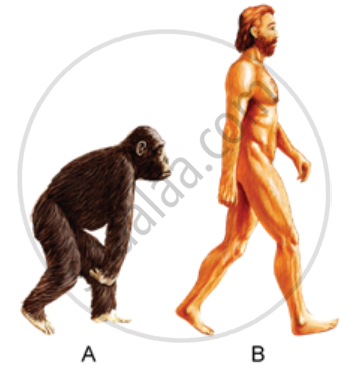
State any two characteristic features of stage B.
Differentiate between Apes and Man with respect to the following characteristic: Cranial capacity.
What is the scientific name of the modern man?
Distinguish New world and old world monkeys based on their tail along with their examples.
Where were the fossils of Ramapithecus discovered?
Features like prominent brow-ridges, low forehead, thick skull bones and outwardly curved thigh bones can be related to ____________.
Long tail, elongated tarsals, and binocular vision are seen in ______
Among the human ancestors, the brain size was more than 1000 cc in ______.
Write any eight major changes that occurred in human evolution.
What is the evolutionary significance of the transition from forest dwelling to grassland habitation?
