Advertisements
Advertisements
प्रश्न
Among Ramapithecus, Australopithecines and Homo habilis - who probably did not eat meat?
Advertisements
उत्तर
Homo habilis
APPEARS IN
संबंधित प्रश्न
Give two characteristic features of Cro-Magnon man.
Name the various tools of tracing evolutionary relationships which have been used for studying human evolution.
The range of cranial capacities in the following ancestral forms were
Homo habilis ______.
The first remarkable human fossil was that of ______.
Given alongside are two figures (A and B) representing the two stages of evolution of human beings.
Answer the following:
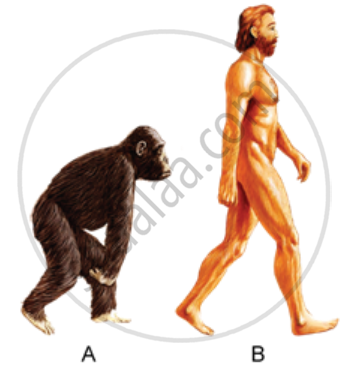
State any two characteristic features of stage B.
Whose fossils were discovered at the site of Shivalik hills, India?
Match the following.
| Column I | Column II | ||
| i. | Homo habilis | p. | 900 cc |
| ii. | Australopithecus | q. | 1350 cc |
| iii. | Homo erectus | r. | 650 - 800 cc |
| iv. | Homo sapiens | s. | 450-600 cc |
Select the correct option.
Amongst the following which is a character of Australopithecus?
Australopithecus was first discovered in which place?
Features like prominent brow-ridges, low forehead, thick skull bones and outwardly curved thigh bones can be related to ____________.
Identify the character which is most relatable to Neanderthal man?
Which of the following fossil in the evolution of man has maximum cranial capacity?
Select the mismatched pair.
Homo sapiens have evolved in:
The extinct human who lived 1,00,000 to 40,000 years ago, in Europe, Asia and parts of Africa, with, short stature, heavy eyebrows, retreating fore heads, large jaws with heavy teeth, stocky bodies, a lumbering gait and stooped posture was ______.
Name the following:
Connecting link between ape and man
Name the following :
Scientific name of Ape man
Which one of the following pair is mismatched regarding their appearance in human evolution?
Which stage of human evolution lived in East African grasslands and hunted with stone tools approximately 2 million years ago?
What was the significance of the development of an opposable thumb in human evolution?
