Advertisements
Advertisements
प्रश्न
Boojho has a cell and a single piece of connecting wire. Without cutting the wire in two, will he be able to make the bulb glow? Explain with the help of a circuit diagram.
Advertisements
उत्तर
With the suggested configuration, he will be able to light the bulb. He can connect one of the bulb’s terminals straight to the electric cell’s negative terminal. As a result, he won’t require any additional cable for our electric circuit. The diagram depicts the needed setup:

APPEARS IN
संबंधित प्रश्न
Draw circuit symbols for
an open switch
Explain the following:
Closed circuit
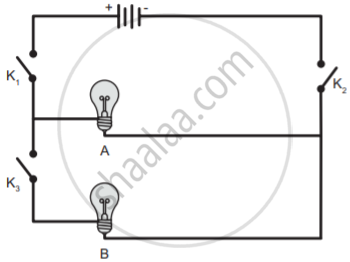
In the given circuit diagram, which of the given switch(s) should be closed. So that only bulb A glows.
In a simple circuit, why does the bulb glow when you close the switch?
______ is a kind of fish which is able to produce an electric current.
A child has drawn the electric circuit to study Ohm’s law as shown in Figure. His teacher told that the circuit diagram needs correction. Study the circuit diagram and redraw it after making all corrections.


In the above circuit, if the current reading in the ammeter A is 2A, what would be the value of R1?
Paheli is running short of connecting wires. To complete an electric circuit, she may use a ______.
Name the device which is used to measure the strength of the electric current in an electric circuit.
An electric motor rated 1100 W is connected to 220 V mains. Find:
- The current drawn from the mains,
- Electric energy consumed if the motor is used for 5 hours daily for 6 days.
- Total cost of energy consumed if the rate of one unit is 5.
