Advertisements
Advertisements
प्रश्न
Attempt any TWO of the following:
With the help of a suitable example illustrate ‘Palindrome’.
Advertisements
उत्तर
A palindromic sequence is a sequence made up of nucleic acids within double helix of DNA and/or RNA that is the same when read from 5’ to 3’ on one strand and 5’ to 3’ on the other, complementary, strand. It is also known as a palindrome or an inverted-reverse sequence.
The pairing of nucleotides within the DNA double-helix is complementary which consist of Adenine (A) pairing with either Thymine (T) in DNA or Uracil (U) in RNA, while Cytosine (C) pairs with Guanine (G). So if a sequence is palindromic, the nucleotide sequence of one strand would be the same as its reverse complementary strand. An example of a palindromic sequence is 5’-GGATCC-3’, which has a complementary strand, 3’-CCTAGG-5’. This is the sequence where the restriction endonuclease, BamHI, binds to and cleaves at a specific cleavage site. When the complementary strand is read backwards, the sequence is 5’-GGATCC-3’ which is identical to the first one, making it a palindromic sequence.
Another restriction enzyme called EcoR1 recognizes and cleaves the following palindromic sequence:
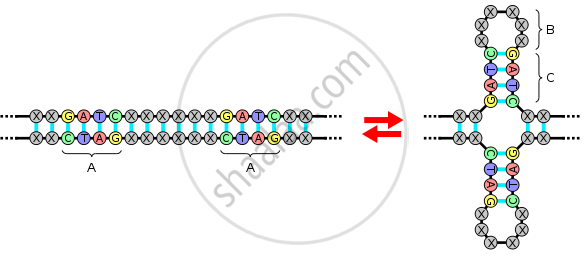
APPEARS IN
संबंधित प्रश्न
Write a note on the packaging of DNA in Eukaryotes.
Telomere has a unique property of __________.
Read the following and answer from given below:
In prokaryotes, DNA is circular and present in the cytoplasm but in eukaryotes, DNA is linear and mainly confined to the nucleus. DNA or deoxyribonucleic acid is a long polymer of nucleotides. In 1953, the first correct double-helical structure of DNA was worked out by Watson and Crick. Based on the X-ray diffraction data produced by Maurice Wilkins and Rosalind Franklin. It is composed of three components, i.e., A phosphate group, a deoxyribose sugar, and a nitrogenous base. Different forms of DNA are B-DNA, Z-DNA, A-DNA, C-DNA, and D-DNA.
The double chain of B-DNA is coiled in a helical fashion. The spiral twisting of the B-DNA duplex produces ______
Distinguish between heterochromatin and euchromatin. Which of the two is transcriptionally active?
Histones are enriched with ______.
Statement I: In prokaryotes, the positively charged DNA is held with some negatively charged proteins in a region called nucleoid.
Statement II: In eukaryotes, the negatively charged DNA is wrapped around the positively charged histone octamer to form nucleosome.
In the light of the above statements, choose the correct answer from the options given below:
What is a histone octamer?
The human genome contains approximately how many base pairs per diploid cell?
What is the role of topoisomerase I in prokaryotic DNA packaging?
Which locations in the eukaryotic nucleus typically contain heterochromatin?
