Advertisements
Advertisements
प्रश्न
Attempt any TWO of the following:
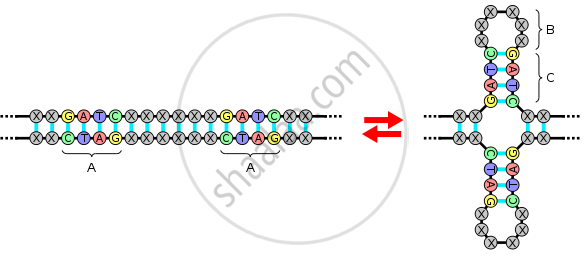
With the help of a suitable example illustrate ‘Palindrome’.
Advertisements
उत्तर
A palindromic sequence is a sequence made up of nucleic acids within double helix of DNA and/or RNA that is the same when read from 5’ to 3’ on one strand and 5’ to 3’ on the other, complementary, strand. It is also known as a palindrome or an inverted-reverse sequence.
The pairing of nucleotides within the DNA double-helix is complementary which consist of Adenine (A) pairing with either Thymine (T) in DNA or Uracil (U) in RNA, while Cytosine (C) pairs with Guanine (G). So if a sequence is palindromic, the nucleotide sequence of one strand would be the same as its reverse complementary strand. An example of a palindromic sequence is 5’-GGATCC-3’, which has a complementary strand, 3’-CCTAGG-5’. This is the sequence where the restriction endonuclease, BamHI, binds to and cleaves at a specific cleavage site. When the complementary strand is read backwards, the sequence is 5’-GGATCC-3’ which is identical to the first one, making it a palindromic sequence.
Another restriction enzyme called EcoR1 recognizes and cleaves the following palindromic sequence:
APPEARS IN
संबंधित प्रश्न
Although a prokaryotic cell has no defined nucleus, yet DNA is not scattered throughout the cell. Explain.
Short Answer Question:
Write a short note on DNA packaging in the eukaryotic cell.
The structure in chromatin seen as ‘beads-on string’ when viewed under electron microscope are called ______.
Which one of the following cell organelle is considered as ‘Cell within a cell’?
What is the function of histones in DNA packaging?
The non-condensed, light stained and transcriptionally active segments of chromosomes are called ______.
Who among the following has developed technique to synthesize artificial mRNA with known repeated sequences of two or three nucleotides?
Which of the following best describes DNA packaging?
What are non-histone chromosomal (NHC) proteins?
What is the charge characteristic of DNA packaging proteins in both prokaryotes and eukaryotes?
