Advertisements
Advertisements
प्रश्न
Answer the following question:
What were the causes and results of the First Anglo-Maratha War? When was it fought?
Advertisements
उत्तर
In 1772, a war of succession followed for the seat of Peshwaship after the death of Peshwa Madhav Rao I between Raghoba and Madhav Rao II. The English sided with Raghoba. Marathas led by Nana Phadnavis supported Madhav Rao II. An indecisive war broke out and continued for seven years. It ended in 1782 with the signing of the Treaty of Salbai. Under this Madhav Rao II was recognised as Peshwa and the Marathas had to cede Salsette. Peace prevailed between the Marathas and the British for 20 years.
संबंधित प्रश्न
Fill in the blank:
The French East India Company was established in __________.
Fill in the blanks:
Bengal in the 18th century was the _______ and the most _________ province in India.
Answer the following question in one or two words/sentences:
Why did the farman of 1717 become a bone of contention between the nawabs of Bengal and the British Company?
Answer the following question briefly:
The Battle of Plassey was a major turning point in the history of India. In this context answer the following question:
State the results of the Battle of Plassey.
Answer the following question briefly:
With reference to the Treaty of Allahabad and its impact, answer the following:
Give an account of the events that followed the death of Mir Jafar, leading to the establishment of the Company as the real ruler of Bengal.
This picture portrays a momentous event in 1765, involving a British Governor and a Mughal emperor wherein the Mughal emperor is conveying the grant of the Diwani to the governor.
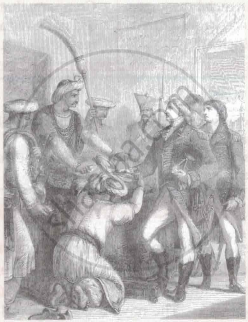
Give a brief account of the battle that preceded this event. When did it take place?
This picture portrays a momentous event in 1765, involving a British Governor and a Mughal emperor wherein the Mughal emperor is conveying the grant of the Diwani to the governor.

What is the importance of this battle?
Why did Siraj-ud-Daulah lose the Battle of Plassey?
The battle of Plassey is a turning point in the history of India. Explain.
Answer the following question:
Describe the circumstances that led to the Battle of Buxar.
