Advertisements
Advertisements
प्रश्न
Answer the following question briefly:
With reference to the Treaty of Allahabad and its impact, answer the following:
Give an account of the events that followed the death of Mir Jafar, leading to the establishment of the Company as the real ruler of Bengal.
Advertisements
उत्तर
After Mir Jafar’s death in 1765, his son was made the Nawab of Bengal. He had to sign a treaty with Clive, according to which he had to disband most of his army.
He also had to transfer the ‘Nizamat’ powers (general administration and criminal justice) to a deputy nawab appointed by the British. The deputy nawab could not be dismissed by the nawab. The nawab was given an allowance of 53 lakh rupees which was subsequently reduced. Thus, the English East India Company became the real ruler of Bengal from 1765.
APPEARS IN
संबंधित प्रश्न
In 1717, the Mughal emperor granted the United East India Company the right to carry on duty-free trade in ______, ______, and ______.
Fill in the blank:
The French East India Company was established in __________.
Answer the following question briefly:
The Battle of Plassey was a major turning point in the history of India. In this context answer the following question:
State the results of the Battle of Plassey.
This picture portrays a momentous event in 1765, involving a British Governor and a Mughal emperor wherein the Mughal emperor is conveying the grant of the Diwani to the governor.
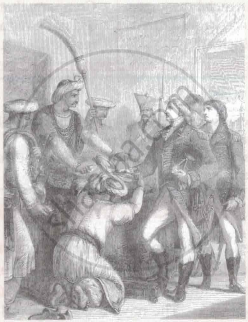
Give a brief account of the battle that preceded this event. When did it take place?
This picture portrays a momentous event in 1765, involving a British Governor and a Mughal emperor wherein the Mughal emperor is conveying the grant of the Diwani to the governor.

What is the importance of this battle?
What plot did Robert Clive hatch to remove Siraj-ud- Daulah?
Why did Siraj-ud-Daulah lose the Battle of Plassey?
The battle of Plassey is a turning point in the history of India. Explain.
When and between whom was the Battle of Buxar fought?
Fill in the blanks:
The British had to face the challenge of the rulers of ________ and __________, ___________after the conquest of Bengal.
