Advertisements
Advertisements
प्रश्न
Answer the following question in detail:
Describe the location of Asia.
Advertisements
उत्तर
Asia lies almost wholly in the northern and eastern hemispheres. It is separated from Europe by the Ural Mountains and the Caspian Sea in the west and the Caucasus Mountain in the South-West. The Arctic Ocean lies to the north of Asia, the Pacific Ocean to the east, and the Indian Ocean to the South of Asia.
Latitudinally, Asia extends from 10°S to 80°N, (8690 km). Its east-west extent is 9,700 km, from 25°E to about 170°W. There are 48 independent countries in Asia. They vary in size from Russia, China and India which are the largest to Singapore, the Maldives, and Bahrain which is the smallest. Some countries consist of group of islands like Japan, the Philippines, and Indonesia.
APPEARS IN
संबंधित प्रश्न
Match the following:
| Column A | Column B |
| 1. Population of Asia | a. Manchurian Plain |
| 2. Countries in Asia | b. Plateau of Tibet |
| 3. Marshy lowlands | c. 4.43 billion people |
| 4. Inter-montane plateau | d. 48 |
| 5. River Amur | e. Great Siberian Plain |
State whether the following is true or false:
Together with Europe, Asia is often referred to as Eurasia.
Answer the following question in brief:
What do you understand by the term ‘archipelago ? Give two examples from the Pacific Ocean.
Name the rivers of the Great Siberian Plain.
The mountain peak seen in the picture is the highest peak in the world.
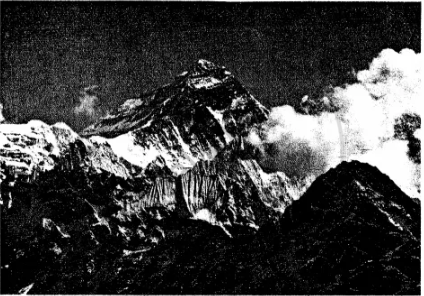
What is the height of this peak?
Name the following (in Asia):
Longest strait
Name the following (in Asia):
Coldest Place
What makes Asia a continent of contrasts?
Fill in the blanks:
Asia occupies ______ of the total land area and _______ of the total population of the world.
Fill in the blank:
USSR broke up into several independent republics in 1991, some of which are in ______ and some in Asia now.
