Advertisements
Advertisements
प्रश्न
Anima left one-half of her property to her daughter, one-third to her son and donated the rest to an educational institute. If the donation was worth Rs. 1,00,000, how much money did Anima have?
Advertisements
उत्तर
Let Anima’s property be ₹ x.
Property left for her daughter = ₹ `x/2`
Remaining property = `x - x/2`
= `(2x - x)/2`
= ₹ `x/2`
Property left for her son = `1/3` of remaining property
= `1/3 xx x/2`
= ₹ `x/6`
Remaining property = `[x - (x/2 + x/6)]`
= `x - ((3x + x)/6)`
= `(6x - 4x)/6`
= `(2x)/6`
= ₹ `x/3`
Since, the remaining property donated to an educational institute.
But donation property = ₹ 100000
∴ `x/3` = 100000
⇒ x = 300000
Hence, Anima had ₹ 300000.
APPEARS IN
संबंधित प्रश्न
Three consecutive integers add up to 51. What are these integers?
Three consecutive integers are such that when they are taken in increasing order and multiplied by 2, 3 and 4 respectively, they add up to 74. Find these numbers.
What should be added to twice the rational number `(-7)/3 "to get" 3/7`?
The present age of Sahil's mother is three times the present age of Sahil. After 5 years their ages will add to 66 years. Find their present ages.
Shikha’s present age is p years. Reemu’s present age is 4 times the present age of Shikha. After 5 years Reemu’s age will be 15p years.
Sum of the ages of Anju and her mother is 65 years. If Anju’s present age is y years then her mother’s age before 5 years is (60 – y) years.
If the sum of two consecutive numbers is 93 and one of them is x, then the other number is 93 – x.
The sum of three consecutive numbers is 156. Find the number which is a multiple of 13 out of these numbers.
Kusum buys some chocolates at the rate of Rs. 10 per chocolate. She also buys an equal number of candies at the rate of Rs. 5 per candy. She makes a 20% profit on chocolates and 8% profit on candies. At the end of the day, all chocolates and candies are sold out and her profit is Rs. 240. Find the number of chocolates purchased.
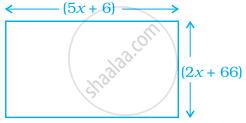
For what value of x is the perimeter of shape 186 cm?