Advertisements
Advertisements
प्रश्न
An object of size 3.0 cm is placed 14 cm in front of a concave lens of focal length 21 cm. Describe the image produced by the lens. What happens if the object is moved further away from the lens?
Advertisements
उत्तर
Size of the object, h1 = 3 cm
Object distance, u = −14 cm
Focal length of the concave lens, f = −21 cm
Image distance = v
According to the lens formula, we have the relation:
`1/"v" - 1/"u" = 1/"f"`
`1/"v" = - 1/21 - 1/14`
`1/"v" = (-2 - 3)/42`
`1/"v" = (-5)/42`
v = `-42/5`
∴ v = −8.4 cm
Hence, the image is formed on the other side of the lens, 8.4 cm away from it. The negative sign shows that the image is erect and virtual.
The magnification of the image is given as:
`"m" = ("Image height" ("h"_2))/("Object height" ("h"_1)) = "v"/"u"`
∴ `"h"_2 = (-8.4)/(-14) xx 3` = 0.6 × 3 = 1.8 cm
Hence, the height of the image is 1.8 cm.
If the object is moved further away from the lens, then the virtual image will move toward the focus of the lens, but not beyond it. The size of the image will decrease with the increase in the object distance.
संबंधित प्रश्न
- Determine the ‘effective focal length’ of the combination of the two lenses, if they are placed 8.0 cm apart with their principal axes coincident. Does the answer depend on which side of the combination a beam of parallel light is incident? Is the notion of the effective focal length of this system useful at all?
- An object 1.5 cm in size is placed on the side of the convex lens in the arrangement (a) above. The distance between the object and the convex lens is 40 cm. Determine the magnification produced by the two-lens system and the size of the image.
A man with normal near point (25 cm) reads a book with small print using a magnifying glass: a thin convex lens of focal length 5 cm.
(a) What is the closest and the farthest distance at which he should keep the lens from the page so that he can read the book when viewing through the magnifying glass?
(b) What is the maximum and the minimum angular magnification (magnifying power) possible using the above simple microscope?
A card sheet divided into squares each of size 1 mm2 is being viewed at a distance of 9 cm through a magnifying glass (a converging lens of focal length 9 cm) held close to the eye.
- What is the magnification produced by the lens? How much is the area of each square in the virtual image?
- What is the angular magnification (magnifying power) of the lens?
- Is the magnification in (a) equal to the magnifying power in (b)? Explain.
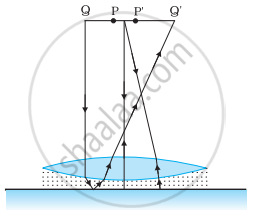
Figure shows an equiconvex lens (of refractive index 1.50) in contact with a liquid layer on top of a plane mirror. A small needle with its tip on the principal axis is moved along the axis until its inverted image is found at the position of the needle. The distance of the needle from the lens is measured to be 45.0 cm. The liquid is removed and the experiment is repeated. The new distance is measured to be 30.0 cm. What is the refractive index of the liquid?
A small piece of wood is floating on the surface of a 2.5 m deep lake. Where does the shadow form on the bottom when the sum is just setting? Refractive index of water = 4/3.
A pin of length 2.0 cm lies along the principal axis of a converging lens, the centre being at a distance of 11 cm from the lens. The focal length of the lens is 6 cm. Find the size of the image.
An object approaches a convergent lens from the left of the lens with a uniform speed 5 m/s and stops at the focus. The image ______.
Will the focal length of a lens for red light be more, same or less than that for blue light?
An unsymmetrical double convex thin lens forms the image of a point object on its axis. Will the position of the image change if the lens is reversed?
A plano convex lens has diameter of 10 cm and its thickness at the centre is 0.5 cm. Speed of light in the lens is 2 × 10⁸ ms-1. What is the focal length of the lens?

The point on the principal axis where rays parallel to the principal axis actually meet after refraction, or appear to diverge after refraction, is called the:
The distance between the optical centre and the principal focus is called the:
According to the new Cartesian sign convention for lenses, heights measured below the principal axis are taken as:
Using the sign convention with \[OB = -u\] and \[DI = +v\] in the combined refraction equation for a thin lens gives:
If the refractive index of a liquid equals that of a glass lens (\[n_1 = n_2\]), the lens maker relation gives \[\frac{1}{f} = 0\]. This means the focal length of the lens becomes:
A lens with an infinite focal length behaves like:
