Advertisements
Advertisements
प्रश्न
An item is manufactured by three machines A, B and C. Out of the total number of items manufactured during a specified period, 50% are manufactured on A, 30% on B and 20% on C. 2% of the items produced on A and 2% of items produced on B are defective, and 3% of these produced on C are defective. All the items are stored at one godown. One item is drawn at random and is found to be defective. What is the probability that it was manufactured on machine A?
Advertisements
उत्तर
Let E1: The event that the item is manufactured on machine A
E2: The event that the item is manufactured on machine B
E3: The event that the item is manufactured on machine C
Let H be the event that the selected item is defective.
∴ Using Bayes’ Theorem,
P(E1) = `50/100`
P(E2) = `30/100`
P(E3) = `20/100`
`"P"("H"/"E"_1_ 2/100`
`"P"("H"/"E"_2) = 30/100`
And `"P"("H"/"E"_3) = 3/100`
∴ `"P"("E"_1/"H") = ("P"("E"_1)*"P"("H"/"E"_1))/("P"("E"_1)*"P"("H"/"E"_1) + "P"("E"_2)*"P"("H"/"E"_2) + "P"("E"_3)*"P"("H"/"E"_3))`
= `(50/100 xx 2/100)/(50/100 xx 2/100 + 30/100 xx 2/100 + 20/100 xx 3/100)`
= `100/(100 + 60 + 60)`
= `100/220`
= `10/22`
= `5/11`
Hence, the required probability is `5/11`.
APPEARS IN
संबंधित प्रश्न
Three persons A, B and C apply for a job of Manager in a Private Company. Chances of their selection (A, B and C) are in the ratio 1 : 2 :4. The probabilities that A, B and C can introduce changes to improve profits of the company are 0.8, 0.5 and 0.3, respectively. If the change does not take place, find the probability that it is due to the appointment of C
A laboratory blood test is 99% effective in detecting a certain disease when it is in fact, present. However, the test also yields a false positive result for 0.5% of the healthy person tested (that is, if a healthy person is tested, then, with probability 0.005, the test will imply he has the disease). If 0.1 percent of the population actually has the disease, what is the probability that a person has the disease given that his test result is positive?
An insurance company insured 2000 scooter drivers, 4000 car drivers and 6000 truck drivers. The probability of accidents are 0.01, 0.03 and 0.15 respectively. One of the insured persons meets with an accident. What is the probability that he is a scooter driver?
Two groups are competing for the position on the board of directors of a corporation. The probabilities that the first and the second groups will win are 0.6 and 0.4 respectively. Further, if the first group wins, the probability of introducing a new product is 0.7 and the corresponding probability is 0.3 if the second group wins. Find the probability that the new product introduced was by the second group.
A card from a pack of 52 cards is lost. From the remaining cards of the pack, two cards are drawn and are found to be both diamonds. Find the probability of the lost card being a diamond.
Probability that A speaks truth is `4/5` . A coin is tossed. A reports that a head appears. The probability that actually there was head is ______.
Often it is taken that a truthful person commands, more respect in the society. A man is known to speak the truth 4 out of 5 times. He throws a die and reports that it is a six. Find the probability that it is actually a six.
Do you also agree that the value of truthfulness leads to more respect in the society?
A bag A contains 2 white and 3 red balls and a bag B contains 4 white and 5 red balls. One ball is drawn at random from one of the bags and is found to be red. Find the probability that it was drawn from bag B.
In a class, 5% of the boys and 10% of the girls have an IQ of more than 150. In this class, 60% of the students are boys. If a student is selected at random and found to have an IQof more than 150, find the probability that the student is a boy.
An insurance company insured 2000 scooters and 3000 motorcycles. The probability of an accident involving a scooter is 0.01 and that of a motorcycle is 0.02. An insured vehicle met with an accident. Find the probability that the accidented vehicle was a motorcycle.
Three urns A, B and C contain 6 red and 4 white; 2 red and 6 white; and 1 red and 5 white balls respectively. An urn is chosen at random and a ball is drawn. If the ball drawn is found to be red, find the probability that the ball was drawn from urn A.
In a group of 400 people, 160 are smokers and non-vegetarian, 100 are smokers and vegetarian and the remaining are non-smokers and vegetarian. The probabilities of getting a special chest disease are 35%, 20% and 10% respectively. A person is chosen from the group at random and is found to be suffering from the disease. What is the probability that the selected person is a smoker and non-vegetarian?
A factory has three machines A, B and C, which produce 100, 200 and 300 items of a particular type daily. The machines produce 2%, 3% and 5% defective items respectively. One day when the production was over, an item was picked up randomly and it was found to be defective. Find the probability that it was produced by machine A.
There are three coins. One is two headed coin, another is a biased coin that comes up heads 75% of the time and third is an unbiased coin. One of the three coins is chosen at random and tossed, it shows heads, what is the probability that it was the two headed coin?
In answering a question on a multiple choice test a student either knows the answer or guesses. Let \[\frac{3}{4}\] be the probability that he knows the answer and \[\frac{1}{4}\] be the probability that he guesses. Assuming that a student who guesses at the answer will be correct with probability \[\frac{1}{4}\]. What is the probability that a student knows the answer given that he answered it correctly?
There are three categories of students in a class of 60 students:
A : Very hardworking ; B : Regular but not so hardworking; C : Careless and irregular 10 students are in category A, 30 in category B and the rest in category C. It is found that the probability of students of category A, unable to get good marks in the final year examination is 0.002, of category B it is 0.02 and of category C, this probability is 0.20. A student selected at random was found to be one who could not get good marks in the examination. Find the probability that this student is category C.
A box contains 2 blue and 3 pink balls and another box contains 4 blue and 5 pink balls. One ball is drawn at random from one of the two boxes and it is found to be pink. Find the probability that it was drawn from first box
If E1 and E2 are equally likely, mutually exclusive and exhaustive events and `"P"("A"/"E"_1 )` = 0.2, `"P"("A"/"E"_2)` = 0.3. Find `"P"("E"_1/"A")`
Jar I contains 5 white and 7 black balls. Jar II contains 3 white and 12 black balls. A fair coin is flipped; if it is Head, a ball is drawn from Jar I, and if it is Tail, a ball is drawn from Jar II. Suppose that this experiment is done and a white ball was drawn. What is the probability that this ball was in fact taken from Jar II?
A box contains three coins: two fair coins and one fake two-headed coin is picked randomly from the box and tossed. What is the probability that it lands head up?
(Activity):
Mr. X goes to office by Auto, Car, and train. The probabilities him travelling by these modes are `2/7, 3/7, 2/7` respectively. The chances of him being late to the office are `1/2, 1/4, 1/4` respectively by Auto, Car, and train. On one particular day, he was late to the office. Find the probability that he travelled by car.
Solution: Let A, C and T be the events that Mr. X goes to office by Auto, Car and Train respectively. Let L be event that he is late.
Given that P(A) = `square`, P(C) = `square`
P(T) = `square`
P(L/A) = `1/2`, P(L/C) = `square` P(L/T) = `1/4`
P(L) = P(A ∩ L) + P(C ∩ L) + P(T ∩ L)
`="P"("A")*"P"("L"//"A") + "P"("C")*"P"("L"//"C") + "P"("T")*"P"("L"//"T")`
`= square * square + square * square + square * square`
`= square + square + square`
`= square`
`"P"("C"//"L") = ("P"("L" ∩ "C"))/("P"("L"))`
= `("P"("C") * "P"("L"//"C"))/("P"("L"))`
`= (square * square)/square`
`= square`
Suppose you have two coins which appear identical in your pocket. You know that one is fair and one is 2-headed. If you take one out, toss it and get a head, what is the probability that it was a fair coin?
Suppose that 6% of the people with blood group O are left handed and 10% of those with other blood groups are left handed 30% of the people have blood group O. If a left handed person is selected at random, what is the probability that he/she will have blood group O?
Refer to Question 41 above. If a white ball is selected, what is the probability that it came from Bag 3
There are two boxes, namely box-I and box-II. Box-I contains 3 red and 6 black balls. Box-II contains 5 red and 5 black balls. One of the two boxes, is selected at random and a ball is drawn at random. The ball drawn is found to be red. Find the probability that this red ball comes out from box-II.
Read the following passage and answer the questions given below.
|
A shopkeeper sells three types of flower seeds A1, A2, A3. They are sold is the form of a mixture, where the proportions of these seeds are 4:4:2 respectively. The germination rates of the three types of seeds are 45%, 60% and 35% respectively.
|
Based on the above information:
- Calculate the probability that a randomly chosen seed will germinate.
- Calculate the probability that the seed is of type A2, given that a randomly chosen seed germinates.
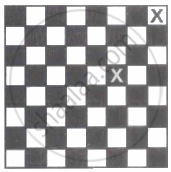
Let P denotes the probability of selecting one white and one black square from the chessboard so that they are not in the same row and also not in the same column (an example of this kind of the choice is shown in figure), then (1024)P is ______.
A speaks truth in 75% of the cases and B in 80% of the cases. The percentage of cases they are likely to contradict each other in making the same statement is ______.
A jewellery seller has precious gems in white and red colour which he has put in three boxes.
The distribution of these gems is shown in the table given below:
| Box | Number of Gems | |
| White | Red | |
| I | 1 | 2 |
| I | 2 | 3 |
| III | 3 | 1 |
He wants to gift two gems to his mother. So, he asks her to select one box at random and pick out any two gems one after the other without replacement from the selected box. The mother selects one white and one red gem.
Calculate the probability that the gems drawn are from Box II.
Why is Bayes' Theorem often called a method of finding reverse probability?
Which expression gives Bayes' Theorem for \[P(B_i\mid A)\]?
The required answer in a Bayes' Theorem problem is often a probability of which form?
