Advertisements
Advertisements
प्रश्न
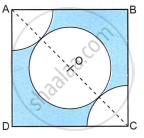
ABCD is a square with diagonal AC = 56 cm. A circle and two quadrants of same radius are inscribed in it as shown in the figure. Find the shaded area.
Advertisements
उत्तर
The area of a square can be calculated using the length of its diagonal with the formula:
Area of square = `1/2 d^2`, where d is the diagonal.
Area of square ABCD = `1/2 (56)^2`
= `1/2 (3136)`
= 1568 cm2.
The diagonal of the square passes through the center of the large circle and the corners of the quadrants.
The length of the diagonal is equal to the sum of the radius of the quadrant at A, the diameter of the central circle and the radius of the quadrant at C.
AC = r + 2r + r = 4r.
56 = 4r.
`r = 56/4`
r = 14 cm.
So, the radius of the circle and each of the quadrants is 14 cm.
Step 3: Find the total area of the unshaded regions
The unshaded regions are one full circle and two quadrants.
Two quadrants of the same radius are equivalent to one semicircle.
In this case, the two quadrants from corners A and C form a semicircle and there is a full circle in the center.
The total unshaded area is the sum of the area of the central circle and the area of the two quadrants.
Area of one circle = πr2
= π(14)2
= 196π cm2.
Area of two quadrants = Area of a semicircle
= `1/2 πr^2`
= `1/2 π(14)^2`
= `1/2(196π)`
= 98π cm2.
Total area of unshaded regions = Area of circle + Area of two quadrants
Total unshaded area = 196π + 98π = 294π cm2.
Step 4: Find the area of the shaded region
Area of shaded region = Area of square – Total unshaded area.
Area of shaded region = 1568 – 294π cm2.
Using the approximation `π ≈ 22/7` for a cleaner calculation:
`294π = 294 xx 22/7`
= 42 × 22
= 924 cm2.
Area of shaded region = 1568 – 924
Area of shaded region = 644 cm2.
