Advertisements
Advertisements
प्रश्न
A woker is paid Rs 200 for 8 days work. If he works for 20 days, how much will he get?
Advertisements
उत्तर
Let Rs x be the income for 20 days of work.
| Income (in Rs) | 200 | x |
| Number of days | 8 | 20 |
\[\text{ Since the income and the number of working days are in direct variation, we have } \]
\[\frac{200}{x} = \frac{8}{20}\]
\[ \Rightarrow 200 \times 20 = 8x\]
\[ \Rightarrow x = \frac{200 \times 20}{8}\]
\[ = \frac{4000}{8}\]
\[ = 500\]
\[\text{ Thus, the worker will get Rs 500 for working 20 days } .\]
संबंधित प्रश्न
Anupama takes 125 minutes in walking a distance of 100 metre. What distance would she cover in 315 minutes?
If the thickness of a pile of 12 cardboards is 35 mm, find the thickness of a pile of 294 cardboards.
Neha types 75 pages in 14 hours. How many pages will she type in 20 hours?
A cistern can be filled by one tap in 8 hours, and by another in 4 hours. How long will it take to fill the cistern if both taps are opened together?
Two quantities x and y are said to vary directly with each other if for some rational number k, xy = k.
If x and y are in direct proportion, then (x – 1) and (y – 1) are also in direct proportion.
The number of workers and the time to complete a job is a case of direct proportion.
From the following table, determine if x and y are in direct proportion or not.
| x | 3 | 6 | 15 | 20 | 30 |
| y | 12 | 24 | 45 | 60 | 120 |
From the following table, determine if x and y are in direct proportion or not.
| x | 4 | 7 | 10 | 16 |
| y | 24 | 42 | 60 | 96 |
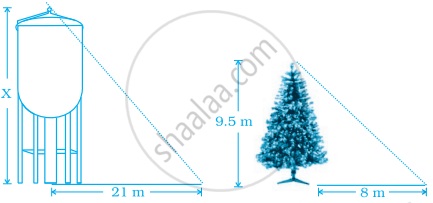
A water tank casts a shadow 21 m long. A tree of height 9.5 m casts a shadow 8 m long at the same time. The lengths of the shadows are directly proportional to their heights. Find the height of the tank.