Advertisements
Advertisements
प्रश्न
Following are the car parking charges near a railway station upto
| 4 hours | ₹60 |
| 8 hours | ₹100 |
| 12 hours | ₹140 |
| 24 hours | ₹180 |
Check if the parking charges are in direct proportion to the parking time.
Advertisements
उत्तर
| Parking time (in hours) |
Parking charges (in ₹) |
Proportion |
| 4 | 60 | `4/60= 1/15` |
| 8 | 100 | `8/100 = 2/25` |
| 12 | 140 | `12/140 = 3/35` |
| 24 | 180 | `24/180 = 2/15` |
Since, `1/15 ne 2/25 ne3/35 ne 2/15`
∴ The parking timing is not in direct proportion to parking charges.
संबंधित प्रश्न
Rashmi has a road map with a scale of 1 cm representing 18 km. She drives on a road for 72 km. What would be her distance covered in the map?
If the cost of 93 m of a certain kind of plastic sheet is Rs 1395, then what would it cost to buy 105 m of such plastic sheet?
8 men can do a piece of work in 9 days. In how many days will 6 men do it?
- How far will it travel in 20 minutes?
- Find the time required to cover a distance of 250 km.
Two quantities are said to vary ______ with each other if they increase (decrease) together in such a manner that the ratio of their corresponding values remains constant.
A car is travelling 48 km in one hour. The distance travelled by the car in 12 minutes is ______.
If the area occupied by 15 postal stamps is 60 cm2, then the area occupied by 120 such postal stamps will be ______.
Length of a side of a square and its area vary directly with each other.
The number of workers and the time to complete a job is a case of direct proportion.
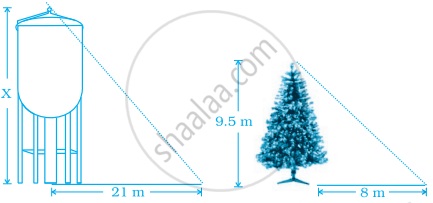
A water tank casts a shadow 21 m long. A tree of height 9.5 m casts a shadow 8 m long at the same time. The lengths of the shadows are directly proportional to their heights. Find the height of the tank.