Advertisements
Advertisements
प्रश्न
- A transformer is designed to work on 200 V A.C mains, such that its output voltage is 6.0 V. Its primary coil has 6000 turns. Draw the fully labelled diagram of transformer.
- State the principle involved in the construction of the above transformer.
- Why is the secondary coil of this transformer far thicker than the primary coil?
- Why is the core of this transformer laminated?
- Can this transformer operate on 200 V D.C mains? Give a reason for your answer.
- Can the efficiency of this transformer be 100%? Explain your answer.
- How many turns are in the secondary coil?
Advertisements
उत्तर
(a)
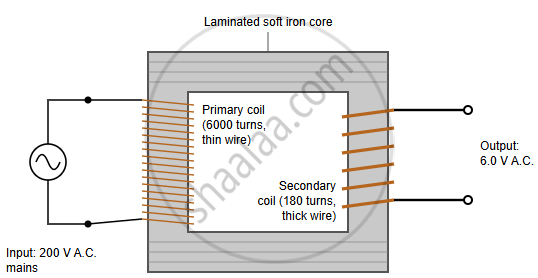
(b) A transformer works on the principle of mutual induction. When alternating current flows through the primary coil, it produces a changing magnetic flux in the soft-iron core. This changing flux links with the secondary coil and induces an alternating e.m.f. in it.
(c) In a step-down transformer, the current in the secondary coil is much larger than the current in the primary coil, because the secondary has fewer turns and gives a lower voltage. A thick wire has low resistance, so it can carry this large current without heating up much. That is why the secondary coil is made far thicker than the primary coil.
(d) The core is laminated to reduce eddy currents. The changing magnetic flux induces eddy currents in the core, which waste energy as heat. Thin, insulated laminations break the path of these currents, reducing energy loss and preventing the core from overheating.
(e) No, this transformer cannot operate on 200 V D.C. mains. A transformer works on mutual induction, which needs a changing magnetic flux. Direct current produces a constant flux, so no e.m.f. is induced in the secondary coil. Also, the primary coil has low resistance, so a large direct current would flow through it and could burn it.
(f) No, the efficiency of this transformer cannot be 100%. Some energy is always lost in a practical transformer:
- as heat in the copper coils due to their resistance (copper loss),
- due to eddy currents in the core,
- due to hysteresis (repeated magnetisation of the core),
- due to leakage of magnetic flux.
So the output power is always a little less than the input power.
(g) Given:
Primary voltage,
$$E_p = 200\ \text{V}$$
Secondary voltage,
$$E_s = 6.0\ \text{V}$$
Number of turns in the primary coil,
$$N_p = 6000$$
Let the number of turns in the secondary coil be \[N_s\]
Using the formula,
$$\frac{N_s}{N_p} = \frac{E_s}{E_p}$$
$$\therefore N_s = N_p \times \frac{E_s}{E_p}$$
$$= 6000 \times \frac{6.0}{200}$$
$$= 180$$
Thus, the secondary coil has 180 turns.
