Advertisements
Advertisements
प्रश्न
A steel tape 1m long is correctly calibrated for a temperature of 27.0 °C. The length of a steel rod measured by this tape is found to be 63.0 cm on a hot day when the temperature is 45.0 °C. What is the actual length of the steel rod on that day? What is the length of the same steel rod on a day when the temperature is 27.0 °C? Coefficient of linear expansion of steel = 1.20 × 10⁻⁵ K–1
Advertisements
उत्तर १
On a day when the temperature is 27 °C, the length of 1 cm division on the steel tape is exactly 1 cm, because the tape has been calibrated for 27 °C.When the temperature rises to 45 °C (that is, ΔT = 45 – 27 = 18 °C), the increase in the length of 1 cm division is Δl = αlΔT = (1.2 x 10⁻⁵C-1) x 1 cm x 18 °C = 0.000216 cm Therefore, the length of 1 cm division on the tape becomes 1.000216 cm at 45 °C. As the length of the steel rod is read to be 63.0 cm on the steel tape at 45 °C, the actual length of the rod at 45 °C is 63.0 x 1.000216 cm = 63.0136 cm The length of the same rod at 27 °C is 63.0 cm, because 1 cm mark on the steel tape is exactly 1 cm at 27 °C.
उत्तर २
Length of the steel tape at temperature T = 27°C, l = 1 m = 100 cm
At temperature T1 = 45°C, the length of the steel rod, l1 = 63 cm
Coefficient of linear expansion of steel, α = 1.20 × 10⁻⁵ K–1
Let l2 be the actual length of the steel rod and l' be the length of the steel tape at 45°C.
`l' = l + al(T-1- T)`
`:. l' = 100 + 1.20 xx 10^(-5) xx 100(45- 27)`
= 100.0216 cm
Hence, the actual length of the steel rod measured by the steel tape at 45°C can be calculated as:
`l_2= 100.0216/100 xx 63 = 63.0136 cm`
Therefore, the actual length of the rod at 45.0°C is 63.0136 cm. Its length at 27.0°C is 63.0 cm.
APPEARS IN
संबंधित प्रश्न
A brass rod of length 50 cm and diameter 3.0 mm is joined to a steel rod of the same length and diameter. What is the change in length of the combined rod at 250 °C, if the original lengths are at 40.0 °C? Is there a ‘thermal stress’ developed at the junction? The ends of the rod are free to expand (Co-efficient of linear expansion of brass = 2.0 × 10⁻⁵ K–1, steel = 1.2 × 10⁻⁵ K–1).
For a constant-volume gas thermometer, one should fill the gas at
A gas thermometer measures the temperature from the variation of pressure of a sample of gas. If the pressure measured at the melting point of lead is 2.20 times the pressure measured at the triple point of water, find the melting point of lead.
The density of water at 0°C is 0.998 g cm–3 and at 4°C is 1.000 g cm–1. Calculate the average coefficient of volume expansion of water in the temperature range of 0 to 4°C.
A steel rod is clamped at its two ends and rests on a fixed horizontal base. The rod is unstrained at 20°C.
Find the longitudinal strain developed in the rod if the temperature rises to 50°C. Coefficient of linear expansion of steel = 1.2 × 10⁻⁵ °C–1.
Answer the following question.
Derive the relation between three coefficients of thermal expansion.
Answer the following question.
What is thermal stress?
A glass flask has a volume 1 × 10⁻⁴ m3. It is filled with a liquid at 30°C. If the temperature of the system is raised to 100°C, how much of the liquid will overflow? (Coefficient of volume expansion of glass is 1.2 × 10⁻⁵ (°C)−1 while that of the liquid is 75 × 10−5 (°C)−1).
A metal rod of Young's moduls 'Y' and coefficient of linear expansion 'a' has its temeprature raised by 'Δ θ'. The linear stress to prevent the expansion of rod is ______.
(L and l is original length of rod and expansion respectively)
A metal rod of cross-sectional area 3 × 10⁻⁶ m2 is suspended vertically from one end has a length 0.4 m at 100°C. Now the rod is cooled upto 0°C, but prevented from contracting by attaching a mass 'm' at the lower end. The value of 'm' is ______.
(Y = 1011 N/m2, coefficient of linear expansion = 10-5/K, g = 10m/s2)
A metal rod of length Land cross-sectional area A is heated through T °C. What is the force required to prevent the expansion of the rod lengthwise?
(Y = Young's modulus of material of the rod, α = coefficient of linear expansion of the rod.)
A uniform metallic rod rotates about its perpendicular bisector with constant angular speed. If it is heated uniformly to raise its temperature slightly ______.
As the temperature is increased, the time period of a pendulum ______.
Find out the increase in moment of inertia I of a uniform rod (coefficient of linear expansion α) about its perpendicular bisector when its temperature is slightly increased by ∆T.
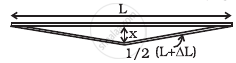
A rail track made of steel having length 10 m is clamped on a raillway line at its two ends (figure). On a summer day due to rise in temperature by 20° C, it is deformed as shown in figure. Find x (displacement of the centre) if αsteel = 1.2 × 10⁻⁵/°C.
Each side of a box made of metal sheet in cubic shape is 'a' at room temperature 'T', the coefficient of linear expansion of the metal sheet is 'α'. The metal sheet is heated uniformly, by a small temperature ΔT, so that its new temeprature is T + ΔT. Calculate the increase in the volume of the metal box.
If the temperature of the sun were to increase from T to 2T and its radius from R to 2R, then the ratio of the radiant energy received on earth to what it was previously will be ______.
A solid metallic cube having a total surface area of 24 m2 is uniformly heated. If its temperature is increased by 10°C, calculate the increase in the volume of the cube.
(Given: α = 5.0 × 10⁻⁴°C−1)
Among solids, liquids, and gases, the thermal expansion on heating is ______.
