Advertisements
Advertisements
प्रश्न
A steady current of 2 amperes was passed through two electrolytic cells X and Y connected in series containing electrolytes FeSO4and ZnSO4 until 2.8g of Fe deposited at the cathode of cell X. How long did the current flow? Calculate the mass of Zn deposited at the cathode of cell Y.
(Molar mass: Fe=56g mol-1,Zn=65.3g mol-1,1F=96500C mol-1)
Advertisements
उत्तर
I=2 A
W1= 2.8 g
Fe2+(aq)+2e-→Fe(s)
96500×2 C of charge is required to deposit=56 g of Fe
9650 C of charge is required to deposit=2.8 g of Fe
∵ Q `=1"t" "or" "t" 9650/2=4825"s"`
Using Faraday's second law of electrolysis,
`("W"_1("Weight of Fe deposited"))/("W"_2("Weight of Zn deposited")`
`=("E"_1("Equivalent weight of Fe"))/("E"_2("Equivalent weight of Fe")`
`2.8/"W"_2 =(56/5)/((65.3)/2)=56/65.3`
Or W2 = 3.265 g
APPEARS IN
संबंधित प्रश्न
Resistance of conductivity cell filled with 0.1 M KCl solution is 100 ohms. If the resistance of the same cell when filled with 0.02 M KCl solution is 520 ohms, calculate the conductivity and molar conductivity of 0.02 M KCl solution. [Given: Conductivity of 0.1 M KCl solution is 1.29 S m-1 .]
In the plot of molar conductivity (∧m) vs square root of concentration (c1/2), following curves are obtained for two electrolytes A and B:
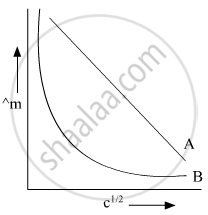
Answer the following:
(i) Predict the nature of electrolytes A and B.
(ii) What happens on extrapolation of ∧m to concentration approaching zero for electrolytes A and B?
Why on dilution the m Λm of \[\ce{CH3COOH}\] increases very fast, while that of \[\ce{CH3COONa}\] increases gradually?
Assertion: Λm for weak electrolytes shows a sharp increase when the electrolytic solution is diluted.
Reason: For weak electrolytes degree of dissociation increases with dilution of solution.
Which of the following increases with the increase in the concentration of the solution?
The molar conductance of NaCl, HCl and CH3COONa at infinite dilution are 126.45, 426.16 and 91.0 S cm2 mol−1 respectively. The molar conductance of CH3COOH at infinite dilution is ______.
Choose the right option for your answer.
Molar conductivity of substance “A” is 5.9 × 10³ S/m and “B” is 1 × 10–16 S/m. Which of the two is most likely to be copper metal and why?
Assertion (A): Molar conductivity decreases with increase in concentration.
Reason (R): When concentration approaches zero, the molar conductivity is known as limiting molar conductivity.
The specific conductance of 2.5 × 10⁻⁴ M formic acid is 5.25 × 10⁻⁵ ohm-1 cm-1. Calculate its molar conductivity and degree of dissociation.
Given `λ°_("H"^+)` = 349.5 ohm-1 cm2 mol-1 and
`λ°_("HCOO"^-) = 50.5 " ohm"^-1 "cm"^2 "mol"^-1`
The solution of two electrolytes A and B are diluted. ^m of B increases 1.5 times while that of A increases 25 times. Which of the two is a strong electrolyte? Give a reason.
