Advertisements
Advertisements
प्रश्न
A source of sound emitting a 1200 Hz note travels along a straight line at a speed of 170 m s−1. A detector is placed at a distance 200 m from the line of motion of the source. (a) Find the frequency of sound receive by the detector at the instant when the source gets closest to it. (b) Find the distance between the source and the detector at the instant in detects the frequency 1200 Hz. Velocity of sound in air = 340 m s−1.
Advertisements
उत्तर
Given:
Velocity of the source \[v_s\] = 170 m/s
Frequency of the source \[f_0\] = 1200Hz
(a)
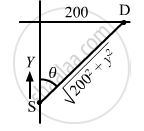
As shown in the figure,
the time taken by the sound to reach the listener is the same as the time taken by the sound to reach the point of intersection.
\[\frac{y}{170} = \frac{\sqrt{{200}^2 + y^2}}{340}\]
\[ \Rightarrow \left( 2y \right)^2 = \left( 200 \right)^2 + \left( y \right)^2 \]
\[ \Rightarrow 4 y^2 - \left( y \right)^2 = \left( 200 \right)^2 \]
\[ \Rightarrow 3 \left( y \right)^2 = \left( 200 \right)^2 \]
\[ \Rightarrow y = \frac{200}{\sqrt{3}}\]
Frequency of source will be :
\[v_s \cos\theta\] = \[170 . \frac{y}{\sqrt{{200}^2 + y^2}} = 170 \times \frac{1}{2} = 85\]
The frequency of sound \[\left( f \right)\] heard by the detector is given by :
\[f = \frac{v}{v - v_s \cos v} \times f_0 \]
\[ \Rightarrow f = \frac{340}{340 - 170 \times \frac{1}{2}} \times 1200\]
\[ \Rightarrow f = 1600 \text{ Hz }\]
(b) The detector will detect a frequency of 1200 Hz at a minimum distance.
\[\frac{200}{340} = \frac{x}{170}\]
\[ \Rightarrow x = 100 \text { m }\]
∴ Distance
\[= \sqrt{\left( 200 \right)^2 + x^2} = \sqrt{\left( 200 \right)^2 + \left( 100 \right)^2}\]
\[ = 224 \text{ m }\]
APPEARS IN
संबंधित प्रश्न
Explain what is Doppler effect in sound
A wave is represented by an equation \[y = c_1 \sin \left( c_2 x + c_3 t \right)\] In which direction is the wave going? Assume that \[c_1 , c_2\] \[c_3\] are all positive.
If you are walking on the moon, can you hear the sound of stones cracking behind you? Can you hear the sound of your own footsteps?
Two loudspeakers are arranged facing each other at some distance. Will a person standing behind one of the loudspeakers clearly hear the sound of the other loudspeaker or the clarity will be seriously damaged because of the 'collision' of the two sounds in between?
Two tuning forks vibrate with the same amplitude but the frequency of the first is double the frequency of the second. Which fork produces more intense sound in air?
When we clap our hands, the sound produced is best described by Here p denotes the change in pressure from the equilibrium value.
The bulk modulus and the density of water are greater than those of air. With this much of information, we can say that velocity of sound in air
When two waves with same frequency and constant phase difference interfere,
A man stands before a large wall at a distance of 50.0 m and claps his hands at regular intervals. Initially, the interval is large. He gradually reduces the interval and fixes it at a value when the echo of a clap merges every 3 seconds, find the velocity of sound in air.
The absolute temperature of air in a region linearly increases from T1 to T2 in a space of width d. Find the time taken by a sound wave to go through the region in terms of T1, T2, d and the speed v of sound at 273 K. Evaluate this time for T1 = 280 K, T2 = 310 K, d = 33 m and v = 330 m s−1.
The sound level at a point 5.0 m away from a point source is 40 dB. What will be the level at a point 50 m away from the source?
If the intensity of sound is doubled, by how many decibels does the sound level increase?
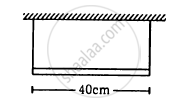
A uniform horizontal rod of length 40 cm and mass 1⋅2 kg is supported by two identical wires as shown in figure. Where should a mass of 4⋅8 kg be placed on the rod so that the same tuning fork may excite the wire on left into its fundamental vibrations and that on right into its first overtone? Take g = 10 m s−2.
A string of length L fixed at both ends vibrates in its fundamental mode at a frequency ν and a maximum amplitude A. (a)
- Find the wavelength and the wave number k.
- Take the origin at one end of the string and the X-axis along the string. Take the Y-axis along the direction of the displacement. Take t = 0 at the instant when the middle point of the string passes through its mean position and is going towards the positive y-direction. Write the equation describing the standing wave.
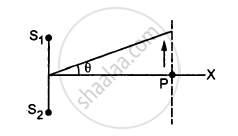
Two speakers S1 and S2, driven by the same amplifier, are placed at y = 1.0 m and y = −1.0 m(See figure). The speakers vibrate in phase at 600 Hz. A man stands at a point on the X-axis at a very large distance from the origin and starts moving parallel to the Y-axis. The speed of sound in air is 330 m s−1. (a) At what angle θ will the intensity of sound drop to a minimum for the first time? (b) At what angle will he hear a maximum of sound intensity for the first time? (c) If he continues to walk along the line, how many more can he hear?
Two coherent narrow slits emitting sound of wavelength λ in the same phase are placed parallel to each other at a small separation of 2λ. The sound is detected by moving a detector on the screen ∑ at a distance D(>>λ) from the slit S1 as shown in figure. Find the distance x such that the intensity at P is equal to the intensity at O.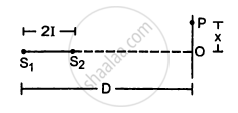
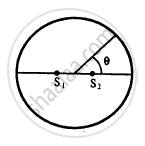
Figure shown two coherent sources S1 and S2 which emit sound of wavelength λ in phase. The separation between the sources is 3λ. A circular wire of large radius is placed in such way that S1,S2 is at the centre of the wire. Find the angular positions θ on the wire for which constructive interference takes place.
With propagation of longitudinal waves through a medium, the quantity transmitted is ______.
The speed of a wave in a string is 20 m/s and the frequency is 50 Hz. The phase difference between two points on the string 10 cm apart will be ______.
