Advertisements
Advertisements
प्रश्न
A radioactive nuclide `""_86^226` Ra decays by emission of two alpha particles, one beta particle and gamma rays. Which of the following is the resulting nuclide X?
विकल्प
223 x 83
218 x 83
218 x 84
217 x 85
218 x 85
Advertisements
उत्तर
Initially element is represented by 86Ra226
a particle is represented by 2He4 this means it contains 2 protons and 2
neutrons so mass of a particle is 4 unit. Thus after emitting a particle mass number of element would decrease by 4 unit and atomic number of element would decrease by 2.
So after emitting 2 a particle 86Ra226 would become 86 - 2 - 2Ra 226 - 4 - 4 = 82Ra218.
β particle is represented by -1e° after emitting a β particle atomic number of element would increase by 1 unit and mass number of element would remain unchanged.
So after emitting a p particle 82Ra218 would become 82 + 1Ra218 =83Ra218
Gamma radiations have zero mass and no charge so after emission of gamma radiation mass and atomic number remains unaltered.
The daughter nucleus is represented by b x a
b x a = 83Ra218
So answer is B.
APPEARS IN
संबंधित प्रश्न
Name a gas caused by the Greenhouse effect
A nucleus `""_11^24Na` emits a beta particle to change into Magnesium (Mg)
(i) Write the symbolic equation for the process.
(ii) What are numbers 24 and 11 called?
(iii) What is the general name of `""_12^24Mg `with respect to `""_11^24Na` ?
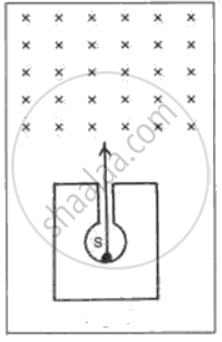
In following fig. shows a mixed source S of alpha and beta particles in a thick lead container. The particles pass through a magnetic field in a direction perpendicular to the plane of paper (inwards as shown by x). State and show in the diagram how the particles get affected.
A radioactive substance is oxidized. What changes would you expect to take place in the nature of radioactivity? Explain your answer.
From α, β and γ-rays, name the one which travels with the speed of light?
88Ra226 experiences three α - decay. Find the number of neutrons in the daughter element.
In the following atoms, which one is a radioisotope? Give one use of this isotope.
O16, C14, N14, He4
Assertion (A): Hydrogen atom consists of only one electron but its emission spectrum has may lines.
Reason (R): Only Lyman series is found in the absorption spectrum of hydrogen atom whereas in the emission spectrum, all the series are found.
Assertion (A): The force of repulsion between atomic nucleus and α-particle varies with distance according to inverse square law.
Reason (R): Rutherford did α-particles scattering experiment.
How does the ionising power of beta particles compare with that of alpha particles?
