Advertisements
Advertisements
प्रश्न
A point source of light moves in a straight line parallel to a plane table. Consider a small portion of the table directly below the line of movement of the source. The illuminance at this portion varies with its distance r from the source as ___________ .
विकल्प
\[1 \propto \frac{1}{r}\]
\[1 \propto \frac{1}{r^2}\]
\[1 \propto \frac{1}{r^3}\]
\[1 \propto \frac{1}{r^4}\]
Advertisements
उत्तर
\[1 \propto \frac{1}{r^3}\]
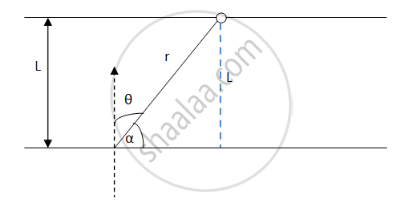
Let the distance between the parallel straight lines be L.
Angle with normal = θ
We know,
\[I = \frac{I_o \cos\theta}{r^2}\]
From the above figure, we get
\[I = \frac{I_o \cos\left( {90}^0 - \alpha \right)}{r^2}\]
\[ \Rightarrow I = \frac{I_o \sin\alpha}{r^2}\]
\[ \Rightarrow I = \frac{I_o}{r^2}\left( \frac{L}{r} \right)\]
\[ \Rightarrow I = \frac{I_o L}{r^3}\]
L = constant for parallel moving source
So, \[I_o L = k ............\left(\text{constant}\right)\]
\[ \Rightarrow I = \frac{k}{r^3}\]
\[ \Rightarrow I\alpha\frac{1}{r^3}\]
APPEARS IN
संबंधित प्रश्न
What is the luminous flux of a source emitting radio waves?
The luminous flux of a 1 W sodium vapour lamp is more than that of a 10 kW source of ultraviolet radiation. Comment.
A bulb is hanging over a table. At which portion of the table is the illuminance maximum? If a plane mirror is placed above the bulb facing the table, will the illuminance on the table increase?
Why is the luminous efficiency small for a filament bulb as compared to a mercury vapour lamp?
As the wavelength is increased from violet to red, the luminosity ____________ .
Figure shows a glowing mercury tube. The intensities at point A, B and C are related as __________ .

The brightness-producing capacity of a source
(a) does not depend on its power
(b) does not depend on the wavelength emitted
(c) depends on its power
(d) depends on the wavelength emitted
Mark the correct options.
(a) The luminous efficiency of a monochromatic source is always greater than that of a white light source of same power.
(b) The luminous efficiency of a monochromatic source of wavelength 555 nm is always greater than that of a white light source of same power.
(c) The illuminating power of a monochromatic source of wavelength 555 nm is always greater than that of a white light source of same power.
(d) The illuminating power of a monochromatic source is always greater than that of a white light source of same power.
Mark out the correct options.
(a) Luminous flux and radiant flux have same dimensions.
(b) Luminous flux and luminous intensity have same dimensions.
(c) Radiant flux and power have same dimensions.
(d) Relative luminosity is a dimensionless quantity.
The relative luminosity of wavelength 600 nm is 0.6. Find the radiant flux of 600 nm needed to produce the same brightness sensation as produced by 120 W of radiant flux at 555 nm.
A light source emits monochromatic light of 555 nwavelengthm. The source consumes 100 W of electric power and emits 35 W of radiant flux. Calculate the overall luminous efficiency.
A source emits 31.4 W of radiant flux distributed uniformly in all directions. The luminous efficiency is 60 lumen watt−1. What is the luminous intensity of the source?
A point source emitting 628 lumen of luminous flux uniformly in all directions is placed at the origin. Calculate the illuminance on a small area placed at (1.0 m, 0, 0) in such a way that the normal to the area makes an angle of 37° with the X-axis.
A point source emitting light uniformly in all directions is placed 60 cm above a table-top. The illuminance at a point on the table-top, directly below the source, is 15 lux. Find the illuminance at a point on the table-top 80 cm away from the first point.
Light from a point source falls on a small area placed perpendicular to the incident light. If the area is rotated about the incident light by an angle of 60°, by what fraction will the illuminance change?
Figure shows a small diffused plane source S placed over a horizontal table-top at a distance of 2.4 m with its plane parallel to the table-top. The illuminance at the point Adirectly below the source is 25 lux. Find the illuminance at a point B of the table at a distance of 1.8 m from A.

An electric lamp and a candle produce equal illuminance at a photometer screen when they are placed at 80 cm and 20 cm from the screen respectively. The lamp is now covered with a thin paper which transmits 49% of the luminous flux. By what distance should the lamp be moved to balance the intensities at the screen again?
Light rays from a point object ______.
