Advertisements
Advertisements
प्रश्न
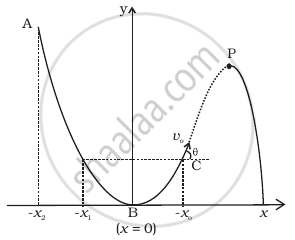
A particle slides down a frictionless parabolic (y = x2) track (A – B – C) starting from rest at point A (Figure). Point B is at the vertex of parabola and point C is at a height less than that of point A. After C, the particle moves freely in air as a projectile. If the particle reaches highest point at P, then
विकल्प
KE at P = KE at B
height at P = height at A
total energy at P = total energy at A
time of travel from A to B = time of travel from B to P
Advertisements
उत्तर
Total energy at P = total energy at A
Explanation:
As the given track y = x2 is a frictionless track thus, the total energy (KE + PE) will be the same throughout the journey.
Hence, total energy at A = Total energy at P. At B, the particle is having only KE but at P some KE is converted to P.
Hence, (KE)B > (KE)P
Total energy at A = PE = Total energy at B = KE
= Total energy at P
= PE + KE
The potential energy at A is converted to KE and PE at P
Hence (PE)P < (PE)A
Hence, (Height)P < (Height)A
As Height of P < Height of A
Hence, path length AB > path length BP
Hence, the time of travel from A to B ≠ Time of travel from B to P.
