Advertisements
Advertisements
प्रश्न
A monochromatic ray strikes the surface of identical prisms (A, B and C) at different angles of incidence. The diagram below shows their refracted rays. Study the path of these refracted rays and identify in which of the diagrams:
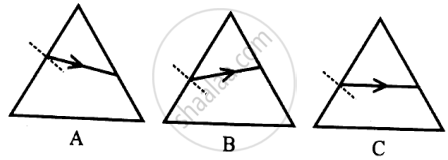
- the angle of incidence is maximum.
- the angle of incidence is minimum.
- the angle of incidence is equal to the angle of emergence.
विस्तार में उत्तर
Advertisements
उत्तर
- The angle of incidence is maximum for prism B. For identical prisms, a larger angle of incidence produces a refracted ray inside the prism, making a larger angle with the normal. Hence, diagram B corresponds to the maximum incidence
- The angle of incidence is minimum for prism A. Diagram A corresponds to minimum incidence.
- The angle of incidence is equal to the angle of emergence for prism C. When the angle of incidence is equal to the angle of emergence, the path of the ray through the prism is symmetrical, and the refracted ray inside the prism becomes parallel to the base. This is shown in diagram C.
shaalaa.com
क्या इस प्रश्न या उत्तर में कोई त्रुटि है?
2025-2026 (March) Official Board Paper
