Advertisements
Advertisements
प्रश्न
A man runs across the roof-top of a tall building and jumps horizontally with the hope of landing on the roof of the next building which is of a lower height than the first. If his speed is 9 m/s, the (horizontal) distance between the two buildings is 10 m and the height difference is 9 m, will he be able to land on the next building? (take g = 10 m/s2)
Advertisements
उत्तर
Horizontal Projectile: When a body is projected horizontally from a certain height ‘y’ vertically above the ground with initial velocity u. If friction is considered to be absent, then there is no other horizontal force which can affect the horizontal motion. The horizontal velocity therefore remains constant and so the object covers an equal distance in the horizontal direction in equal intervals of time.
Time of flight: If a body is projected horizontally from a height h with velocity u and the time taken by the body to reach the ground is T, then
`h = 0 + 1/2 gT^2` ......(For vertical motion)
`T = sqrt((2h)/g)`
Horizontal range: Let R be the horizontal distance travelled by the body
`R = uT + 1/2 0T^2` .......(For horizontal motion a = 0)
`R = u sqrt((2h)/g)`
We will apply kinematic one by one downward and horizontal. We first consider motion horizontal and there is no horizontal force which can affect horizontal motion. The horizontal velocity therefore remains constant and so the object covers an equal distance in the horizontal direction in equal intervals of time.
According to the problem, the horizontal speed of the man (ux) = 9 m/s Horizontal distance between the two buildings = 10 m
Height difference between the two buildings = 9 m and g = 10 m/s2

Let the man jumps from point A and land on the roof of the next building at point B.
Taking motion in the vertical direction,
`y = ut + 1/2 at^2`
9 = `0 xx t + 1/2 xx 10 xx t^2`
9 = 5t2
or t = `sqrt(9/5) = 3/sqrt(5)`
∴ Horizontal distance travelled = `u_x xx t = 9 xx 3/sqrt(5) = 27/sqrt(5)` m ≈ 12 m
The horizontal distance travelled by the man is greater than 10 m, therefore, he will land on the next building.
APPEARS IN
संबंधित प्रश्न
The position-time (x-t) graphs for two children A and B returning from their school O to their homes P and Q respectively, are shown in the figure. Choose the correct entries in the brackets below;

- (A/B) lives closer to the school than (B/A)
- (A/B) starts from the school earlier than (B/A)
- (A/B) walks faster than (B/A)
- A and B reach home at the (same/different) time
- (A/B) overtakes (B/A) on the road (once/twice).
The figure shows the x-t plot of one-dimensional motion of a particle. Is it correct to say from the graph that the particle moves in a straight line for t < 0 and on a parabolic path for t > 0? If not, suggest a suitable physical context for this graph.

A police van moving on a highway with a speed of 30 km h–1 fires a bullet at a thief’s car speeding away in the same direction with a speed of 192 km h–1. If the muzzle speed of the bullet is 150 m s–1, with what speed does the bullet hit the thief’s car? (Note: Obtain that speed which is relevant for damaging the thief’s car).
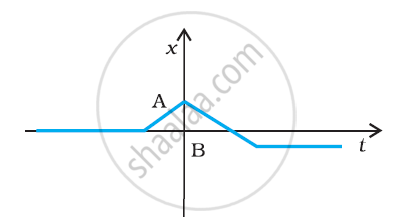
Suggest a suitable physical situation for the following graphs:
Two projectiles A and B are projected with angle of projection 15° for the projectile A and 45° for the projectile B. If RA and RB be the horizontal range for the two projectiles, then
A particle moves along the X-axis as x = u (t − 2 s) + a (t − 2 s)2.
(a) the initial velocity of the particle is u
(b) the acceleration of the particle is a
(c) the acceleration of the particle is 2a
(d) at t = 2 s particle is at the origin.
A particle starts from the origin, goes along the X-axis to the point (20 m, 0) and then return along the same line to the point (−20 m, 0). Find the distance and displacement of the particle during the trip.
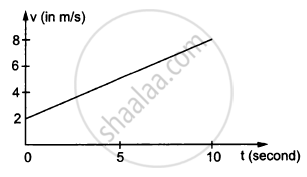
In the following figure Shows the graph of velocity versus time for a particle going along the X-axis. Find the distance travelled in 0 to 10s
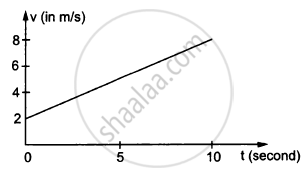
In the following figure Shows the graph of velocity versus time for a particle going along the X-axis. Find the displacement in 0 to 10 s.
Refer to the graphs in figure. Match the following.
| Graph | Characteristic |
(a) 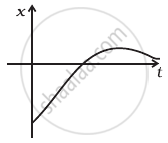 |
(i) has v > 0 and a < 0 throughout. |
(b) 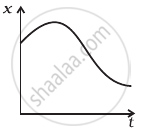 |
(ii) has x > 0 throughout and has a point with v = 0 and a point with a = 0. |
(c) 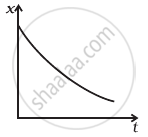 |
(iii) has a point with zero displacement for t > 0. |
(d) 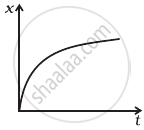 |
(iv) has v < 0 and a > 0. |
A ball is dropped and its displacement vs time graph is as shown figure (displacement x is from ground and all quantities are +ve upwards).
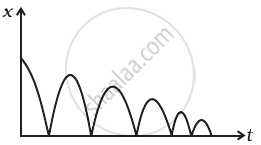
- Plot qualitatively velocity vs time graph.
- Plot qualitatively acceleration vs time graph.
Ship A is sailing towards the northeast with velocity `vecv = 30hati + 50hatj` km/hr where `hati` points east and `hatj`, north. Ship B is at a distance of 80 km east and 150 km north of Ship A and is sailing west at 10 km/hr. A will be at the minimum distance from B in ______.
A person moved from A to B on a circular path as shown in figure. If the distance travelled by him is 60 m, then the magnitude of displacement would be: (Given cos135° = - 0.7)

A car covers the first half of the distance between two places at 40 km/h and other half at 60 km/h. The average speed of the car is ______.
