Advertisements
Advertisements
प्रश्न
A male honeybee has 16 chromosomes whereas its female has 32 chromosomes. Give one reason.
Advertisements
उत्तर १
Male honey bees are born from unfertilised eggs, whereas female honey bees are born from fertilised eggs. Because the unfertilised egg carries half the number of chromosomes as compared to the fertilised egg, male honey bees have half the number of chromosomes as compared to female honey bees.
उत्तर २
A male honeybee has 16 chromosomes because it is haploid, developing from unfertilized eggs by parthenogenesis. A female honeybee has 32 chromosomes because it is diploid, developing from fertilized eggs and thus having two sets of chromosomes. This is the haplodiploid mechanism of sex determination in honeybees.
APPEARS IN
संबंधित प्रश्न
If centromere is situated in the middle of the chromosome, it is called ________.
(a) Metacentric
(b) Acrocentric
(c) Submetacentric
(d) Telocentric
What is gene pool?
State the difference between meiocyte and gamete with respect to chromosome number.
Briefly mention the contribution of T. H. Morgan in genetics.
Who had proposed the chromosomal theory of inheritance?
Name the type of cell division involved in the production of sperms by honey bees.
Give an account of artificial chromosomes in the transfer of genetic material.
Genes G S L H are located on the same chromosome. The recombination percentage is between L and G is 15%, S and L is 50%, H and S are 20%. The correct order of genes is
Codon – anticodon interactions occur by
When two different genes came from the same parent they tend to remain together.
Write the observed phenotypic ratio.
Match the column I (Type of chromosome) with column II (name of chromosome).
| Type of chromosome | Name of chromosome | ||
| i. |  |
P. | Acrocentric |
| ii. |  |
Q. | Telocentric |
| iii. |  |
R. | Metacentric |
| iv. |  |
S. | Sub-metacentric |
Telocentric chromosome differs from acrocentric chromosome in that ____________.
Identify the term that represents the degree of repetition of the primary basic number of chromosomes in a cell.
Chromosomal theory of inheritance was given by ______.
A couple has two daughters. What is the probability that the third child will also be a female?
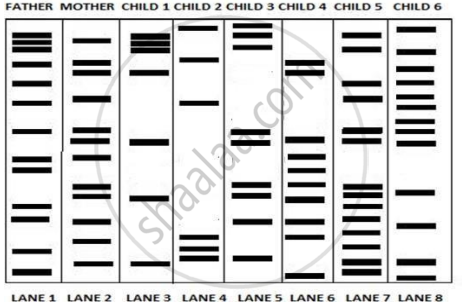
There was a mix-up at the hospital after a fire accident in the nursery division. Which of these children belong to the parents?
During mitosis, chromosomes distribution to the daughter cell is ______.
Which of the following phase follows S and G2 phases of interphase?
Which of the following is sex chromosomal disorder?
