Advertisements
Advertisements
प्रश्न
A fruit vendor bought some mangoes of which 10% were rotten. He sold `33 1/3%` of the rest. Find the total number of mangoes bought by him initially, if he still has 240 mangoes with him
Advertisements
उत्तर
Let the number of mangoes bought by fruit seller initially be x.
Given that 10% or mangoes were rotten
∴ Number of rotten mangoes = `10/100 xx x`
Number of good mangoes = x – no. of rotten mangoes
= `x - 10/100 x`
= `(100x - 10x)/100`
= `90/100 x` ...(1)
Number of mangoes sold = `33 1/3%` of good mangoes
= `100/3%`
∴ Mangoes sold = `100/3 xx 90/100 xx 1/100`
= `30/100 x` ...(2)
Number of mangoes remaining = No. of good mangoes – No. of mangoes sold
From (1) and (2)
∴ `90/100 x - 30/100 x` = 240
⇒ `(90x - 30x)/100` = 240
∴ `(60x)/100` = 240
∴ x = `(240 xx 100)/60`
x = 400
∴ Intially he had 400 mangoes
APPEARS IN
संबंधित प्रश्न
A shop selling sewing machines offers 3% discount on all cash purchases. What cash amount does a customer pay for a sewing machine the price of which is marked as Rs 650.
A shopkeeper marks his goods at 40% above the cost price but allows a discount of 5% for cash payment to his customers. What actual profit does he make, if he receives Rs 1064 after paying the discount?
Jyoti and Meena run a ready-made garment shop. They mark the garments at such a price that even after allowing a discount of 12.5%, they make a profit of 10%. Find the marked price of a suit which costs them Rs 1470.
Pramod bought 100 bunches of methi greens for Rs 400. In a sudden downpour, 30 of the bunches on his handcart got spoilt. He sold the rest at the rate of Rs 5 each. Did he make a profit or a loss? How much?
A bought a tape recorder for Rs 8,000 and sold it to B. B in turn sold it to C, each earning a profit of 20%. Which of the following is true?
What price should a shopkeeper mark on an article that costs him Rs 600 to gain 20%, after allowing a discount of 10%
Music CD originally priced at Rs 120 is on sale for 25% off. What is the S.P.?
Sonia and Rahul have different ways of calculating the sale price for the items they bought.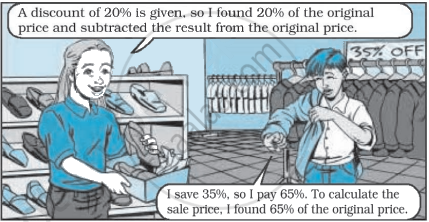
As you work on the next problem, try both of these methods to see which you prefer.
A store is having a 25% discount sale. Sheela has a Rs 50 gift voucher and wants to use it to buy a board game marked for Rs 320. She is not sure how to calculate the concession she will get. The sales clerk has suggested two ways to calculate the amount payable.
- Method 1: Subtract Rs 50 from the price and take 25% off the resulting price.
- Method 2: Take 25% off the original price and then subtract Rs 50.
For each method, calculate the amount Sheela would have to pay. Show your work.
A cricket bat was purchased for ₹ 800 and was sold for ₹ 1600. Then profit earned is ______.
The marked price of an article is ₹ 2,000. The GST on the article is 12% and discount is ₹ 500, the total amount to be paid is ______.
