Advertisements
Advertisements
प्रश्न
A force of 50 N acts on a body and moves it a distance of 4 m on horizontal surface. Calculate the work done if the direction of force is at an angle of 60° to the horizontal surface.
Advertisements
उत्तर
We have a situation in which, work is done by force acting obliquely.
Force, (F) = 50 N
Distance travelled by the body, (S) = 4 m
Angle between force and direction of distance, (θ) = 60°
We have a relation as,
W = (F)(S) cos θ
So,
`W = (50) (4) cos 60^circ`
= `200 (1/2)` J
= 100 J
So , the work done is 100 J .
APPEARS IN
संबंधित प्रश्न
A pair of bullocks exerts a force of 140 N on a plough. The field being ploughed is 15 m long. How much work is done in ploughing the length of the field?
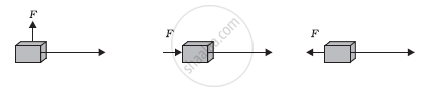
In each of the following a force, F is acting on an object of mass, m. The direction of displacement is from west to east, as shown by the longer arrow. Observe the diagrams carefully and state whether the work done by the force is negative, positive or zero.
A body, when acted upon by a force of 10 kgf, moves to a distance 0.5 m in the direction of force. Find the work done by the force. Take 1 kgf = 10 N.
In which of the following cases, is work being done?
(i) A man pushing a wall.
(ii) a coolie standing with a load of 12 kgf on his head.
(iii) A boy climbing up a staircase.
A boy throws a rubber ball vertically upwards. What type of work, positive or negative, is done : by the force applied by the boy?
(a) by the force applied by the boy?
(b) by the gravitational force of earth?
How much work is done by the gravitational force of earth acting on a satellite moving around it in a circular path? Give reason for your answer.
List any six forms of energy and write a short note on each of them.
A bullet is of mass 'm' g and is moving with a velocity 'v' m/s. Find the kinetic energy of the bullet when
(a) The mass is doubled,
(b) The velocity is tripled.
Force acting on a particle moving in a straight line varies with the velocity of the particle v as F = `K/v`, where K is a constant. The work done by this force in time t is
