Advertisements
Advertisements
प्रश्न
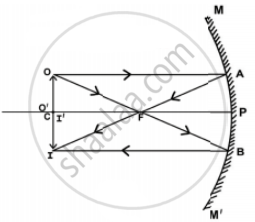
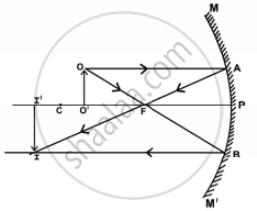
a) Draw ray diagrams to show how the image is formed using a concave mirror, when the position of object is:
- at C
- between C and F
- between F and P of the mirror.
b) Mention the position and nature of image in each case.
Advertisements
उत्तर
a)
i. At the centre of curvature C
ii. Between C and F
iii. Between the focus F and the Pole P of the mirror.
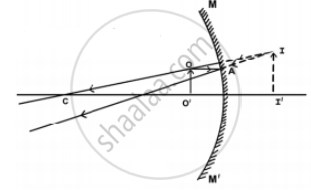
b) Mention the position and nature of image in each case.
| Position of object | Position of Image | Nature of Image |
| At the centre of curvature C | AtC | Real and Inverted |
| Between C and F | Beyond C | Real and inverted |
| Between F and P | Behind the mirror | Virtual and Erect |
APPEARS IN
संबंधित प्रश्न
Match the following
| (a). A light ray passes from air to glass | (1) . speeds up |
| (b). A light ray passes from glass to water | (2). reflects red light |
| (c). Virtual image | (3). primary colours |
| (d). Red rose | (4). plane mirror |
| (e). Red, green, and blue | (5). slows down |
Fill in the blank.
Light travels in a ................. path.
Name two natural sources of light.
Fill in the blank
The brightness of light is measured in ...................
Fill in the blank
Light consists of .............. colours.
Write about two everyday situations that tell you that light travels in a straight line.
A ray of light passes from one medium to another medium. Refraction takes place when angle of incidence is ______.
The path of the light is called as ______.
What happens to light when it gets dispersed? Give an example.
Boojho and Paheli were given one mirror each by their teacher. Boojho found his image to be erect and of the same size whereas Paheli found her image erect and smaller in size. This means that the mirrors of Boojho and Paheli are, respectively
