Advertisements
Advertisements
प्रश्न
A diagnostic test has a probability 0.95 of giving a positive result when applied to a person suffering from a certain disease, and a probability 0.10 of giving a (false) positive result when applied to a non-sufferer. It is estimated that 0.5% of the population are sufferers. Suppose that the test is now administered to a person about whom we have no relevant information relating to the disease (apart from the fact that he/she comes from this population). Calculate the probability that: given a positive result, the person is a sufferer
Advertisements
उत्तर
Let E1 ≡ the event that person is sufferer
E2 ≡ the event that person is not a sufferer
E1, E2 are mutually exclusive and exhaustive events
It is given that 0.5% of population are sufferers
∴ 99.5% of population are not sufferers
∴ P(E1) = `0.5/100` = 0.005
P(E2) = `99.5/100` = 0.995
Let T ≡ the event that result is positive
Since the test has a probability of 0.95 of giving positive results when person is sufferer and 0.10 when person is non-sufferer, we have
`"P"("T"//"E"_1)` = 0.95 and `"P"("T"//"E"_2)` = 0.10
By Baye's Theorem, the required probability
= `"P"("E"_1//"T")`
= `("P"("E"_1)*"P"("T"//"E"_1))/("P"("E"_1)*"P"("T"//"E"_1) + "P"("E"_2)*"P"("T"//"E"_2))`
= `(0.005 xx 0.95)/(0.005 xx 0.95 + 0.995 xx 0.1)`
= `(0.00475)/(0.10425)`.
APPEARS IN
संबंधित प्रश्न
An urn contains 5 red and 5 black balls. A ball is drawn at random, its colour is noted and is returned to the urn. Moreover, 2 additional balls of the colour drawn are put in the urn and then a ball is drawn at random. What is the probability that the second ball is red?
A bag contains 4 red and 4 black balls, another bag contains 2 red and 6 black balls. One of the two bags is selected at random and a ball is drawn from the bag which is found to be red. Find the probability that the ball is drawn from the first bag.
In answering a question on a multiple choice test, a student either knows the answer or guesses. Let 3/4 be the probability that he knows the answer and 1/4 be the probability that he guesses. Assuming that a student who guesses at the answer will be correct with probability 1/4 What is the probability that the student knows the answer given that he answered it correctly?
An insurance company insured 2000 scooter drivers, 4000 car drivers and 6000 truck drivers. The probability of accidents are 0.01, 0.03 and 0.15 respectively. One of the insured persons meets with an accident. What is the probability that he is a scooter driver?
Three urns contains 2 white and 3 black balls; 3 white and 2 black balls and 4 white and 1 black ball respectively. One ball is drawn from an urn chosen at random and it was found to be white. Find the probability that it was drawn from the first urn.
Suppose a girl throws a die. If she gets 1 or 2, she tosses a coin three times and notes the number of tails. If she gets 3, 4, 5 or 6, she tosses a coin once and notes whether a 'head' or 'tail' is obtained. If she obtained exactly one 'tail', then what is the probability that she threw 3, 4, 5 or 6 with the die?
Suppose 5 men out of 100 and 25 women out of 1000 are good orators. An orator is chosen at random. Find the probability that a male person is selected. Assume that there are equal number of men and women.
A letter is known to have come either from LONDON or CLIFTON. On the envelope just two consecutive letters ON are visible. What is the probability that the letter has come from
(i) LONDON (ii) CLIFTON?
Suppose we have four boxes A, B, C, D containing coloured marbles as given below:
Figure
One of the boxes has been selected at random and a single marble is drawn from it. If the marble is red, what is the probability that it was drawn from box A? box B? box C?
A company has two plants to manufacture bicycles. The first plant manufactures 60% of the bicycles and the second plant 40%. Out of the 80% of the bicycles are rated of standard quality at the first plant and 90% of standard quality at the second plant. A bicycle is picked up at random and found to be standard quality. Find the probability that it comes from the second plant.
Three urns A, B and C contain 6 red and 4 white; 2 red and 6 white; and 1 red and 5 white balls respectively. An urn is chosen at random and a ball is drawn. If the ball drawn is found to be red, find the probability that the ball was drawn from urn A.
In a group of 400 people, 160 are smokers and non-vegetarian, 100 are smokers and vegetarian and the remaining are non-smokers and vegetarian. The probabilities of getting a special chest disease are 35%, 20% and 10% respectively. A person is chosen from the group at random and is found to be suffering from the disease. What is the probability that the selected person is a smoker and non-vegetarian?
A bag contains 1 white and 6 red balls, and a second bag contains 4 white and 3 red balls. One of the bags is picked up at random and a ball is randomly drawn from it, and is found to be white in colour. Find the probability that the drawn ball was from the first bag.
For A, B and C the chances of being selected as the manager of a firm are in the ratio 4:1:2 respectively. The respective probabilities for them to introduce a radical change in marketing strategy are 0.3, 0.8 and 0.5. If the change does take place, find the probability that it is due to the appointment of B or C.
Coloured balls are distributed in four boxes as shown in the following table:
| Box | Colour | |||
| Black | White | Red | Blue | |
| I II III IV |
3 2 1 4 |
4 2 2 3 |
5 2 3 1 |
6 2 1 5 |
A box is selected at random and then a ball is randomly drawn from the selected box. The colour of the ball is black, what is the probability that ball drawn is from the box III.
Assume that the chances of a patient having a heart attack is 40%. It is also assumed that meditation and yoga course reduces the risk of heart attack by 30% and prescription of certain drug reduces its chances by 25%. At a time a patient can choose any one of the two options with equal probabilities. It is given that after going through one of the two options and patient selected at random suffers a heart attack. Find the probability that the patient followed a course of meditation and yoga?
Let d1, d2, d3 be three mutually exclusive diseases. Let S be the set of observable symptoms of these diseases. A doctor has the following information from a random sample of 5000 patients: 1800 had disease d1, 2100 has disease d2 and the others had disease d3. 1500 patients with disease d1, 1200 patients with disease d2 and 900 patients with disease d3 showed the symptom. Which of the diseases is the patient most likely to have?
A test for detection of a particular disease is not fool proof. The test will correctly detect the disease 90% of the time, but will incorrectly detect the disease 1% of the time. For a large population of which an estimated 0.2% have the disease, a person is selected at random, given the test, and told that he has the disease. What are the chances that the person actually have the disease?
Let d1, d2, d3 be three mutually exclusive diseases. Let S be the set of observable symptoms of these diseases. A doctor has the following information from a random sample of 5000 patients: 1800 had disease d1, 2100 has disease d2, and others had disease d3. 1500 patients with disease d1, 1200 patients with disease d2, and 900 patients with disease d3 showed the symptom. Which of the diseases is the patient most likely to have?
In answering a question on a multiple choice test a student either knows the answer or guesses. Let \[\frac{3}{4}\] be the probability that he knows the answer and \[\frac{1}{4}\] be the probability that he guesses. Assuming that a student who guesses at the answer will be correct with probability \[\frac{1}{4}\]. What is the probability that a student knows the answer given that he answered it correctly?
There are three categories of students in a class of 60 students:
A : Very hardworking ; B : Regular but not so hardworking; C : Careless and irregular 10 students are in category A, 30 in category B and the rest in category C. It is found that the probability of students of category A, unable to get good marks in the final year examination is 0.002, of category B it is 0.02 and of category C, this probability is 0.20. A student selected at random was found to be one who could not get good marks in the examination. Find the probability that this student is category C.
Jar I contains 5 white and 7 black balls. Jar II contains 3 white and 12 black balls. A fair coin is flipped; if it is Head, a ball is drawn from Jar I, and if it is Tail, a ball is drawn from Jar II. Suppose that this experiment is done and a white ball was drawn. What is the probability that this ball was in fact taken from Jar II?
Solve the following:
The chances of P, Q and R, getting selected as principal of a college are `2/5, 2/5, 1/5` respectively. Their chances of introducing IT in the college are `1/2, 1/3, 1/4` respectively. Find the probability that IT is introduced by Q
There are two identical urns containing respectively 6 black and 4 red balls, 2 black and 2 red balls. An urn is chosen at random and a ball is drawn from it. if the ball is black, what is the probability that it is from the first urn?
Refer to Question 41 above. If a white ball is selected, what is the probability that it came from Bag 2
Refer to Question 41 above. If a white ball is selected, what is the probability that it came from Bag 3
A letter is known to have come either from TATA NAGAR or from CALCUTTA. On the envelope, just two consecutive letter TA are visible. What is the probability that the letter came from TATA NAGAR.
In a factory, machine A produces 30% of total output, machine B produces 25% and the machine C produces the remaining output. The defective items produced by machines A, B and C are 1%,1.2%, 2% respectively. An item is picked at random from a day's output and found to be defective. Find the probability that it was produced by machine B?
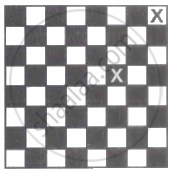
Let P denotes the probability of selecting one white and one black square from the chessboard so that they are not in the same row and also not in the same column (an example of this kind of the choice is shown in figure), then (1024)P is ______.
In an entrance test, there are multiple choice questions. There are four possible answers to each question, of which one is correct. The probability that a student knows the answer to a question is 90%. If he gets the correct answer to a question, then the probability that he was guessing is ______.
Why is Bayes' Theorem often called a method of finding reverse probability?
Which expression gives Bayes' Theorem for \[P(B_i\mid A)\]?
Which conditions are specified for the probabilities in Bayes' Theorem?
What does prior probability mean?
The required answer in a Bayes' Theorem problem is often a probability of which form?
