Advertisements
Advertisements
प्रश्न
A circle with radius 16 cm is cut into four equal parts and rearranged to form another shape as shown in the following figure:

Does the perimeter change? If it does change, by how much does it increase or decrease?
Advertisements
उत्तर
Radius of the circle = 16 cm
∴ Perimeter of the circle = 2πr = 2 × 16 × π = 32π cm
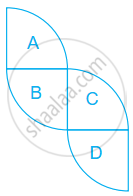
Now, the circle is rearranged into another shape such that A = B = C = D.
Perimeter of above shape = 27πr + 2r = (32π + 32) cm
Yes, the perimeter increases by (32π + 32 – 32π) = 32 cm
APPEARS IN
संबंधित प्रश्न
Find the angle subtended at the centre of circle of radius 5cm by an arc of length `((5pi)/3)` cm
The radius of the wheel of a vehicle is 42 cm. How many revolutions will it complete in a 19.8-km-long journey?
The radius of a circular garden is 100 m. There is a road 10 m wide, running all around it. Find the area of the road and the cost of levelling it at Rs 20 per m2. [Use π = 3.14.]
A conical tent requires 264 m2 of canvas. If the slant height is 12 m, find the vertical height of the cone.
Two circles touch each other externally. The sum of their areas is 5811 cm2 and the distance between their centres is 10 cm. Find the radii of the two circles.
A canvas tent is in the shape of a cylinder surmounted by a conical roof. The common diameter of the cone and the cylinder is 14 m. The height of the cylindrical part is 8 m and the height of the conical roof is 4 m. Find the area of the canvas used to make the tent.
The diameter of a wheel is 1.4m. How many revolutions does it make in moving a distance of 2.2 kms?
A bucket is raised from a well by means of a rope wound round a wheel of diameter 35 cm. If the bucket ascends in 2 minutes with a uniform speed of 1.1 m per sec, calculate the number of complete revolutions the wheel makes in raising the bucket.
