Advertisements
Advertisements
प्रश्न
A circle with radius 16 cm is cut into four equal parts and rearranged to form another shape as shown in the following figure:

Does the perimeter change? If it does change, by how much does it increase or decrease?
Advertisements
उत्तर
Radius of the circle = 16 cm
∴ Perimeter of the circle = 2πr = 2 × 16 × π = 32π cm
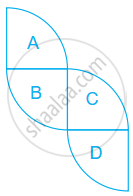
Now, the circle is rearranged into another shape such that A = B = C = D.
Perimeter of above shape = 27πr + 2r = (32π + 32) cm
Yes, the perimeter increases by (32π + 32 – 32π) = 32 cm
APPEARS IN
संबंधित प्रश्न
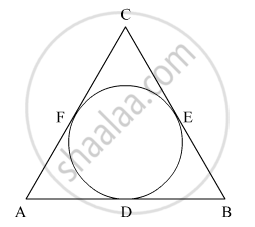
In Fig. 2, a circle is inscribed in a ΔABC, such that it touches the sides AB, BC and CA at points D, E and F respectively. If the lengths of sides AB, BC and CA and 12 cm, 8 cm and 10 cm respectively, find the lengths of AD, BE and CF.
Four cows are tethered at four corners of a square plot of side 50m, so that’ they just cant reach one another. What area will be left ungrazed.
A chord of a circle of radius 30 cm makes an angle of 60° at the centre of the circle. Find the areas of the minor major segments.
A boy is cycling in such a way that the wheels of his bicycle are making 140 revolutions per minute. If the diameter of a wheel is 60 cm, calculate the speed (in km/hr) at which the boy is cycling.
The circumference of a circle is equal to the sum of the circumference of two circles having diameters 36 cm and 20 cm. The radius of the new circle is ______.
The area between the circumferences of two concentric circles is 2464 cm2. If the inner circle has circumference of 132 cm, calculate the radius of outer circle.
A cylindrical beaker of 7 cm diameter is partly filled with water. Determine the number of spherical marbles of diameter 1.4 cm that are to be submerged in it to raise the water level by 5.6 cm
Find the dimensions of a rectangular park whose perimeter is 60 m and area 200 m2.
Is it true that the distance travelled by a circular wheel of diameter d cm in one revolution is 2 π d cm? Why?
Find the area of the shaded region given in figure
