Advertisements
Advertisements
प्रश्न
A bullet of mass m fired at 30° to the horizontal leaves the barrel of the gun with a velocity v. The bullet hits a soft target at a height h above the ground while it is moving downward and emerges out with half the kinetic energy it had before hitting the target.
Which of the following statements are correct in respect of bullet after it emerges out of the target?
- The velocity of the bullet will be reduced to half its initial value.
- The velocity of the bullet will be more than half of its earlier velocity.
- The bullet will continue to move along the same parabolic path.
- The bullet will move in a different parabolic path.
- The bullet will fall vertically downward after hitting the target.
- The internal energy of the particles of the target will increase.
Advertisements
उत्तर
b, d and f
Explanation:
Consider the adjacent diagram for the given situation in the question.
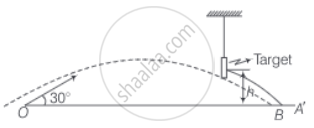
b. Conserving energy between "O" and "A"
`U_i + K_i = U_f + K_f`
⇒ `0 + 1/2 mv^2 = mgh + 1/2 mv^'`
⇒ `(v^')^2/2 = v^2/2 = - gh`
⇒ `(v^')^2 = v^2 - 2 gh`
⇒ `v^' = sqrt(v^2 - 2 gh)` ......(i)
Where v' is the speed of the bullet just before hitting the target. Let speed after emerging from the target is v" then,
By question, = `1/2 (mv^")^2 = 1/2[1/2 m(v^')^2]`
= `1/2 m(v^")^2`
= `1/4 m(v^')^2`
= `1/4 m[v^2 - 2 gh]`
⇒ `(v^")^2 = (v^2 - 2 gh)/2 = v^2/2 - gh`
⇒ `v^" = sqrt(v^2/2 - gh)` .....(ii)
From equations (i) and (ii)
`v^'/v^" = (sqrt(v^2 - 2 gh))/(sqrt(v^2 - 2 gh)/(sqrt(2))) = sqrt(2)`
⇒ `v^" = v^'/sqrt(2) = v^2 (v^'/2)`
⇒ `v^"/(v^'/2) = sqrt(2)` = 1.414 > 1
⇒ `v^" > v^'/2`
Hence, after emerging from the target velocity of the bullet (v") is more than half of its earlier velocity v’ (velocity before emerging into the target).
d. As the velocity of the bullet changes to v’ which is less than v1 hence, the path, followed will change and the bullet reaches point B instead of A', as shown in the figure.
f. As the bullet is passing through the target the loss in energy of the bullet is transferred to particles of the target. Therefore, their internal energy increases.
APPEARS IN
संबंधित प्रश्न
A ball is given a speed v on a rough horizontal surface. The ball travels through a distance l on the surface and stops. what are the initial and final kinetic energies of the ball?
The US athlete Florence Griffith-Joyner won the 100 m sprint gold medal at Seoul Olympics in 1988, setting a new Olympic record of 10⋅54 s. Assume that she achieved her maximum speed in a very short time and then ran the race with that speed till she crossed the line. Take her mass to be 50 kg. What power Griffith-Joyner had to exert to maintain uniform speed?
In a factory, 2000 kg of metal needs to be lifted by an engine through a distance of 12 m in 1 minute. Find the minimum horsepower of the engine to be used.
A block of mass 30 kg is being brought down by a chain. If the block acquires a speed of 40 cm/s in dropping down 2 m, find the work done by the chain during the process.
A small block of mass 200 g is kept at the top of a frictionless incline which is 10 m long and 3⋅2 m high. How much work was required (a) to lift the block from the ground and put it an the top, (b) to slide the block up the incline? What will be the speed of the block when it reaches the ground if (c) it falls off the incline and drops vertically to the ground (d) it slides down the incline? Take g = 10 m/s2.
A block of mass 5 kg is suspended from the end of a vertical spring which is stretched by 10 cm under the load of the block. The block is given a sharp impulse from below, so that it acquires an upward speed of 2 m/s. How high will it rise? Take g = 10 m/s2.
The bob of a pendulum at rest is given a sharp hit to impart a horizontal velocity \[\sqrt{10 \text{ gl }}\], where l is the length of the pendulum. Find the tension in the string when (a) the string is horizontal, (b) the bob is at its highest point and (c) the string makes an angle of 60° with the upward vertical.
A simple pendulum consists of a 50 cm long string connected to a 100 g ball. The ball is pulled aside so that the string makes an angle of 37° with the vertical and is then released. Find the tension in the string when the bob is at its lowest position.
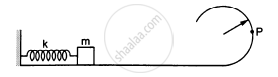
Following figure following shows a smooth track, a part of which is a circle of radius R. A block of mass m is pushed against a spring of spring constant k fixed at the left end and is then released. Find the initial compression of the spring so that the block presses the track with a force mg when it reaches the point P, where the radius of the track is horizontal.
The bob of a stationary pendulum is given a sharp hit to impart it a horizontal speed of \[\sqrt{3 gl}\] . Find the angle rotated by the string before it becomes slack.
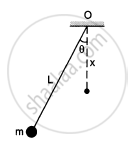
A simple pendulum of length L with a bob of mass m is deflected from its rest position by an angle θ and released (following figure). The string hits a peg which is fixed at a distance x below the point of suspension and the bob starts going in a circle centred at the peg. (a) Assuming that initially the bob has a height less than the peg, show that the maximum height reached by the bob equals its initial height. (b) If the pendulum is released with \[\theta = 90^\circ \text{ and x = L}/2\] , find the maximum height reached by the bob above its lowest position before the string becomes slack. (c) Find the minimum value of x/L for which the bob goes in a complete circle about the peg when the pendulum is released from \[\theta = 90^\circ \]
A chain of length l and mass m lies on the surface of a smooth sphere of radius R > l with one end tied to the top of the sphere. Suppose the chain is released and slides down the sphere. Find the kinetic energy of the chain, when it has slid through an angle θ.
A chain of length l and mass m lies on the surface of a smooth sphere of radius R > l with one end tied to the top of the sphere. Find the tangential acceleration \[\frac{d\nu}{dt}\] of the chain when the chain starts sliding down.
Two bodies of unequal mass are moving in the same direction with equal kinetic energy. The two bodies are brought to rest by applying retarding force of same magnitude. How would the distance moved by them before coming to rest compare?
Suppose the average mass of raindrops is 3.0 × 10⁻⁵ kg and their average terminal velocity 9 ms–1. Calculate the energy transferred by rain to each square metre of the surface at a place which receives 100 cm of rain in a year.
