Advertisements
Advertisements
प्रश्न
`[(2/13)^-6 ÷ (2/13)^3]^3 xx (2/13)^-9` = ______.
Advertisements
उत्तर
`[(2/13)^-6 ÷ (2/13)^3]^3 xx (2/13)^-9` = `underlinebb((2/13)^-36)`.
Explanation:
Using laws of exponents,
am ÷ an = (a)m – n and am × an = (a)m + n ...[∵ a is non-zero integer]
∴ `[(2/13)^-6 ÷ (2/13)^3]^3 xx (2/13)^-9 = [(2/13)^(-6 - 3)]^3 xx (2/13)^-9`
= `(2/13)^-27 xx (2/13)^-9`
= `(2/13)^(-27 - 9)`
= `(2/13)^-36`
Hence, `[(2/13)^-6 ÷ (2/13)^3]^3 xx (2/13)^-9 = (2/13)^-36`
APPEARS IN
संबंधित प्रश्न
Simplify and write the answer in the exponential form.
(25 ÷ 28)5 × 2-5
55 × 5–5 = ______.
Simplify:
`(1/4)^-2 + (1/2)^-2 + (1/3)^-2`
An insect is on the 0 point of a number line, hopping towards 1. She covers half the distance from her current location to 1 with each hop. So, she will be at `1/2` after one hop, `3/4` after two hops, and so on.
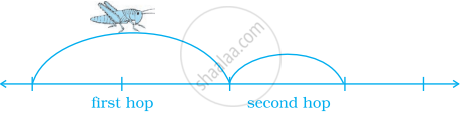
- Make a table showing the insect’s location for the first 10 hops.
- Where will the insect be after n hops?
- Will the insect ever get to 1? Explain.
An insect is on the 0 point of a number line, hopping towards 1. She covers half the distance from her current location to 1 with each hop. So, she will be at `1/2` after one hop, `3/4` after two hops, and so on.
Will the insect ever get to 1? Explain.
Consider a quantity of a radioactive substance. The fraction of this quantity that remains after t half-lives can be found by using the expression 3–t. What fraction of substance remains after 7 half-lives?
Fill in the blanks

What happens when 1 cm worms are sent through these hook-ups?

Find a single repeater machine that will do the same work as hook-up.

Supply the missing information for diagram.