Topics
Psychology : A Scientific Discipline
- Science of Psychology
- Key Features of Science
- History of Psychology as a Science
- Research Methods in Psychology> Experimental Method
- Research Methods in Psychology> Survey Method
- Research Methods in Psychology> Observation Method
- Research Methods in Psychology> Case Study Method
- Research Methods in Psychology> Correlation Studies
- Challenges in Establishing Psychology as a Science
- Importance of Rationality
Intelligence
- Concept of Intelligence
- Perspectives on Intelligence
- Intelligence as a Single, General Ability
- Theories of Intelligence
- E. L. Thorndike's Theory
- Louis Thurstone’s Multifactor Theory
- Charles Spearman's Two Factor Theory
- Theory of Intelligence by Cattell
- Howard Gardner's Multiple Intelligence Theory
- Measurement of Intelligence
- History of Measurement of Intelligence
- Mental Age
- Intelligence Quotient
- Types of Intelligence Tests
- Individual Test
- Group Test
- Verbal Test
- Non-Verbal Test
- Applications of Intelligence Testing
- New Trends in Intelligence> Social Intelligence
- New Trends in Intelligence> Emotional Intelligence
- New Trends in Intelligence> Artificial Intelligence
Personality
Cognitive Processes
Emotions
- Concept of Emotions
- History of Emotions
- Basic Emotions
- Plutchik’s Model
- Physiological Changes During Emotions
- Emotional Well-Being
- Achieving Emotional Well Being
- Benefits of Emotional Well-Being
- Emotional Abuse
- Managing Emotions
- Anger Management
- Anticipating and Managing Anger
- The 3 R's: Relax, Reassess, and Respond
Psychological Disorders
- Concept of Abnormal Behaviour
- Nature of Psychological Disorders
- Criteria for Psychological Disorders
- Concept of Mental Wellness
- Mental Disorders - Its Classification
- Major Psychological Disorder> Anxiety Disorders
- Depressive Disorders
- Major Psychological Disorder> Bipolar Disorder
- Major Psychological Disorder> Trauma and Stress Related Disorders
- Major Psychological Disorder> Substance-Related and Addictive Disorders
- Major Psychological Disorder> Schizophrenia
- Identifying and Treating Psychological Disorders
First Aid in Mental Health
Positive Psychology
Estimated time: 16 minutes
- Key Concepts
- Fluid vs. Crystallized Intelligence
- Measurement & Assessment
- Developmental Trends
- Real-Life Application
- Key Points: Theory of Intelligence by Cattell
CISCE: Class 12
Key Concepts
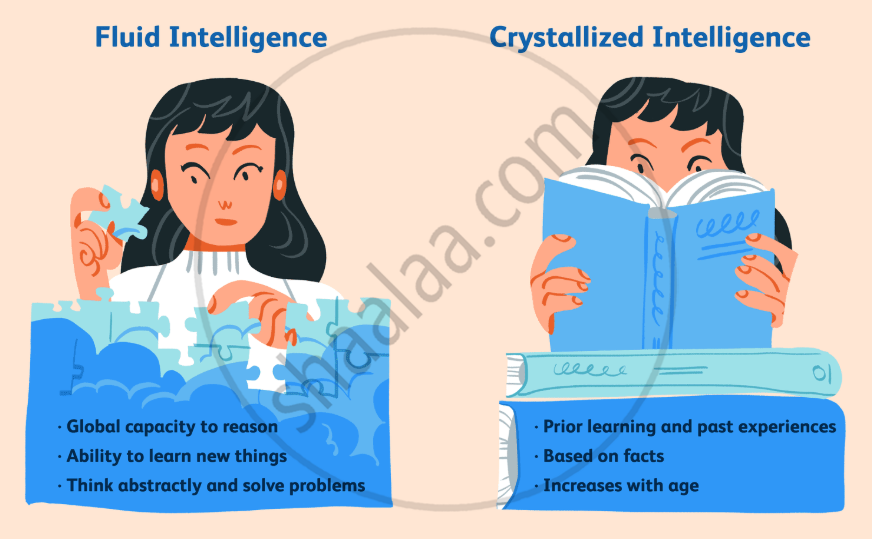
Fluid Intelligence (Gf)
- Meaning: Innate capacity to reason abstractly and solve novel problems without relying on prior learning.
- Origins: Predominantly hereditary, linked to neurological development.
- Example: Deciphering the rules of an unfamiliar board game by observation.
Key Points:
- Gf = “Problem-solving speed.”
- Peaks in adolescence, then gradually declines.
Crystallized Intelligence (Gc)
- Meaning: Accumulation of knowledge and skills acquired through education and experience.
- Origins: Shaped by environment, culture, and learning opportunities.
- Example: Using vocabulary and facts to compose a history essay.
Key Points:
- Gc = “Knowledge reservoir.”
- Increases steadily through adulthood.
CISCE: Class 12
Fluid vs. Crystallized Intelligence
CISCE: Class 12
Measurement & Assessment
| Intelligence Type | Common Tests | Skills Assessed |
|---|---|---|
| Fluid (Gf) | Pattern-completion, analogies | Abstract reasoning; novel problem solving |
| Crystallized (Gc) | Vocabulary tests; general knowledge quizzes | Verbal comprehension: learned information |
CISCE: Class 12
Developmental Trends
Fluid Intelligence:
- Rapid increase during childhood and adolescence.
- Gradual decline after early adulthood.
Crystallized Intelligence:
- Continuous growth through adulthood; plateaus but remains stable later.
Analogy:
- Gf is like a device’s processor speed.
- Gc is like the apps and data stored on the device.
CISCE: Class 12
Real-Life Application
Educational Applications
Enhancing Gf:
- Integrate novel problem–based activities (e.g., logic puzzles, escape-room scenarios).
- Encourage abstract reasoning through pattern recognition games.
Enhancing Gc:
- Use content-focused exercises (e.g., flashcards, quizzes, debates).
- Incorporate discussion and reflection to deepen understanding.
CBSE: Class 12
Maharashtra State Board: Class 12
CISCE: Class 12
Maharashtra State Board: Class 12
CISCE: Class 12
Key Points: Theory of Intelligence by Cattell
- Fluid Intelligence (Gf): Refers to problem-solving and reasoning skills used in new situations without prior knowledge; peaks in adolescence, then declines.
- Crystallized Intelligence (Gc): Refers to accumulated knowledge and skills gained through learning and experience; increases with age.
- Key Differences: Gf is innate and fast, like a processor; Gc is learned and stored, like apps and data.
- Assessment Tools: Gf is tested with puzzles and analogies; Gc is tested with vocabulary and general knowledge questions.
- Educational Use: Gf improves through logic games and novel tasks, while Gc builds through quizzes, discussions, and content-based learning.
