Advertisements
Online Mock Tests
Chapters
2: Financial Statement Analysis
3: Tools of Financial Statement Analysis-Comparative Statements and Common-Size Statements
4: Accounting Ratios
5: Cash Flow Statement
![TS Grewal solutions for अकाऊंटन्सी अनॅलिसिस ऑफ फाइनैन्शल स्टंटमेंट्स [इंग्रजी] इयत्ता १२ chapter 1 - Financial Statements of a Company - Shaalaa.com](/images/accountancy-analysis-of-financial-statements-english-class-12_6:b683741d06224defaee71d239118ce40.jpg "TS Grewal solutions for अकाऊंटन्सी अनॅलिसिस ऑफ फाइनैन्शल स्टंटमेंट्स [इंग्रजी] इयत्ता १२ chapter 1 - Financial Statements of a Company")
Advertisements
Solutions for Chapter 1: Financial Statements of a Company
Below listed, you can find solutions for Chapter 1 of CBSE TS Grewal for अकाऊंटन्सी अनॅलिसिस ऑफ फाइनैन्शल स्टंटमेंट्स [इंग्रजी] इयत्ता १२.
TS Grewal solutions for अकाऊंटन्सी अनॅलिसिस ऑफ फाइनैन्शल स्टंटमेंट्स [इंग्रजी] इयत्ता १२ 1 Financial Statements of a Company QUESTIONS [Pages 1.52 - 1.61]
MULTIPLE CHOICE QUESTIONS (MCQs) Select the correct alternative:
The Balance Sheet shows the financial position of an enterprise ______.
over a period of time.
during a period of time.
for a period of time.
at a point of time.
The financial statements of a business enterprise include ______.
Balance sheet
Statement of Profit and Loss Account
Cash flow statement
All the above
Which of the following statements shows the financial position of a company as at a given date?
Statement of Profit & Loss
Cash Flow Statement
Balance Sheet
Income Statement
A Statement of Assets (Current and Non-current), Liabilities (Current and Non-current) and Equity (i.e., Shareholders' Funds) showing the financial position of an enterprise at a given date is known as ______.
Income Statement.
Balance Sheet.
Cash Flow Statement.
Funds Flow Statement.
Debentures redeemable after 10 years from the date of issue are shown as ______.
Long-term Borrowings
Other Long-term Liabilities
Short-term Borrowings
Other Short-term Liabilities
Name the item out of the following which is shown as Short-term Provision:
Provision for Tax
Interest Accrued but not Due
Employees’ Provident Fund
Interest Accrued and Due
Money Received Against Share Warrants is shown in the Balance Sheet under ______.
Shareholders’ Funds.
Other Long-term Liabilities.
Long-term Provisions.
Other Current Liabilities.
Share Application Money (Refundable) is shown in the Balance Sheet as ______.
Other Long-term Liabilities.
Other Current Liabilities.
Short-term Provisions.
Short-term Borrowings.
Schedule III has prescribed ...?... format of presentation of Balance Sheet.
Horizontal
Vertical
Either Horizontal or Vertical
Neither Horizontal or Vertical
Match Group I with Group II and select the correct answer using the codes given below the lists:
| Group I (Parties) | Group II (Interest in Financial Analysis) | ||
| 1. | Investors | A. | Interested to regulate the activities of the company and to set suitable taxation policy and other acts. |
| 2. | Suppliers and Creditors | B. | Interested to get better returns in terms of dividend and interest on their investment. |
| 3. | Government | C. | Interested to know regarding repayment of their dues in time. |
| 4. | Management | D. | Interested in the overall financial performance and financial position ofthe enterprise. |
1 - B, 2 - A, 3 - D, 4 - C
1 - D, 2 - B, 3 - A, 4 - C
1 - A, 2 - B, 3 - D, 4 - C
1 - B, 2 - C, 3 - A, 4 - D
Calls-in-Advance and interest payable thereon is shown in the Balance Sheet as ______.
Shareholders’ Funds.
Other Non-current Liabilities.
Other Current Liabilities.
Trade Payables.
Which of the following is not shown under the heading “Non-current Assets”?
Capital Work-in-Progress.
Cash and Cash Equivalents.
Patents and Trademarks.
Property, Plant and Equipment.
Mining Rights are ______.
Property, Plant and Equipment.
Intangible Assets.
Intangible Assets Under Development.
Capital Work-in-Progress.
Premium on Redemption of Debentures is shown in the Balance Sheet as ______.
Long-term Borrowings.
Short-term Borrowings.
Other Long-term Liabilities.
Short-term Provisions.
‘Loose Tools’ appear in the company’s Balance Sheet under the head/sub-head ______.
Inventory
Non-Current Assets
Other Current Assets
Stores and Spare Parts
Surplus, i.e., Balance in Statement of Profit & Loss is shown in the Balance Sheet under ______.
Share Capital.
Reserves and Surplus.
Other Long-term Liabilities.
Current Liabilities.
In a company’s balance sheet, the debit balance of the statement of profit & loss is shown under ______.
Non-current Liabilities.
Current Liabilities.
Non-current Assets.
Reserves and Surplus.
Identify the item which is not a part of Shareholders’ Funds:
Share Application Money Pending Allotment
Share Capital
Reserves and Surplus
Money Received against Share Warrants.
Which of the following is not a sub-head under the current assets?
Cash and Cash Equivalents
Trademarks
Short-term Loans and Advances
Inventories
From the given items which is a part of Current Liabilities:
Inventories
Trade Payables
Cash and Cash Equivalents
Trade Receivables
Which of the following is not shown as Non-Current Liabilities in the Balance Sheet?
Trade Payables
Long-term Borrowings
Deferred Tax Liabilities
Long-term Provisions
Interest Accrued but not Due on Debentures will be shown under the heading ______.
Current Assets.
Current Liabilities.
Contingent Liabilities.
Non-current Assets.
As per Schedule IIIl, Part I of the Companies Act, 2013 ‘Unpaid dividend’ will be presented under which of the following head/sub-head in the Balance Sheet of a company?
Reserves and Surplus
Current Liabilities
Contingent Liabilities
Shareholders’ Funds
Claims against the company not acknowledged as debt is shown as ______.
Capital Commitments.
Non-current Liabilities.
Current Liabilities.
Contingent Liabilities.
Match Group I with Group II and select the correct answer using the codes given below the lists:
| Group I | Group II | ||
| 1. | Interest accrued on Investments | A. | Current Liabilities-Short-term Borrowings. |
| 2. | Bank Overdraft | B. | Property, Plant and Equipment and Intangible Assets-Intangible Assets. |
| 3. | Trade Mark | C. | Current Assets-Inventories. |
| 4. | Stores and Spares | D. | Current Assets-Other Current Assets. |
1 - C, 2 - B, 3 - D, 4 - A
1 - D, 2 - C, 3 - B, 4 - A
1 - D, 2 - A, 3 - B, 4 - C
1 - D, 2 - A, 3 - C, 4 - B
Which of the following is not presented under ‘Current Liabilities’ in the Balance Sheet of a company?
Short-term Borrowings
Deferred Tax Liabilities
Short-term Provisions
Trade Payables
According to Schedule III of the Companies Act, 2013, which asset is shown as the first entry?
Non-current Assets.
Current Assets.
Current Investments.
Loans and Advances.
Which of the following items is shown under the head ‘Non-current Assets’, in the Balance Sheet of a company?
Underwriting Commission
Current Investment
Inventory
Patents
‘Calls-in-Advance’ is shown in the company’s Balance Sheet under the head ______.
Non-current Asset.
Current Liabilities.
Shareholders’ Funds.
Non-current Liabilities.
In the Balance Sheet of a Company, Securities Premium is shown under ______.
Non-current Assets.
Share Capital.
Long-term Borrowings.
Reserves and Surplus.
An operating cycle is the time between the ______.
Production and sales.
Procuring of raw material and production of goods.
Financing and selling of products.
Acquiring of raw material for processing and its realisation into Cash and Cash Equivalents.
If the Operating Cycle cannot be identified, it is assumed to be a period of ______.
10 months.
11 months.
9 months.
12 months.
In the following case, Operating Cycle = ?
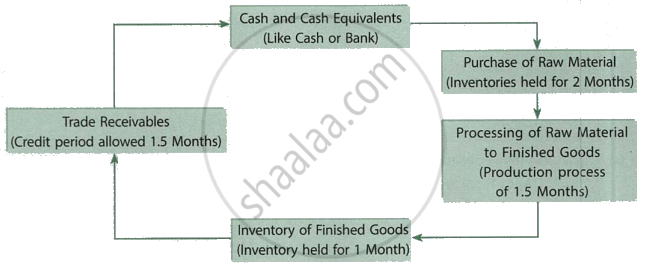
3.5 Months
4.5 Months
5 Months
6 Months
Trade Payable of a company, whose Operating Cycle Period is 18 months, is payable in 24 months, will be ______.
Current Liabilities.
Non-current Liabilities.
Either current liabilities or non-current liabilities.
None of these.
A company has an operating cycle of eight months. It has accounts receivables amounting to ₹ 1,00,000 out of which ₹ 60,000 have a maturity period of 11 months. How would this information be presented in the balance sheet?
₹ 40,000 as current assets and ₹ 60,000 as non-current assets
₹ 60,000 as current assets and ₹ 40,000 as non-current assets
₹ 1,00,000 as non-current assets
₹ 1,00,000 as Current assets
Zee Ltd. has an Operating Cycle Period of 20 months. A trade receivable is realisable in 20 months, it will be shown under ______.
Current Assets.
Non-current Assets.
Cannot be determined.
None of these.
In a company’s Balance Sheet, Provision for Employees Benefits to be settled within 12 months is shown under ______.
Non-current Liabilities
Current Liabilities
Non-current Assets.
Current Assets.
A company had following balances in their books of Accounts.
| 31 March, 2025 | 31 March, 2024 | |
| Raw Material | 40,000 | 30,000 |
| Work in Progress | 1,00,000 | 1,40,000 |
| Finished Goods | 70,000 | 1,00,000 |
| Stock in Trade | 2,00,000 | 1,20,000 |
Determine the amount of Change in Inventories to be shown in Statement of Profit and Loss Account.
₹ 20,000
₹ (20,000)
₹ (10,000)
₹ 10,000
Out of the following, identify the item that is not shown in the Note to Accounts on Finance Costs:
Interest paid on term loan
Bank Deposit
Interest paid on Bank Overdraft
Discount on Issue of Debentures Written off.
Under which of the following head/sub-head is ‘Forfeited Shares’ presented in the Balance Sheet of a Company?
Reserves and Surplus
Share Capital
Other Long-term Liabilities
Other Current Liabilities
ASSERTION-REASON BASED MCQS Given below are two statements (in each question), one labelled as Assertion (A) and other labelled as Reason (R):
Assertion (A): Financial statements of a company are prepared in the form prescribed in Schedule III of the Companies Act, 2013.
Reason (R): The Companies Act, 2013, prescribes Schedule III, as per which financial statements are prepared by all companies.
In the context of the above two statements, which option is correct?
Both Assertion (A) and Reason (R) are correct but Reason (R) is not the correct explanation for Assertion (A).
Both Assertion (A) and Reason (R) are correct and Reason (R) is the correct explanation for Assertion (A).
Only Assertion (A) is correct.
Both Assertion (A) and Reason (R) are not correct.
Assertion (A): Balance Sheet is a list of assets and liabilities of the company presented in a specified form for the year ended on that date.
Reason (R): Balance Sheet is a statement of revenue and expenses of the company as at that date.
In the context of the above two statements, which option is correct?
Both Assertion (A) and Reason (R) are correct but Reason (R) is not the correct explanation for Assertion (A).
Both Assertion (A) and Reason (R) are correct and Reason (R) is the correct explanation for Assertion (A).
Only Assertion (A) is correct.
Both Assertion (A) and Reason (R) are not correct.
Assertion (A): Financial Statements are the summarised statements which give information as to financial performance and financial position of the company.
Reason (R): Statement of Profit & Loss gives the information as to net profit or net loss for the year while Balance Sheet gives information of financial position of the company as at that date.
In the context of the above two statements, which option is correct?
Both Assertion (A) and Reason (R) are correct but Reason (R) is not the correct explanation for Assertion (A).
Both Assertion (A) and Reason (R) are correct and Reason (R) is the correct explanation for Assertion (A).
Only Assertion (A) is correct.
Both Assertion (A) and Reason (R) are not correct.
Assertion (A): Two broad heads under which Balance Sheet is prepared are Equity & Liabilities and Assets.
Reason (R): Part I of Schedule Ill of the Companies Act, 2013 prescribes to show Equity & Liabilities in first part followed by Assets in the second part.
In the context of the above two statements, which option is correct?
Both Assertion (A) and Reason (R) are correct but Reason (R) is not the correct explanation for Assertion (A).
Both Assertion (A) and Reason (R) are correct and Reason (R) is the correct explanation for Assertion (A).
Only Assertion (A) is correct.
Both Assertion (A) and Reason (R) are not correct.
Assertion (A): Surplus, i.e., Balance in Statement of Profit & Loss is shown under Reserves and Surplus.
Reason (R): Surplus, i.e., Balance in Statement of Profit & Loss is an item of Balance Sheet which shows accumulated profits or losses.
In the context of the above two statements, which option is correct?
Both Assertion (A) and Reason (R) are correct but Reason (R) is not the correct explanation for Assertion (A).
Both Assertion (A) and Reason (R) are correct and Reason (R) is the correct explanation for Assertion (A).
Only Assertion (A) is correct.
Both Assertion (A) and Reason (R) are not correct.
Assertion (A): Non-current Liabilities are the liabilities which are not Current Liabilities.
Reason (R): Liabilities are of two types, i.e., Non-current Liabilities and Current Liabilities.
In the context of the above two statements, which option is correct?
Both Assertion (A) and Reason (R) are correct, but Reason (R) is not the correct explanation for Assertion (A).
Both Assertion (A) and Reason (R) are correct, and Reason (R) is the correct explanation for Assertion (A).
Only Assertion (A) is correct.
Both Assertion (A) and Reason (R) are not correct.
Assertion (A): Interest accrued but not due and interest accrued and due are shown as Other Current Liabilities.
Reason (R): Since both interest accrued but not due and interest accrued and due are payable within 12 months from the date of Balance Sheet, they are shown as Other Current Liabilities.
In the context of the above two statements, which option is correct?
Both Assertion (A) and Reason (R) are correct but Reason (R) is not the correct explanation for Assertion (A).
Both Assertion (A) and Reason (R) are correct and Reason (R) is the correct explanation for Assertion (A).
Only Assertion (A) is correct.
Both Assertion (A) and Reason (R) are not correct.
Assertion (A): Dividend Payable or Unpaid Dividend is a Short-term Provision and shown under the main head Current Liabilities.
Reason (R): Dividend Payable or Unpaid Dividend is not a provision but a liability and is shown under Other Non-current Liabilities.
In the context of the above two statements, which option is correct?
Both Assertion (A) and Reason (R) are correct but Reason (R) is not the correct explanation for Assertion (A).
Both Assertion (A) and Reason (R) are correct and Reason (R) is the correct explanation for Assertion (A).
Only Assertion (A) is correct.
Both Assertion (A) and Reason (R) are not correct.
Assertion (A): Property, Plant and Equipment (Fixed Assets) is shown as Non-current Asset in the Balance Sheet of a company.
Reason (R): Property, Plant and Equipment (Fixed Assets) are used for a long time hence, is a Non-current Asset. Schedule III (Part I) of the Companies Act, 2013 requires it to be shown as Non-current Asset.
In the context of the above two statements, which option is correct?
Both Assertion (A) and Reason (R) are correct, but Reason (R) is not the correct explanation for Assertion (A).
Both Assertion (A) and Reason (R) are correct, and Reason (R) is the correct explanation for Assertion (A).
Only Assertion (A) is correct.
Both Assertion (A) and Reason (R) are not correct.
Assertion (A): Intangible Assets are the Assets which do not have physical existence.
Reason (R): Intangible Assets are shown under the head ‘Current Assets’ and Sub-head ‘Other-current Assets’.
In the context of the above two statements, which option is correct?
Both Assertion (A) and Reason (R) are correct but Reason (R) is not the correct explanation for Assertion (A).
Both Assertion (A) and Reason (R) are correct and Reason (R) is the correct explanation for Assertion (A).
Only Assertion (A) is correct.
Both Assertion (A) and Reason (R) are not correct.
Assertion (A): Contingent Liabilities are not the liabilities payable yet but may become liabilities when an event associated with it happens in future.
Reason (R): Proposed Dividend is a Contingent Liability because it will become a liability after the shareholders declare, i.e., approve it.
In the context of the above two statements, which option is correct?
Both Assertion (A) and Reason (R) are correct, but Reason (R) is not the correct explanation for Assertion (A).
Both Assertion (A) and Reason (R) are correct, and Reason (R) is the correct explanation for Assertion (A).
Only Assertion (A) is correct.
Both Assertion (A) and Reason (R) are not correct.
COMPETENCY BASED QUESTIONS
Shapoorji Pallonji group and Wilson Renewable Energy Ltd. is considering an Equity Share sale to raise up to1,500 crore to repay its debts maturing this financial year.
This repayment of debt would have been shown by the company in the Balance Sheet of 2023–24 as:
Long-term Borrowings.
Short-term Borrowings.
Other Current Liabilities.
Trade Payables.
Venus Ltd. provides you with the following information:
- ₹ 2,00,000 10% Debentures of ₹ 100 each issued at par on 1.07.2022 to be redeemed in a lump sum on 30.06.2026.
- Interest is payable half-yearly, on 31st December and 30th June every year.
- Interest on Debentures paid till 31.3.2023 is ₹ 3,000.
How will the interest on Debentures be shown under Other Current Liabilities in the notes to accounts accompanying the Balance Sheet of Venus Ltd. as at 31st March, 2023?
Interest accrued and due ₹ 17,000.
Interest accrued but not due ₹ 5,000; interest accrued and due ₹ 7,000.
Interest accrued but not due ₹ 10,000; interest accrued and due ₹ 2,000.
Interest accrued but not due ₹ 17,000.
Savory Ltd. had issued ₹ 1,00,000 shares of ₹ 10 each at par payable ₹ 4 on application and balance on allotment on 25th March, 2026.
It received ₹ 10,00,000 as application money.
Shares were allotted on 10th April, 2026.
How much amounts will be shown in the Balance Sheet as at 31st March, 2026 against
- Shares Application Money Pending Allotment, and
- Shares Application Money and under which main head and sub-head?
Give reason for showing it under the respective heads.
Partha Ltd. issued ₹ 1,00,000 shares of ₹ 10 each payable with applications. It received ₹ 8,00,000 Application Money.
Under which Main head and Sub-head it will be shown in the Balance Sheet and why?
CASE STUDY BASED MULTIPLE CHOICE QUESTIONS
Sachin, Saurav and Rahul are civil engineers. They incorporated a real estate company called SSR Realty Ltd. in the year 2017, to engage in purchase and sale of properties (i.e., land, buildings, flats, apartments, etc.). Extracts related to the Balance Sheet of their company is given as follows, but is not arranged as per Schedule III, Part I of Companies Act, 2013:
| Particulars | ₹ | Particulars | ₹ |
| Authorised Share Capital | 10,00,000 | Advance Tax | 20,000 |
| Prepaid Insurance | 1,40,000 | 9% Debentures | 2,30,000 |
| Securities Premium | 1,15,000 | Provision for Employees Retirement Benefits | 1,60,000 |
| Building (Held for Sale) | 11,60,000 | Bank | 1,00,000 |
| Subscribed Share Capital | 7,20,000 | GST Payable | 90.000 |
| Advance from Customers | 1,35,000 | Investment in Mutual Funds | ?? |
| Provident Fund Payable | 1,20,000 | (Investment made for 6 months) | |
| Revaluation Reserve | 1,15,000 | Office Building | 2,60,000 |
| Issued Share Capital | 7,50,000 |
Based on the above information, answer the following questions:
- Balance to be shown in Balance Sheet as Shareholders’ Funds is ______.
- ₹ 7,20,000
- ₹ 2,30,000
- ₹ 9,50,000
- ₹ 4,90,000
- Balance of Non-current Liabilities is ______.
- ₹ 2,30,000.
- ₹ 3,90,000
- ₹ 5,20,000
- ₹ 1,60,000
- Non-current Assets in the Balance Sheet will be ______.
- ₹ 2,60,000
- ₹ 14,20,000
- ₹ 11,60,000
- ₹ 16,60,000
- Investment in Mutual Funds is ______.
- ₹ 5,000
- ₹ 25,000
- ₹ 1,25,000
- ₹ 65,000
Zaika Foods Limited, a food chain company has certain items which have not yet been categorised according to the Schedule III of Companies Act, 2013:
| Particulars | ₹ | Particulars | ₹ |
| Marketable Securities | 90,000 | Advance Tax | 60,000 |
| Equity Share Capital | 6,00,000 | Treasury Bills | 50.000 |
| 9% Preference Share Capital | 16,00,000 | Bank Overdraft | 30,000 |
| Advance to Suppliers | 1,75,000 | Interest Due on Calls-in-Arrears | 25,000 |
| Patented Recipes | 2,10,000 | Money Received against Share Warrants | 45,000 |
| Capital Reserve | 35,000 | Investment in Government Securities with maturity period less than 12 months | 1,15,000 |
| Stock of Raw Material | 1,25,000 |
Based on the above information, answer the following questions:
- Money Received against Share Warrants is to be shown under ______.
- Non-current Liabilities.
- Current Assets.
- Current Liabilities.
- Shareholders’ Funds.
- Identify an item from the options below which should be classified under Cash & Cash Equivalents in the Balance Sheet.
- Cash at Bank
- Bank Overdraft
- Investment in Government Securities with maturity period less than 12 months
- Marketable Securities
- Current Investments are ______.
- ₹ 90,000.
- ₹ 1,40,000.
- ₹ 2,05,000.
- ₹ 25,000.
- Patented Recipes are classified as ______.
- Current Assets.
- Shareholders’ Funds.
- Non-Current Assets.
- None of these.
Knowledge Park Ltd. requires your assistance in quantifying/classifying certain items as per Schedule III of the Companies Act, 2013:
| Particulars | ₹ | Particulars | ₹ |
| Equity Share Capital | 10,00,000 | Bank Overdraft | 70,000 |
| Franchise Fee paid | 4,20,000 | Calls-in-Advance | 50,000 |
| Provision for Tax | 1,00,000 | Goodwill | 2,50,000 |
| Cash-in-Hand | 3,00,000 | Cheques-in-Hand | 6,00,000 |
| 9% Debentures | 5,00,000 | Building | 7,70,000 |
| Patents | 5,25,000 | Deposits with bank with more than 12 months maturity | 5,00,000 |
| Bonds | 6,50,000 | Computer Software | 2,10,000 |
| Loan from SBI for 3 years | 3,40,000 | Premises | 6,00,000 |
| 8% Preference Share Capital | 1,00,000 | Publishing Rights | 2,20,000 |
| Margin money with Bank | 8,10,000 | ||
| Premium on Redemption of Debentures | 1,00,000 |
Based on the above information, answer the following questions.
- Cash and Cash Equivalent is ______.
- ₹ 22,10,000
- ₹ 16,70,000
- ₹ 21,40,000
- ₹ 14,00,000
- Correct heading and sub-heading for 'Bank Deposits with more than 12 months maturity':
- Current Assets - Current Investments
- Non-current Assets - Property, Plant and Equipment
- Current Assets - Cash & Cash equivalents
- Current Assets - Other Current Assets
- Total value of Intangible Assets is ______.
- ₹ 12,05,000
- ₹ 11,00,000
- ₹ 21,55,000
- ₹ 16,25,000
- Long-term Borrowings to be shown in the Balance Sheet are ______.
- ₹ 14,90,000
- ₹ 15,90,000
- ₹ 8,40,000
- None of these.
Accountant of Glimpse India Private Ltd. resigned without completing the financial statements. Management is unsure how balances of certain heads are to be computed for the purpose of preparing the Balance Sheet as per Schedule III of Companies Act, 2013. In this regard, they have sought your assistance. Information for the purpose is as follows:
| Particulars | ₹ | Particulars | ₹ |
| Equity Share Capital | 5,00,000 | Bank Overdraft | 40,000 |
| Capital Work-in-Progress | 1,00,000 | Public Deposits | 2,50,000 |
| Retirement benefits Payable to Employees | 60,000 | Trademarks | 40,000 |
| Provision for Tax | 1,20,000 | Advances from Customers | 60,000 |
| Investment in Shares in Another Company | 50,000 | Furniture and Fittings | 6,00,000 |
| Share Forfeiture Account | 90,000 | Livestock | 1,60,000 |
| Securities Premium | 2,50,000 | 9% Debentures | 3,00,000 |
| Goodwill | 2,50,000 | Surplus, i.e., Balance in Statement of Profit & Loss | 2,60,000 |
| Building | 12,00,000 | Trade Payables | 3,10,000 |
| 10% Preference Share Capital | 20,00,000 |
Based on the above information, answer the following questions.
- Current Assets to be shown in the Balance Sheet is ______.
- ₹ 31,00,000
- ₹ 44,00,000
- ₹ 18,40,000
- ₹ 11,50,000
- Value of Non-current Assets is ______.
- ₹ 44,70,000
- ₹ 24,00,000
- ₹ 31,50,000
- None of these.
- Total of Equity and Liabilities of the company is ______.
- ₹ 42,40,000
- ₹ 32,70,000
- ₹ 56,95,000
- ₹ 37,80,000
- Total value of Non-current Liabilities in Equity and Liabilities part of Balance Sheet is ______.
- ₹ 8,50,000
- ₹ 5,50,000
- ₹ 9,00,000
- ₹ 6,10,000
TS Grewal solutions for अकाऊंटन्सी अनॅलिसिस ऑफ फाइनैन्शल स्टंटमेंट्स [इंग्रजी] इयत्ता १२ 1 Financial Statements of a Company EXERCISE [Pages 1.62 - 1.70]
What are the major heads in the Equity and Liabilities part of the Balance Sheet as per Schedule III?
Under which major head will the following be shown:
(i) Share Capital; and (ii) Money Received Against Share Warrants?
List any five items that are shown under Reserves and Surplus.
Name the Sub-heads under the head ‘Current Liabilities’ in the Equity and Liabilities part of the Balance Sheet as per Schedule III, Part I of the Companies Act, 2013.
Under which sub-head will the following be classified or shown:
(i) Long-term Borrowings;
(ii) Deferred Tax Liabilities (Net); and
(iii) Long-term Provision?
Name the itmes that are shown under Long-term Borrowings.
State giving reason whether Trade Receivables are classified as Current Assets or Non-current Assets in the Balance Sheet of a Company as per Schedule III of the Companies Act, 2013 in the following cases.
| Case | Operating cycle Period (months) | Expected realization period (months) |
| 1 | 10 | 11 |
| 2 | 10 | 12 |
| 3 | 10 | 13 |
| 4 | 14 | 13 |
| 5 | 15 | 16 |
State giving reason whether Trade Payables are classified as Current Liabilities or Non-current Liabilities in the Balance Sheet of a Company as per Schedule III of the Companies Act, 2013 in the following cases:
| Case | Operating Cycle Period (Months) | Expected Payment Period (Months) |
| 1 | 10 | 11 |
| 2 | 10 | 12 |
| 3 | 10 | 13 |
| 4 | 14 | 13 |
| 5 | 15 | 16 |
State any two items that are included in the following major heads under which liabilities of a company are shown:
(i) Reserves and Surplus;
(ii) Long-term Borrowings;
(iii) Short-term Borrowings;
(iv) Other Current Liabilities.
Classify the following items under Major heads and Sub-heads (if any) in the Balance Sheet of a company as per Schedule III of the Companies Act 2013:
- Securities Deposits (More than 12 months);
- Interest due on Calls-in-Arrears;
- Balance in Forfeited Shares Account;
- Capital Work-in-Progress;
- Loan Repayable on Demand;
- Cash in Hand.
Under which major heads and sub-heads will the following items be placed in the balance sheet of the company as per Schedule III, Part I of the Companies Act, 2013?
- Debentures with maturity period in current financial year;
- Securities Premium;
- Provident Fund.
Under which heads the following items on the Assets part of the Balance Sheet of a company will be shown:
- Sundry Debtors
- Patents and Trademarks
- Shares in Quoted Companies
- Advances recoverable in cash
- Prepaid Insurance and
- Work-in-Progress?
Under which major headings and sub-headings (if any) will the following items be shown in the Balance Sheet of a company as per Schedule III, Part I of the Companies Act, 2013?
- Calls-in-Advance
- Loose Tools
- Outstanding Salaries
- Accrued Income
- Prepaid Insurance
- Unpaid Dividend
- Capital Work-in-Progress
- Patents
- Capital Reserve
- Current Maturities of Long-term Debts
Under which of the major heads will the following items be shown in the Balance Sheet of a company, as per Schedule III of the Companies Act, 2013:
- 10% Debentures;
- Stock-in-Trade;
- Cash at Bank;
- Bills Receivable;
- Goodwill;
- Loose Tools;
- Share Application Money Pending Allotment.
Classify the following items under Major Heads and Sub-Heads (if any) in the Balance Sheet of a company as per Schedule III, Part I of the Companies Act, 2013:
- Accrued Income
- Capital Advances
- Capital work-in-progress
Under which heads will the following items be shown in the Balance Sheet of a company:
- Bank Balance;
- Investments (Long-term);
- Outstanding Salary;
- Subscribed and paid-up Capital;
- Bills Payable;
- Unclaimed Dividends;
- Shares Option Outstanding Account; and
- General Reserve;
- Uncalled Liability on Shares?
Under which major heads and sub-heads will the following items be presented in the Balance Sheet of the company as per Schedule III, Part I of the Companies Act, 2013?
- Bank Overdraft
- Subsidy Reserve
- Capital Redemption Reserve
- Publishing Titles
- Copyrights and Patents
- Debit balance in the Statement of Profit & Loss
- Debenture Redemption Reserve
- Income Received in Advance
Under which heads are the following shown in a company's Balance Sheet:
(i) Public Deposits
(ii) Office Furniture
(iii) Prepaid Rent
(iv) Outstanding Salaries
(v) Computer Software
(vi) Interest Accrued on Investment
(vii) Trade Payables payable after 12 months from the date of Balance Sheet?
Classify the following items under major heads and sub-heads (if any) in the Balance Sheet of the company as per Schedule III, Part I of the Companies Act, 2013:
- Loose Tools
- Provision for Tax
- Copyrights
- Capital Work-in-Progress
- Stores and Spares
- Public Deposits
How are the following items shown while preparing Balance Sheet of a company:
- Surplus, i.e., Balance in Statement of Profit and Loss (Dr.);
- Interest accrued and due on Debentures;
- Computer Software under development;
- Interest accrued on Investment
- Arrears of dividends on Cumulative Preference Shares?
Under which heads and sub-heads are the following items shown in the Balance Sheet of a Company as per Schedule III, Part I of the Companies Act, 2013?
- Securities Premium
- Interest accrued and due on secured loans
- Drafts in Hand
- Interest accrued but not due
- Building
- Brands/Trademarks
- Sundry Debtors
- Sundry Creditors
- Premium on Redemption of Debentures
- Mastheads and Publishing Title
Prepare Balance Sheet of Recovery Ltd. as per Schedule III of the Companies Act, 2013:
| ₹ | |
| 10% Debentures of ₹ 100 each | 1,90,000 |
| Stock-in-Trade (inventories) | 40,000 |
| Goodwill | 20,000 |
| Provision for Tax | 60,000 |
Totalting of Balance Sheet is not required.
From the following information extracted from the books of Howrach Ltd., prepare Balance Sheet of the company as at 31st March, 2026, as per Schedule III of the Companies Act, 2013:
| (₹ in '000) | (₹ in '000) | ||
| Long-term Borrowings | 1,000 | Property, Plant and Equipment | 1,600 |
| Trade Payable | 60 | Inventories | 40 |
| Share Capital | 800 | Trade Receivables | 160 |
| Reserves and Surplus | 180 | Cash and Cash Equivalents | 240 |
Prepare Balance Sheet of VT Ltd. as at 31st March 2026, from the following information as per Schedule III, Part I of the Companies Act, 2013:
| ₹ | ₹ | |||
| General Reserve | 3,000 | Property, Plant and Equipment (Cost) | 9,000 | |
| 8% Debentures | 3,000 | Other Current Liabilities | 2,500 | |
| Surplus, i.e., Balance in Statement of Profit and Loss (Credit) | 1,200 | Share Capital | 5,000 | |
| Depreciation | 700 | Other Current Assets | 6,400 |
Prepare Balance Sheet of HP Ltd. as at 31st March, 2026 from the following information:
| ₹ | ₹ | ||
| Equity Share Capital | 20,00,000 | Workmen Compensation Reserve | 1,00,000 |
| 12% Preference Share Capital | 10,00,000 | Surplus, i.e., Balance in Statement of Profit and Loss (Cr.) | 3,00,000 |
| Fixed Assets (At cost) | 46,60,000 | Stock | 6,00,000 |
| Accumulated Depreciation | 16,60,000 | Sundry Debtors | 8,00,000 |
| Investments | 4,00,000 | Cash | 1,50,000 |
| Current Liabilities | 8,00,000 | Loans and Advances | 50,000 |
| 12% Debentures | 6,00,000 | Provision for Taxation | 2,00,000 |
Revenue from Operations and Other Incomes
Under which head following revenue items of a non-financial company will be shown:
(i) Sales;
(ii) Revenue from Services Rendered;
(iii) Sale of Scrap;
(iv) Interest Earned on Loans; and
(v) Gain (profit) on Sale of Investments?
Cost of Materials Consumed
Where will Purchase of Raw Materials be disclosed in Financial Statement of Company?
Calculate Cost of Materials Consumed from the following:
Opening Inventory of Materials ₹5,00,000; Purchase of Materials ₹25,00,000; and Closing Inventory of Materials ₹4,00,000.
Calculate Cost of Materials Consumed from the following:
Opening Inventory of Materials ₹3,50,000; Finished Goods ₹75,000; Stock-in-Trade ₹2,00,000; Closing Inventory of: Materials ₹3,25,000; Finished Goods ₹85,000; Stock-in-Trade ₹1,50,000; Purchases during the year: Raw Material ₹17,50,000; Stock-in-Trade ₹9,00,000.
Changes in Inventories of Finished Goods, Work-in-Progress and Stock-in-Trade
Give two examples of Inventory except Raw Materials, Work in Progress, Finished Goods and Stock in Trade.
From the following information of Hospitality Ltd. for the year ended 31st March, 2025, calculate the amount that will be shown in the Note to Accounts on Changes in Inventories of Finished Goods, Work-in-Progress and stock-in-Trade:
| Particulars | Opening Inventory (₹) | Closing inventory (₹) |
| Finished Goods | 5,00,000 | 5,50,000 |
| Work-in-Progress | 4,50,000 | 4,25,000 |
| Stock-in-Trade | 6,50,000 | 6,00,000 |
Depreciation and Amortisation Expenses
From the following information of Best Marketing Ltd. for the year ended 31st March, 2025 prepare Note to Accounts on Depreciation and Amortisation Expenses:
Depreciation on: Building ₹ 15,500; Plant and Machinery ₹ 25,000; Computers ₹ 60,000; Goodwill written off ₹ 7,500; Patents written off ₹ 12,500.
Employees Benefit Expensess
From the following information compute the amount to be shown in Note to Accounts on Employees Benefit Expenses: Wages ₹ 5,40,000; Salaries ₹ 7,20,000; bonus ₹ 1,05,000; Staff Welfare Expenses ₹ 60,000 and Business Promotion Expenses ₹ 50,000.
From the following information, prepare Note to Accounts on Employees Benefit Expenses:
Wages ₹ 2,70,000; Salaries ₹ 3,60,000; Staff Welfare Expenses 60,000; Printing and Stationery Expenses ₹ 20,000 and Business Promotion Expenses ₹ 50,000.
Finance Cost
Prepare Notes to Accounts of Finance Cost of Cosmo Ltd. for the year ended 31st March, 2026:
- Interest paid on 9% Debentures ₹ 1,50,000;
- Discount on Issue of Debentures 36,000;
- Dividend paid ₹ 1,80,000;
- Bank Charges ₹ 6,000;
- Interest Received on Fixed Deposits ₹ 70,000;
- Interest on Bank overdraft 28,000.
Hint: Bank Charges are included in ‘Other Expenses’, and Dividend is paid on shares and not on borrowings. Hence, it is not ‘Finance Cost’.
Where will you disclose the amount of loss on issue of debentures written off out of Statement of Profit and Loss?
From the following information, calculate Total Income, Other Expenses, Total Expenses, Change in Inventory, Profit before Tax and Profit after Tax for the year ended 31st March, 2026 as per Schedule III, Part II of the Companies Act, 2013:
| Particulars | ₹ |
| Opening Inventory of Finished Goods and Work-in-Progress | 1,75,000 |
| Cost of Material Consumed | 7,50,000 |
| Administrative Expenses | 50,000 |
| Selling and Distribution Expenses | 87,500 |
| Finance Cost | 75,000 |
| Loss on Sale of Machinery | 62,500 |
| Employees Benefit Expenses | 3,00,000 |
| Closing Inventory of Finished Goods and Work-in-Progress | 1,00,000 |
| Revenue from Operations | 19,00,000 |
| Other Income | 1,00,000 |
| Tax | 1,50,000 |
TS Grewal solutions for अकाऊंटन्सी अनॅलिसिस ऑफ फाइनैन्शल स्टंटमेंट्स [इंग्रजी] इयत्ता १२ 1 Financial Statements of a Company TEST YOUR KNOWLEDGE [Pages 1.71 - 1.72]
TEST YOUR KNOWLEDGE
Financial Statements of a company consists of ______.
Statement of Profit & Loss.
Balance Sheet.
Cash Flow Statement.
All of these.
Which of the following is not the limitation of financial statements?
Not free from personal bias.
Ignores qualitative elements.
Ignores price level changes.
None of these.
Interest accrued and due on debentures is shown in a Company’s Balance Sheet under the sub-head ______.
Short-term Provisions.
Other Current Liabilities.
Short-term Borrowings.
Trade Payable.
Interest accrued but not due on investment will be shown under which head of Current Assets?
Short-term Loans and Advances
Current Investments
Other Current Assets
Cash and Cash Equivalents
Which of the following is not included in Short-term Borrowings?
Bank Overdraft
Cash Credit from Bank
Retirement Benefit of Employees
Loan repayable on Demand
In a company’s Balance Sheet, employees’ earned leave payable on retirement is disclosed under ______.
Non-current Liabilities.
Current Liabilities.
Non-current Assets.
Current Assets.
In a company’s balance sheet, the debit balance of the statement of profit & loss is shown under ______.
Non-current Liabilities.
Current Liabilities.
Non-current Assets.
Reserves and Surplus.
Assertion (A): Non-current Liabilities are the liabilities which are not Current Liabilities.
Reason (R): Liabilities are of two types, i.e., Non-current Liabilities and Current Liabilities. Liabilities which are payable after 12 months or after the period of Operating Cycle from the date of Balance Sheet are shown as Non-current Liabilities.
In the context of the above two statements, which of the following is correct?
Assertion (A) is correct but Reason (R) is wrong.
Both Assertion (A) and Reason (R) are correct, but Reason (R) is not the correct explanation of Assertion (A).
Both Assertion (A) and Reason (R) are incorrect.
Both Assertion (A) and Reason (R) are correct, and Reason (R) is the correct explanation of Assertion (A).
The following information was extracted from the books of Mask Ltd. answer the question (In accordance with the provisions of the Companies Act, 2013):
| Particulars | ₹ |
| 10% Debentures payable after 3 years | 5,00,000 |
| 10% Bank Loan from PNB repayable after 4 years | 2,50,000 |
| Stock-in-Trade (Inventories) | 1,00,000 |
| Goodwill | 1,25,000 |
| Computer Software under Development | 1,25,000 |
| Provision for Tax | 1,50,000 |
Computer software under development will be shown under ______ head of the sub-head property, plant and equipment and intangible assets on the assets part of the Balance Sheet.
Intangible Assets under Development
Tangible Assets
Capital Work-in-Progress
Capital Advance
The following information was extracted from the books of Mask Ltd. answer the question (In accordance with the provisions of the Companies Act, 2013):
| Particulars | ₹ |
| 10% Debentures payable after 3 years | 5,00,000 |
| 10% Bank Loan from PNB repayable after 4 years | 2,50,000 |
| Stock-in-Trade (Inventories) | 1,00,000 |
| Goodwill | 1,25,000 |
| Computer Software under Development | 1,25,000 |
| Provision for Tax | 1,50,000 |
Total value of intangible assets that will be shown under the sub-head intangible assets on the assets part of the Balance Sheet is ______.
₹ 1,25,000
₹ 2,50,000
₹ 3,75,000
₹ 5,50,000
The following information was extracted from the books of Mask Ltd. answer the question (In accordance with the provisions of the Companies Act, 2013):
| Particulars | ₹ |
| 10% Debentures payable after 3 years | 5,00,000 |
| 10% Bank Loan from PNB repayable after 4 years | 2,50,000 |
| Stock-in-Trade (Inventories) | 1,00,000 |
| Goodwill | 1,25,000 |
| Computer Software under Development | 1,25,000 |
| Provision for Tax | 1,50,000 |
Total Long-term Borrowings that will be shown under the head Non-current Liabilities on the Equity and Liabilities part of the Balance Sheet is ______.
₹ 1,25,000
₹ 2,50,000
₹ 7,50,000
₹ 5,00,000
The following information was extracted from the books of Mask Ltd. answer the question (In accordance with the provisions of the Companies Act, 2013):
| Particulars | ₹ |
| 10% Debentures payable after 3 years | 5,00,000 |
| 10% Bank Loan from PNB repayable after 4 years | 2,50,000 |
| Stock-in-Trade (Inventories) | 1,00,000 |
| Goodwill | 1,25,000 |
| Computer Software under Development | 1,25,000 |
| Provision for Tax | 1,50,000 |
Provision for tax of the company will be shown under the sub-head of the Current Liabilities of the Balance Sheet as ______.
Trade Payable
Short-term Borrowings
Other Current Liabilities
Short-term Provisions
The following information was extracted from the books of Mask Ltd. answer the question (In accordance with the provisions of the Companies Act, 2013):
| Particulars | ₹ |
| 10% Debentures payable after 3 years | 5,00,000 |
| 10% Bank Loan from PNB repayable after 4 years | 2,50,000 |
| Stock-in-Trade (Inventories) | 1,00,000 |
| Goodwill | 1,25,000 |
| Computer Software under Development | 1,25,000 |
| Provision for Tax | 1,50,000 |
10% Debentures will be shown under ______ head of the Equity and Liabilities part of the Balance Sheet.
Shareholders’ Funds
Non-current Liabilities
Current Liabilities
None of these.
Classify the following items under Major-heads and Sub-heads (if any) in the Balance Sheet of a company as per Schedule IIl of the Companies Act, 2013:
- Current maturities of Long-term Debts;
- Building under Construction;
- Provision for Warranties;
- Calls-in-Advancе;
- Capital Advance;
- Advances recoverable in Cash within the Operating Cycle.
Match the following:
| Column I | Column II | ||
| A. | Proposed Dividend. | (i) | Other Current Liabilities. |
| B. | Unclaimed Dividend. | (ii) | Reserves and Surplus. |
| C. | Capital Reserve. | (iii) | Part I of Schedule III of the Companies Act, 2013. |
| D. | Balance Sheet. | (iv) | Contingent Liabilities. |
A - (iii), B - (ii), C - (i), D - (iv)
A - (ii), B - (iii), C - (iv), D - (i)
A - (iv), B - (ii), C - (iii), D - (i)
A - (iv), B - (i), C - (ii), D - (iii)
List any three objectives of financial statements.
State two items of ‘Other Incomes’ of the Statement of Profit & Loss.
Revenue earned from the Sale of ‘Stock-in-Trade’ is shown in the Statement of Profit & Loss as ______.
Revenue from Operations
Other Income
Solutions for 1: Financial Statements of a Company
TS Grewal solutions for अकाऊंटन्सी अनॅलिसिस ऑफ फाइनैन्शल स्टंटमेंट्स [इंग्रजी] इयत्ता १२ chapter 1 - Financial Statements of a Company
Shaalaa.com has the CBSE Mathematics अकाऊंटन्सी अनॅलिसिस ऑफ फाइनैन्शल स्टंटमेंट्स [इंग्रजी] इयत्ता १२ CBSE solutions in a manner that help students grasp basic concepts better and faster. The detailed, step-by-step solutions will help you understand the concepts better and clarify any confusion. TS Grewal solutions for Mathematics अकाऊंटन्सी अनॅलिसिस ऑफ फाइनैन्शल स्टंटमेंट्स [इंग्रजी] इयत्ता १२ CBSE 1 (Financial Statements of a Company) include all questions with answers and detailed explanations. This will clear students' doubts about questions and improve their application skills while preparing for board exams.
Further, we at Shaalaa.com provide such solutions so students can prepare for written exams. TS Grewal textbook solutions can be a core help for self-study and provide excellent self-help guidance for students.
Concepts covered in अकाऊंटन्सी अनॅलिसिस ऑफ फाइनैन्शल स्टंटमेंट्स [इंग्रजी] इयत्ता १२ chapter 1 Financial Statements of a Company are Concept of Financial Statements, Format of Company's Balance Sheet, Contents of Balance Sheet> Equity and Liabilities, Shareholder's Fund> Share Capital of a Company, Shareholders' Fund> Reserves and Surplus, Shareholders' Fund> Money Received Against Share Warrants, Equity and Liabilities> Share Application Money Pending Allotment, Equity and Liabilities> Non-Current Liabilities, Equity and Liabilities> Current Liabilities, Contents of Balance Sheet> Assets, Assets> Non-Current Assets, Assets> Current Assets, Statement of Profit and Loss.
Using TS Grewal अकाऊंटन्सी अनॅलिसिस ऑफ फाइनैन्शल स्टंटमेंट्स [इंग्रजी] इयत्ता १२ solutions Financial Statements of a Company exercise by students is an easy way to prepare for the exams, as they involve solutions arranged chapter-wise and also page-wise. The questions involved in TS Grewal Solutions are essential questions that can be asked in the final exam. Maximum CBSE अकाऊंटन्सी अनॅलिसिस ऑफ फाइनैन्शल स्टंटमेंट्स [इंग्रजी] इयत्ता १२ students prefer TS Grewal Textbook Solutions to score more in exams.
Get the free view of Chapter 1, Financial Statements of a Company अकाऊंटन्सी अनॅलिसिस ऑफ फाइनैन्शल स्टंटमेंट्स [इंग्रजी] इयत्ता १२ additional questions for Mathematics अकाऊंटन्सी अनॅलिसिस ऑफ फाइनैन्शल स्टंटमेंट्स [इंग्रजी] इयत्ता १२ CBSE, and you can use Shaalaa.com to keep it handy for your exam preparation.
