Advertisements
Chapters
*: Use of Literary Devices in Acts-1 and 2 - Scene 1
*: Use of Literary Devices in Acts-1 and 2 - Scene 2
*: Use of Literary Devices in Acts-1 and 2 - Scene 3
Act 2
*: Use of Literary Devices in Acts-1 and 2 - Scene 1
*: Use of Literary Devices in Acts-1 and 2 - Scene 2
*: Use of Literary Devices in Acts-1 and 2 - Scene 3
*: Use of Literary Devices in Acts-1 and 2 - Scene 4
*: Project Work- Acts-1 and 2
Act 3
*: Use of Literary Devices in Acts 3, 4 and 5 - Scene 1
▶ *: Use of Literary Devices in Acts 3, 4 and 5 - Scene 2
*: Use of Literary Devices in Acts 3, 4 and 5 - Scene 3
Act 4
*: Use of Literary Devices in Acts 3, 4 and 5 - Scene 1
*: Use of Literary Devices in Acts 3, 4 and 5 - Scene 2
*: Use of Literary Devices in Acts 3, 4 and 5 - Scene 3
Act 5
*: Use of Literary Devices in Acts 3, 4 and 5 - Scene 1
*: Use of Literary Devices in Acts 3, 4 and 5 - Scene 2
*: Use of Literary Devices in Acts 3, 4 and 5 - Scene 3
*: Use of Literary Devices in Acts 3, 4 and 5 - Scene 4
*: Use of Literary Devices in Acts 3, 4 and 5- Scene 5
*: Project Work- Acts-3, 4 and 5
Advertisements
Solutions for Chapter *: Use of Literary Devices in Acts 3, 4 and 5 - Scene 2
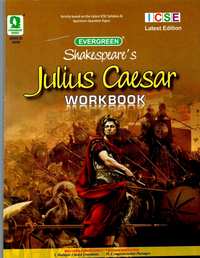
Below listed, you can find solutions for Chapter * of CISCE Shirin Puri Lama for इंग्लिश शेक्सपियर्स जूलियस केसर वर्कबुक [इंग्रजी] इयत्ता ९ अँड १० आईसीएसई.
Shirin Puri Lama solutions for इंग्लिश शेक्सपियर्स जूलियस केसर वर्कबुक [इंग्रजी] इयत्ता ९ अँड १० आईसीएसई * Use of Literary Devices in Acts 3, 4 and 5 - Scene 2 ASSIGNMENTS [Pages 159 - 173]
MULTIPLE CHOICE QUESTIONS Choose the correct answers to the questions from the given options: Analysis, Application and Evaluation:
Mark Antony stirs the emotions of the crowd in his ______.
farewell speech
eulogy
prologue
epilogue
Select the option that shows the correct relationship between statements I and II.
Statement I: They will kiss dead Caesar’s wounds with reverence.
Statement II: The people of Rome have just heard Antony read out Caesar’s will to them.
Statement I is true, and Statement II is false.
Statement II is cause of Statement I.
Statement I and Statement II are independent of each other.
Statement II is true, and Statement I is false.
What is the attitude of the mob in this scene?
clever
intelligent
sensitive
irrational
Which of the following is NOT TRUE about Brutus’ words said for Caesar?
Brutus was happy over Caesar’s fortune.
Brutus was against Caesar as he (Brutus) loved Rome more than he loved Caesar.
He was jealous of Caesar’s valiance.
Brutus killed Caesar as he was over ambitious.
Antony’s speech is full of ______.
rhetoric and irony
anger and arrogance
paradox and metaphors
plain arguments
Which of the following options is NOT true about the citizens:
They were eager to know why Caesar was murdered.
They were eager to attack Brutus as soon as he goes up to the pulpit to speak.
They were eager to listen from Brutus the reason why Caesar was assassinated.
They wanted to listen to Brutus as he was honourable.
Why does Brutus want the citizens to stay back after he has finished speaking with them?
He wants them to debate on the reasons he had given for killing Caesar.
He wants them to listen to Mark Antony speak of Caesar’s glories.
He wants them to pay respect to Caesar’s corpse and to listen to Antony speak of Caesar’s glories.
He wants them to listen to Antony speak about his i.e. Brutus’ glories.
We feel that Brutus’ speech ______.
did not appeal to the mob’s emotions.
was exciting.
was not forceful and impressive.
was devoid of humour.
When Antony tells the citizens to ‘bear with me,’ and starts to cry ______.
he is actually watching the reaction of the crowd to what he has just told them.
he is heart broken and cannot speak.
he does not wish to speak further.
he is feeling very emotional at the loss of his dear friend, Caesar.
Give an example of personification in this scene.
Antony describes Caesar’s wounds as red lips that are parted and begging him to speak.
Antony is describing to the mob about how Caesar was killed.
when Antony asks the crowd why they are not grieving for Caesar.
when Antony begs the citizens to be patient.
Give an example of the literary device called irony in this scene.
when the citizens are patiently listening to Antony.
when the same citizens who had called Brutus ‘noble’ now apply the same adjective to Mark Antony and not to Brutus.
when Antony shows the citizens the wounds of Caesar.
when the fourth citizen insists that Antony should read the will.
Which two examples does Antony give to show that Caesar was not ambitious?
- that Caesar badly wanted the crown which he had offered him earlier.
- Caesar had refused the crown offered to him by Antony not once but three times.
- Caesar saw to it that all the money collected from the prisoners of war as ransom was put for the welfare of the common people.
- Caesar was loved by the upper class of people.
2 and 3
3 and 1
1 and 4
4 and 1
Antony uses the word honourable like a refrain eight times so that by the end of his speech it becomes a term of ______.
verbal mockery to describe Brutus
endearment
addressing all the conspirators
respect for the conspirators
Recalling and Understanding:
Select the correct option regarding the sequence of events what Antony does:
- Mark Antony asks the servant to help him carry Caesar’s body into the marketplace.
- Mark Antony requests Brutus that he be allowed to speak at Caesar’s funeral.
- Mark Antony sends his servant to first go and speak with Brutus that he be allowed to come and meet him.
- Mark Antony flees to his house after Caesar is assassinated.
3, 4, 1, 2
1, 2, 3, 4
3, 4, 2, 1
4, 3, 2, 1
How does Brutus address the citizens in his speech?
Friends, Romans, countrymen.
Friends, countrymen, lovers.
Romans, countrymen and lovers.
Friends, countrymen and Romans.
Brutus rose against Caesar because ______.
not that he loved Caesar less, but that he loved Rome more
not that he loved Rome more, but because he loved Caesar less
he wanted to rule Rome instead of Caesar
Caesar was becoming his enemy
Brutus tells the citizens that had Caesar lived, he would have treated them like ______.
honourable people
slaves
ordinary citizens
self-respecting citizens
Brutus ends his speech by telling the mob ______.
he too can kill himself for the welfare of Rome, just as he killed Caesar
to sleep in peace now that he has explained why he had to kill Caesar
to leave the pulpit for Cassius to tell the crowd why he had plotted to kill Caesar
to even go to war in the interest of Rome
The fickle-minded citizens, after hearing Brutus are ______.
all praise for Brutus and against Caesar
all praise for Caesar and against Brutus
not convinced about Brutus’ explanation
do not allow him to leave the pulpit
By referring to the citizens as ‘Friends’ Antony cleverly ______.
impresses them deeply and they are happy
establishes equality with them and repels their suspicions of him
reminds them that they are friends
makes them feel honoured and respected
Antony begins his speech by telling the mob that he had ______.
not come here to bury Caesar but to praise him
come to bury Caesar, not praise him
come to speak ill of Brutus
come here to criticize Caesar
Mark Antony cleverly appeals to their sentiments and sways the citizens’ feelings in favour of Caesar when he says ______.
‘O judgement! thou art fled to brutish beasts/And men have lost their reason’
‘I speak not to disprove what Brutus spoke’
‘But here I am to speak what I do know’
‘And Brutus is an honourable man’
Mark Antony tells the crowd that he dared not read aloud the will to them because ______.
they will be very disappointed
they will be angry with him
there would be mutiny and bloodshed
there would be too much merry making
While Antony pretends to turn the mob away from mutiny and bloodshed, he actually is ______.
driving them to mutiny against the conspirators
making them feel sympathy for the conspirators
testing the mob as to what they can do.
driving them away from mutiny
Antony asks the crowd to ______.
make a ring around Caesar’s corpse
climb up to the pulpit
not to come too close to him
disperse
Antony’s intention of making the mob to stand around Caesar’s mutilated body was to ______.
show respect and honour for his memory
inflame their passion against the conspirators and increase the dramatic effect
follow a custom which must be followed
make them count the wounds
According to Antony, who was Brutus?
Caesar’s enemy
Caesar’s Angel
Caesar’s Guardian Angel
Caesar’s best friend
Is it true when Antony tells the citizens, ‘I come not, friends, to steal your hearts.’?
It is not true because he is only pretending to soothe their hearts, but his only intention is to inflame their hearts to mutiny.
It is true because he is genuinely trying to soothe their hearts.
It is true because he is trying to convince the citizens that what the 'honourable Brutus' did was right.
It is true because Antony is denying what he has told them.
What had Caesar bequeathed to each of the citizens?
seventy five drachmas
twenty five drachmas
gold
silver coins
What is Antony’s concluding line of his speech to the citizens?
‘Bring me to Octavius.’
‘Hear me with patience.’
‘Here was a Caesar! when comes such another?’
‘Now let it work...’
What does the servant inform Antony about both Brutus and Cassius?
They had to leave Rome and run for their lives.
They have been killed by the mob.
They have been arrested.
They had to hide indoors.
CONTEXT QUESTIONS
Read the extract given below and answer the questions that follow:
| Antony: “Friends, Romans, countrymen, lend me your ears; I come to bury Caesar, not to praise him. The evil that men do lives after them, The good is oft interred with their bones...” So let it be with Caesar. The noble Brutus Hath told you Caesar was ambitious; If it were so, it was a grievous fault, And grievously hath Caesar answer’d it. Here, under leave of Brutus and the rest - For Brutus is an honourable man; So are they all, all honourable men - Come I to speak in Caesar’s funeral. |
- What does Antony say he is there for?
What does he say he is not there for?
What do you think he is actually there for? - What were the three conditions that Brutus had laid down before allowing Antony to speak to the citizens of Rome?
- List the three arguments that Antony uses immediately after he has spoken these lines to prove conclusively that Julius Caesar was not ambitious.
- Antony repeatedly uses certain words in his speech to describe Brutus. What are they? Why does he do this?
- What one argument of Antony do you think had the greatest impact on his listeners? Give a reason to support your answer.
What were the citizens’ feelings towards Antony before he began his speech?
How do their feelings towards him change at the end of his speech?
Read the extract given below and answer the questions that follow:
| Antony: You all do know this mantle. I remember The first time ever Caesar put it on; 'Twas on a summer’s evening, in his tent, That day he overcame the Nervii. |
- Who were the ‘Nervii’? Why does Antony mention the names of Cassius, Casca and Brutus as he shows the mob the mantle? (Recall & Understanding)
- State three arguments put forward by Antony earlier to prove that Caesar was not ambitious. (Understanding)
- Why does Antony refer to Brutus as well-beloved? Why was the stabbing of Caesar by Brutus referred to as the ‘most unkindest cut of all’? (Understanding & Application)
- Mention three ways Brutus’ speech differs from Antony’s. (Analysis)
- What characteristic of the mob is highlighted in this scene? State any two characteristic traits of Mark Antony revealed in this scene. Justify your answer by giving a suitable reason. (Analysis, Application & Evaluate)
Read the extract given below and answer the questions that follow:
| CITIZENS - We will be satisfied; let us be satisfied. BRUTUS - Then follow me and give me audience, friends. |
- Why do the citizens wish to be satisfied? What mood are they in? Give the meaning of 'audience'. (Understanding & Application)
- What instructions does Brutus give Cassius? What does Brutus tell the crowd before he goes up to the pulpit? (Recalling)
- What do the First Citizen and Second citizen tell each other? (Recalling)
- What will be the purpose of Brutus' speech to the citizens who are waiting for him to speak? (Understanding)
- According to Brutus what was the single major evil in Caesar's character? (Understanding)
Read the extract given below and answer the questions that follow:
| BRUTUS – As Caesar loved me, I weep for him, as he was fortunate, I rejoice at it; as he was valiant, I honour him, but as he was ambitious, I slew him. |
- What are the different feelings that Brutus had for Caesar? Why did he kill Caesar? (Understanding)
- What does this extract reveal about Brutus? (Analysis)
- Who does Brutus feel he has offended in his speech? What reply does he get? (Recalling)
- How does Brutus justify that he has offended no one at the end of his speech? Who enters after his speech? (Recalling & Understanding)
- How does Brutus introduce the person who enters? Why is he confident that the person means no harm to the conspirators? (Recalling & Understanding)
Read the extract given below and answer the questions that follow:
| ANTONY - The noble Brutus Hath told you that Caesar was ambitious; If it was so, it was a grievous fault, And grievously hath Caesar answer'd it. |
- Bring out the real purpose of Antony's speech. How does he succeed? (Understanding & Analysis)
- State two instances cited by Antony in his speech to prove to the mob that Caesar was not ambitious. (Application)
- What is the word used by Antony in his speech which is a repetition in a sarcastic manner (verbal irony) to incite the mob to anger and fury? How does he cleverly play on the emotions of the mob against Brutus indirectly refuting what Brutus spoke of Caesar? (Recalling, Application & Analysis)
- Why does Antony ask the mob to bear with him? What is his ulterior motive in doing so? (Understanding)
- What is the reaction of the mob? What do they discuss among themselves? Give two instances of their conversation. (Analysis)
- What qualities of Antony do you admire? What character traits of Antony are portrayed in his speech? (Analysis)
Read the extract given below and answer the questions that follow:
| ANTONY – O masters, if I were disposed to stir your hearts and minds to mutiny and rage, I should do Brutus wrong, and Cassius wrong, Who, you all know, are honourable men. |
- Antony shifts the focus of his speech to something else also. What is it? Why does Antony do this? (Recalling & Analysis)
- What had Antony found in Caesar's closet? What four things would the people do if they came to know of the contents of what Antony found? (Recalling & Understanding)
- What reasons does Antony give for delaying the reading of the contents of what he had found in Caesar's closet? How does he incite the mob further? (Recalling & Understanding)
- How does the mention of Caesar's will and Antony's reference to Caesar's stabbing affect the citizens?
- Explain - "If I were disposed to stir your hearts and minds to mutiny and rage". (Understanding)
Read the extract given below and answer the questions that follow:
| ANTONY - This was the most unkindest cut of all; For when the noble Caesar saw him stab, ingratitude, more strong than traitors' arms Quite vanquish'd him, then burst his mighty heart; |
- Which was the unkindest cut of all? Who have already stabbed Caesar? Where? When? (Recalling)
- Why was it referred to as 'the unkindest cut of all'? What was the reaction in Caesar's body to this cut? What does it show about Caesars's relationship with the person who gave him this cut? (Understanding & Analysis)
- Where did Caesar fall? What was ironical about his fall? (Recalling & Analysis)
- What is spoken about the vesture of Caesar by Antony in his speech? What was so special about it? What was its significance in history? (Recalling & Analysis)
- How did the mob react? What did Antony want to achieve through his speech? How far was he successful? (Understanding & Analysis)
Read the extract given below and answer the questions that follow:
| ANTONY - Good friends, sweet friends, let me not stir you up To such a flood of mutiny. They that have done this deed are honourable: |
- How does Antony go on to compare himself with Brutus? How does Antony try to project himself to be simple and outright to the mob? Why does he do so? Does he really mean it when he says 'let me not stir you up"? (Analysis)
- What does Antony show the people that incites them still further to mutiny and rage? What does it contain? (Recalling & Understanding)
- What do the mob decide to do at the end of the scene? (Recalling)
- Who enters after the mob has dispersed? What information does the person bring? (Recalling)
- What shortcomings does Antony have as an orator according to himself? What would have happened had Antony and Brutus changed their places? (Understanding & Evaluation)
COMPETENCY - FOCUSED QUESTIONS
Solutions for *: Use of Literary Devices in Acts 3, 4 and 5 - Scene 2
Shirin Puri Lama solutions for इंग्लिश शेक्सपियर्स जूलियस केसर वर्कबुक [इंग्रजी] इयत्ता ९ अँड १० आईसीएसई chapter * - Use of Literary Devices in Acts 3, 4 and 5 - Scene 2
Shaalaa.com has the CISCE Mathematics इंग्लिश शेक्सपियर्स जूलियस केसर वर्कबुक [इंग्रजी] इयत्ता ९ अँड १० आईसीएसई CISCE solutions in a manner that help students grasp basic concepts better and faster. The detailed, step-by-step solutions will help you understand the concepts better and clarify any confusion. Shirin Puri Lama solutions for Mathematics इंग्लिश शेक्सपियर्स जूलियस केसर वर्कबुक [इंग्रजी] इयत्ता ९ अँड १० आईसीएसई CISCE * (Use of Literary Devices in Acts 3, 4 and 5 - Scene 2) include all questions with answers and detailed explanations. This will clear students' doubts about questions and improve their application skills while preparing for board exams.
Further, we at Shaalaa.com provide such solutions so students can prepare for written exams. Shirin Puri Lama textbook solutions can be a core help for self-study and provide excellent self-help guidance for students.
Concepts covered in इंग्लिश शेक्सपियर्स जूलियस केसर वर्कबुक [इंग्रजी] इयत्ता ९ अँड १० आईसीएसई chapter * Use of Literary Devices in Acts 3, 4 and 5 - Scene 2 are .
Using Shirin Puri Lama इंग्लिश शेक्सपियर्स जूलियस केसर वर्कबुक [इंग्रजी] इयत्ता ९ अँड १० आईसीएसई solutions Use of Literary Devices in Acts 3, 4 and 5 - Scene 2 exercise by students is an easy way to prepare for the exams, as they involve solutions arranged chapter-wise and also page-wise. The questions involved in Shirin Puri Lama Solutions are essential questions that can be asked in the final exam. Maximum CISCE इंग्लिश शेक्सपियर्स जूलियस केसर वर्कबुक [इंग्रजी] इयत्ता ९ अँड १० आईसीएसई students prefer Shirin Puri Lama Textbook Solutions to score more in exams.
Get the free view of Chapter *, Use of Literary Devices in Acts 3, 4 and 5 - Scene 2 इंग्लिश शेक्सपियर्स जूलियस केसर वर्कबुक [इंग्रजी] इयत्ता ९ अँड १० आईसीएसई additional questions for Mathematics इंग्लिश शेक्सपियर्स जूलियस केसर वर्कबुक [इंग्रजी] इयत्ता ९ अँड १० आईसीएसई CISCE, and you can use Shaalaa.com to keep it handy for your exam preparation.
