Advertisements
Chapters
2: Tissues
3: Improvements In Food Resources
▶ 4: Diversity in Living Organisms
Advertisements
Solutions for Chapter 4: Diversity in Living Organisms
Below listed, you can find solutions for Chapter 4 of CBSE P S Verma and V K Agarwal for बायोलॉजी पार्ट ३ [इंग्रजी] इयत्ता ९.
P S Verma and V K Agarwal solutions for बायोलॉजी पार्ट ३ [इंग्रजी] इयत्ता ९ 4 Diversity in Living Organisms Intext Questions [Pages 177 - 178]
Activity 1
Find out the names of the following animals and plants in as many languages as you can:
| 1. Rat | 2. Cat | 3. Bat | 4. Tiger | 5. Lion | 6. Dog | 7. Wolf |
| 8. Peacock | 9. Ant | 10. Housefly | 11. Honey bee | 12. Lotus | 13. Potato | 14. Neem |
| 15. Mango |
Note down that these names are not related with the names you normally use to identify them.
Activity 2
Find out the scientific names of any five common animals and plants. Do these names have anything in common with the names you normally use to identify them. For example, margosa tree in Hindi is called Neem, in Bangla Neem, in Marathi Limba and in Tamil Vembu.
P S Verma and V K Agarwal solutions for बायोलॉजी पार्ट ३ [इंग्रजी] इयत्ता ९ 4 Diversity in Living Organisms Very Short Answer Type Questions [Pages 221 - 225]
(Carrying 1 mark each)
What is diversity?
How many types of organisms are believed to be present on Earth?
What is the size of blue whale?
What is the height of Redwood tree?
Who is close to us, monkey or cow?
What is megadiversity?
What is the region of megadiversity?
Name two countries that are centres of megadiversity.
What is nomenclature?
Define binomial nomenclature.
Who proposed binomial nomenclature?
What is common or vernacular name?
Rewrite the following scientific names correctly, if incorrect.
- Amoeba Histolytica;
- Atthala rosea (holly-hock);
- Brassica Campestris;
- brassica capitata (cabbage).
What is the scientific name of humans?
Write scientific name of one animal.
Write scientific name of one plant.
What is main advantage of using scientific name?
What is classification?
What is taxonomy?
Who is considered father of taxonomy?
What is characteristic?
Define artificial system of classification.
What is natural system of classification?
What is the utility of artificial systems of classification?
Write down one drawback of artificial system of classification.
Which characteristic is likely to be more basic?
Who has described the idea of evolution in book “The origin of species"?
What is primitive organism?
What are advanced organisms?
What is taxonomic category?
What is hierarchy of categories?
What is Linnaean hierarchy?
What is the basic unit of classification?
Which is the highest taxonomic category?
How many categories are there in hierarchy classification?
What is a species?
Who proposed the five kingdom system of classification and when?
What is contribution of Carl Woese in classification of organisms?
What is Monera?
Define prokaryotes?
Which special biochemical constitutes the wall in monera?
Give two examples of Monera.
What is protista?
What are eukaryotes?
What is mixotrophic nutrition?
Give two examples of protozoan protists.
Give one example of algal protist.
Which one is called plant-animal?
What are fungi?
What is mycelium?
What is chemical characteristics of fungal cell wall.
Give two examples of fungi.
What is lichen?
Give one use of lichen.
Define - Thallus.
Write down two important characteristics of algal cell wall?
What is the chemical characteristics of algal cell wall?
To which division of cryptogams do algae belong?
Name the division which is known as “amphibians of plant kingdom".
Name the body part which helps in attaching the bryophytes to the substratum.
What is peculiar about sex organs in bryophytes?
Give two examples of bryophytes.
Give two examples of pteridophytes.
Name the group of vascular cryptogams.
Why bryophytes and pteridophytes grow in moist and shady places?
What do you mean by the term spermatophyta?
Name the group in which seeds are naked.
Name the group in which reproductive organs are flowers.
Classify the following seeds into dicot and monocot: wheat, maize, bean, gram.
Name the class of angiosperms in which reticular venation is present.
Name the class of angiosperms in which leaves show parallel venation.
Name the sex organs of gymnosperms.
Name the sex organs of angiosperms.
Name the subdivision in which xylem contains vessels.
What are phanerogams?
What are nonchordates?
What is cell level organisation?
What are parazoa?
What is choanocyte?
What are cnidoblasts?
Define diploblastic animals.
What is pseudocoelom?
Define enterocoelom.
What is bilateral symmetry?
Name a fresh water sponge?
Name the following:
Cavity present in the body of sponges.
Name the following:
Cavity present in the body of cnidarians.
What is the skeleton of sponges made up of?
Name the following:
Simplest sponges
Name the following:
Commonly known as bath sponge.
Write down two unique characters of Porifera.
What is the name of gelatinous layer existing between two germ layer of Cnidaria?
What is the body symmetry of cnidarians or coelenterates?
What type of digestion takes place in cnidarians?
In which phylum, nervous system develops for the first time?
Name the organisms in which asexual reproduction takes place by budding.
To which phylum do sponges belong?
What is alternation of generation?
What is common name of following:
Pleurobranchi
What is common name of following:
Cestum
Give an example of ctenophora.
What are colloblasts?
What types of body symmetry is present in Platyhelminthes?
Name the excretory organs in Platyhelminthes.
Name the following:
Free living Platyhelminthes
Name the following:
Scientific name of pork tape worm.
Which type of body organisation is present in Platyhelminthes?
Give one example of Platyhelminthes.
Give one example of Nematoda.
What is common name of nematoda.
Give the scientific name of the following:
Roundworm
Write the scientific name of the filarial worm that causes filariasis.
Name the causal organisms of elephantitis.
What is the common name of annelids?
Which type of circulatory system is present in annelids?
Name the excretory organ of annelids.
Give the scientific name of the following:
Earthworm
Give the scientific name of the following:
Leech
Name the parasitic annelid.
Enumerate locomotory organs of annelids?
Name the largest phylum of Invertebrata.
Which is second largest phylum of Invertebrata.
Which is second largest phylum of Invertebrata.
What is literal meaning of Arthropoda.
What is literal meaning of Mollusca.
Name those phyla in which circulatory system is open and body cavity is filled with blood.
Name the excretory organ of Crab.
Name the excretory organ of Insect.
Which type of eye is present in insects?
Which part of Molluscan's body secrete the shell?
Name the organ of locomotion in Mollusca.
Give two examples of Mollusca.
Name the locomotory organs in insects.
What is habitat of all echinoderms?
What is body symmetry of echinoderms?
Name the organ of echinoderms which helps in respiration and locomotion?
What is literal meaning of echinoderms?
Given one example of Onychophora?
Name the phylum in which pharyngeal gill slits are present but notochord is absent.
Give one example of phylum Hemichordata.
What is common name of Balanoglossus?
Name the phylum in which dorsal nerve tube, notochord and pharyngeal gill clefts are present.
Give one example of Urochordata.
Give one example of Cephalochordata.
What do you meant by the term Craniata?
What is the position of Notochord in the body of Urochordata?
What is the position of Notochord in the body of Cephalochordata?
Give two examples of Cyclostomata.
What do you mean by the term Chondrichthyes?
What do you mean by the term Osteichthyes?
How many chambers are present in the heart of Fishes.
How many chambers are present in the heart of Frog?
Name four Chordata classes having cold blooded animals.
Name the superclass of Chordata in which lateral line sense organs are found.
Identify the following fish:
Fish with 5 to 7 pairs of gills
Identify the following fish:
Fish with air bladder
Give one example of cartilaginous fish.
Give one example of bony fish.
Give the scientific name of the following:
Mosquito fish
Give the scientific name of the following:
Flying fish
Why amphibians are present close to the water bodies?
What do you understand by the term tetrapoda?
Name two classes belonging to tetrapoda.
Name the following:
Organism in which external ear (pinna) is present.
Name the following:
Organism in which nictitating membrane is present.
Name two classes of chordates in which clawed digits are present.
Name the first class of terrestrial chordates.
Name the reptile in which heart is four chambered.
Name the class in which syrinx is present.
Name the class in which pneumatic bones are present.
Name the chordate class of flying worm blooded animals in which teeth are absent.
Name the class in which digits end up in nail and claws.
Name the class in which hair are present as exoskeleton.
How many cervical vertebrae are found in mammals?
Mention one unique feature of mammals.
P S Verma and V K Agarwal solutions for बायोलॉजी पार्ट ३ [इंग्रजी] इयत्ता ९ 4 Diversity in Living Organisms Short Answer Type Questions [Pages 225 - 226]
(Carrying 2 marks each)
Enlist various types of species diversity.
By given the example of a tree explain various types species diversity.
What is the need for classification?
What is basis of classification?
How is the complexity of cell structure and their number used in classification?
Mention seven categories of hierarchical classification.
Give distinguishing features of plants and animals.
Write down two disadvantages of two kingdom classification.
With the help of flow chart depict five kingdoms classification.
Mention two characteristics of kingdom Protista.
Write a note on lichens.
Draw a flow chart showing classification of kingdom Plantae.
Write four general characters of Thallophyta.
Distinguish between algae and fungi.
Give the four characteristics of algae.
Write down differences between dicots and monocots.
Write down differences between bryophytes and pteridophytes.
Write down four main characters of Bryophyta.
Give two examples of bryophyta
Write down four main characters of Pteriodophyta.
Give two examples of pteridophyta
Write down four main characters of gymnosperms.
Write down four main characters of angiosperms.
Distinguish between Nonchordata and Chordata.
How do animals of Porifera differ from animals of Cnidaria?
Distinguish between polyp and medusa.
Write down four general characters of Porifera.
Give two examples of Porifera.
Write down four general characters of cnidarians (coelenterates).
Give two examples of Coelenterates:
What is difference between bilateral symmetry and radial symmetry?
Write down four characteristics of Ctenophora.
Give two examples of Ctenophora.
Write down four main characters of Platyhelminthes.
Write a short answer.
Give two examples of Platyhelminthes.
Main characteristics of Nematoda:
Give two examples of Nematoda.
Write down four main characters of Annelida.
Define the term hermaphrodite.
Give two examples of hermaphrodite.
What do you mean by the term triploblastic animals?
Give two examples of triploblastic animals.
What do you mean by the term coelomate animals?
Give two examples of coelomate animals.
Write down four general characters of phylum Arthropoda.
Give two examples of phylum Arthropoda.
Give four general characters of phylum Mollusca.
Write down two examples of phylum Mollusca.
Write down four general characters of phylum Echinodermata.
Give two examples of phylum Echinodermata.
Write the scientific name of prawn.
Write the scientific name of house fly.
Write the scientific name of star fish.
Write the scientific name of squid.
Write the scientific name of apple snail.
Write the scientific name of fresh water mussel.
Name the phylum in which ambulacral system is present. What is its function?
What are adaptations in fishes due to which they are aquatic?
Write down four characters of Chondrichtyes.
Give two examples of Chondrichthyes.
Write down four characters of Osteichtyes.es.
Give two examples of Osteichthyes.
What are differences between the following:
Cartilaginous fishes and bony fishes
What are differences between the following?
Amphibia and Reptilia
Differentiate between
aves and mammals
Write down four characters of mammals.
Give two examples of mammals.
Describe some flight adaptations of the birds.
Write down four main characters of chordates.
Write short note on protochordates.
Give an example of Urochordata.
Give an example of Cephalochordata.
Give one point of difference between notochord and nerve cord.
P S Verma and V K Agarwal solutions for बायोलॉजी पार्ट ३ [इंग्रजी] इयत्ता ९ 4 Diversity in Living Organisms Long Answer Type Questions [Pages 226 - 227]
(Carrying 5 marks each)
Describe the characteristics used in hierarchial classification of organisms.
Briefly describe the importance of classification.
What is hierarchy of categories? Describe the same.
Write a note on kingdom Monera.
Describe the characteristics of kingdom Protista.
Give two examples of kingdom Protista.
Write a note on kingdom Fungi.
Describe general characters, classification and example of old division Spermatophyta.
Define pteridophytes.
Write down differences between bryophytes and pteridophytes.
Explain general characteristics of phylum Platyhelminthes.
Main characteristics of Nematoda:
Give two examples of phylum Platyhelminthes.
Give two examples of phylum Nematoda.
Describe general characteristics of phylum Annelida.
Give one example each class of Annelida.
Explain the general charaters of phylum Mollusca.
Give one example of following class of Mollusca:
Gastropoda
Give one example of following class of Mollusca:
Pelecypoda
Give one example of following class of Mollusca:
Cephalopoda
Explain the general characters of phylum Arthropoda.
Give one example of following class:
Crustacea
Give one example of following class:
Myriapoda
Give one example of following class:
Insecta
Give one example of following class:
Arachnida
Name major phyla of Animal kingdom. Write down one character and one example of each of them.
Describe the important characters of mammals.
Describe the important characters of birds.
Give two examples of mammals.
Give two examples of birds.
What are pisces? Classify and explain two different kinds of fishes by the help of suitable examples.
P S Verma and V K Agarwal solutions for बायोलॉजी पार्ट ३ [इंग्रजी] इयत्ता ९ 4 Diversity in Living Organisms Multiple Choice Questions (MCQs) [Pages 227 - 228]
The warm and humid tropical regions of the Earth, between the Tropic of Cancer and the Tropic of Capricorn are rich in biodiversity. This is called the region of ______.
biodiversity
mesodiversity
megadiversity
all of these
Who divided Monera into Archaebacteria and Eubacteria?
Carl Woese
Carl von Linne
Ernst Haeckel
Charles Darwin
The basic unit of classification is ______.
genes
kingdom
species
order
Diatoms and Paramecium belongs to ______.
Monera
Protista
Plantae
Fungi
Binomial nomenclature was introduced by ______.
R.H. Whittaker
Carlous Linnaeus
Carl Woese
All of these
The binomial nomenclature is made up of two words ______.
a generic name and a specific name
a generic name and a sub-species name
a family name and a generic name
all of these
Slipper animalcule refers to ______.
Euglena
Paramecium
Amoeba
Hydra
Protista is ______.
unicellular prokaryotic organisms
unicellular eukaryotic organisms
multicellular prokaryotic organisms
multicellular eukaryotic organisms
Which of the following is a diploblastic animal?
Hydra
Earthworm
Pila
Cockroach
Coral forming organisms belong to the phylum ______.
Porifera
Ctenophora
Mollusca
Coelentrata
Malpighian tubules are ______.
excretory organs
respiratory organs
endocrine glands
sense organs
Water vascular system exists in members of the phylum ______.
Porifera
Echinodermata
Chordata
Mollusca
Canal system exists in members of the phylum ______.
Coelenterata
Protozoa
Porifera
Arthropoda
Pneumatic bones are found in ______.
birds
insects
snakes
whales
Which one of these is not a cold-blooded animal?
frog
wall lizard
owl
turtle
Which one of the following is a true fish?
jelly fish
devil fish
silver fish
dog fish
Identify the correct match.
Frog – Panthera onca
Neem – Oryza sativa
Housefly – Musca domestica
Potato – Solanum esculentum
In which group of animals, coelom is filled with blood?
Arthropoda
Annelida
Nematoda
Echinodermata
The feature that places fishes and birds in the same phylum is ______.
pointed head
presence of scales
bulky thorax
post anal tail
Who is Father of Biology?
Carl Linnaeus
Aristotle
Theophrastus
Charakan
Who used the term species for first time?
Aristotle
John Ray
Theophrastus
Charakan
Pyrenoids are the structures seen in ______.
Marchantia
Cycas
Spirogyra
Funaria
Which of the following is the characteristic of the phylum to which the housefly belong?
acoelomate
four-chambered heart
spinal cord
open circulatory system
P S Verma and V K Agarwal solutions for बायोलॉजी पार्ट ३ [इंग्रजी] इयत्ता ९ 4 Diversity in Living Organisms Questions Based on High Order Thinking Skills (HOTS) [Pages 228 - 229]
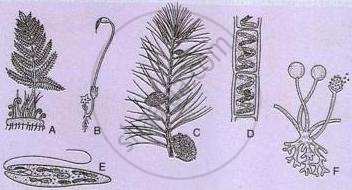
- Identify figures A to F.
- What is the phylum of D, E and F?
- What is the division of A, B and C?
- Which of them is unicellular and eukaryotic organism?
- Which one of them exhibits (i) Heterotrophic nutrition; (ii) Mixotrophic nutrition.
- Which one of them is multicellular decomposer?
- Which one amphibian of plant kingdom?
- In which one of them plant xylem lacks vessels and phloem is without companion cells?
- What is the scientific name of each of them: (i) Male shield fern; (ii) Bread mould?
- In which of them endosperm is haploid?
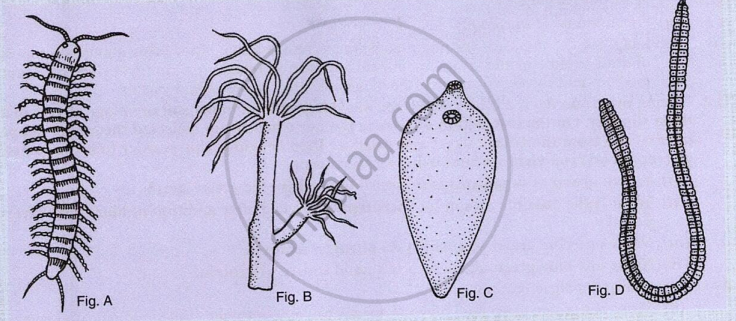
- Identify figure A to D.
- Which one of them is (i) diplobalstic; (ii) triploblastic?
- Which triplobalstic animal is (i) Acoelomate; (ii) Coelomate?
- Which one belong to phylum
(i) Cnidaria; (ii) Platyhelminthes; (iii) Annelids; (iv) Arthropoda? - Which one of them has
(i) Organ level organisation; (ii) Organ-system level organisation? - Which one of them has excretory organs in the form of (i) Flame cells; (ii) Nephridia?
- Which one of them has trachae as the respiratory organ?
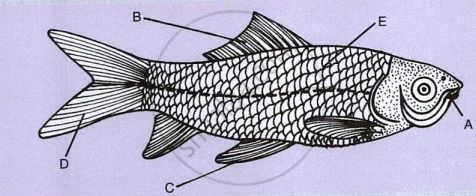
- Identify the figure and write down its class.
- Label A, B, C and D.
- What is its respiratory organs?
- What type of adaptation this creature has?
- What type of endoskeleton it has?
P S Verma and V K Agarwal solutions for बायोलॉजी पार्ट ३ [इंग्रजी] इयत्ता ९ 4 Diversity in Living Organisms Questions Based on Assertion-Reason [Page 230]
In the following questions, two statements are given-one labelled Assertion (A) and the other labelled Reason (R): Select the correct answer to these questions from the codes given below:
Assertion (A): Rays, skates and sharks are cartilaginous fishes.
Reason (R): They have a cartilaginous endoskeleton.
Both A and R are true and R is correct explanation of the assertion.
Both A and R are true but R is not the correct explanation of the assertion.
A is true but R is false.
A is false but R is true.
Assertion (A): Filaria(Wuchereria) worm belongs to phylum Annelida.
Reason (R): It has unsegmented body.
Both A and R are true and R is correct explanation of the assertion.
Both A and R are true but R is not the correct explanation of the assertion.
A is true but R is false.
A is false but R is true.
Assertion (A): Cnidoblasts (stinging cells) occur over the tentacles in Coelenterates.
Reason (R): They help in attachment and paralyzing the prey.
Both A and R are true and R is correct explanation of the assertion.
Both A and R are true but R is not the correct explanation of the assertion.
A is true but R is false.
A is false but R is true.
Solutions for 4: Diversity in Living Organisms
P S Verma and V K Agarwal solutions for बायोलॉजी पार्ट ३ [इंग्रजी] इयत्ता ९ chapter 4 - Diversity in Living Organisms
Shaalaa.com has the CBSE Mathematics बायोलॉजी पार्ट ३ [इंग्रजी] इयत्ता ९ CBSE solutions in a manner that help students grasp basic concepts better and faster. The detailed, step-by-step solutions will help you understand the concepts better and clarify any confusion. P S Verma and V K Agarwal solutions for Mathematics बायोलॉजी पार्ट ३ [इंग्रजी] इयत्ता ९ CBSE 4 (Diversity in Living Organisms) include all questions with answers and detailed explanations. This will clear students' doubts about questions and improve their application skills while preparing for board exams.
Further, we at Shaalaa.com provide such solutions so students can prepare for written exams. P S Verma and V K Agarwal textbook solutions can be a core help for self-study and provide excellent self-help guidance for students.
Concepts covered in बायोलॉजी पार्ट ३ [इंग्रजी] इयत्ता ९ chapter 4 Diversity in Living Organisms are Introduction of Biological Classification, Classification of Living Organisms, Taxonomic Hierarchy of Living Organisms: Unit of Classification, Five Kingdom Classification, Kingdom Monera, Kingdom Protista, Kingdom Fungi, Kingdom Animalia, Differences Between Plantae (Plants) and Animalia (Animals), Sub-division Algae, Kingdom Plantae: Thallophyta (Fungi), Kingdom Animalia, Phylum: Porifera, Phylum: Cnidaria/Coelenterata, Phylum: Platyhelminthes, Invertebrate: Phylum Nematoda, Phylum: Annelida, Phylum: Arthropoda, Phylum: Mollusca, Phylum: Echinodermata, Subphylum: Prochordata, Invertebrata and Vertebrata, Taxonomy and Systematics, Kingdom Plantae, Kingdom Plantae, Cryptogams > Division II- Bryophytes, Cryptogams > Division III- Pteridophytes, Phanerogams > Division I-Gymnosperms, Phanerogams > Division II- Angiosperms, Subphylum: Vertebrata/Craniata, Nomenclature.
Using P S Verma and V K Agarwal बायोलॉजी पार्ट ३ [इंग्रजी] इयत्ता ९ solutions Diversity in Living Organisms exercise by students is an easy way to prepare for the exams, as they involve solutions arranged chapter-wise and also page-wise. The questions involved in P S Verma and V K Agarwal Solutions are essential questions that can be asked in the final exam. Maximum CBSE बायोलॉजी पार्ट ३ [इंग्रजी] इयत्ता ९ students prefer P S Verma and V K Agarwal Textbook Solutions to score more in exams.
Get the free view of Chapter 4, Diversity in Living Organisms बायोलॉजी पार्ट ३ [इंग्रजी] इयत्ता ९ additional questions for Mathematics बायोलॉजी पार्ट ३ [इंग्रजी] इयत्ता ९ CBSE, and you can use Shaalaa.com to keep it handy for your exam preparation.
