Advertisements
Advertisements
प्रश्न
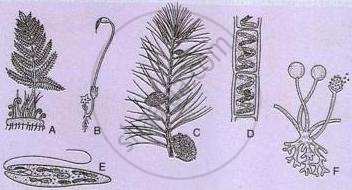
- Identify figures A to F.
- What is the phylum of D, E and F?
- What is the division of A, B and C?
- Which of them is unicellular and eukaryotic organism?
- Which one of them exhibits (i) Heterotrophic nutrition; (ii) Mixotrophic nutrition.
- Which one of them is multicellular decomposer?
- Which one amphibian of plant kingdom?
- In which one of them plant xylem lacks vessels and phloem is without companion cells?
- What is the scientific name of each of them: (i) Male shield fern; (ii) Bread mould?
- In which of them endosperm is haploid?
दीर्घउत्तर
Advertisements
उत्तर
- A - Male shield fern (Dryopteris); B - Moss (Funaria); C - Pinus; D - Spirogyra; E - Euglena; F - Bread mould (Rhizopus).
- D - Algae; E - Protozoa; F - Fungi.
- A - Pteridophyta; B - Bryophyta; C - Gymnospermae.
- Euglena is unicellular and eukaryotic.
- (i) Heterotrophic nutrition - Rhizopus. (ii) Mixotrophic nutrition - Euglena.
- Rhizopus is a multicellular decomposer.
- Funaria (moss) is an amphibian of the plant kingdom.
- In Pinus, the xylem lacks vessels and the phloem lacks companion cells.
- (i) Male shield fern - Dryopteris. (ii) Bread mould - Rhizopus.
- Pinus has haploid endosperm.
shaalaa.com
या प्रश्नात किंवा उत्तरात काही त्रुटी आहे का?
