Advertisements
Online Mock Tests
Chapters
I: The Rise of Nationalism in Europe
▶ II: Nationalism in India
Section II : Livelihoods, Economics and Societies
III: The Making of a Global World
IV: The Age of Industrialisation
Section III: Everyday Life, Culture and Politics
V: Print Culture and the Modern World
![NCERT solutions for सोशल सायन्स इंडिया अँड ध कॉनटेंपोरारी वर्ल्ड २ [इंग्रजी] इयत्ता १० chapter II - Nationalism in India - Shaalaa.com](/images/social-science-india-and-the-contemporary-world-2-english-class-10_6:73fb944f40ae4f72a92aa78c628a737c.jpg "NCERT solutions for सोशल सायन्स इंडिया अँड ध कॉनटेंपोरारी वर्ल्ड २ [इंग्रजी] इयत्ता १० chapter II - Nationalism in India")
Advertisements
Solutions for Chapter II: Nationalism in India
Below listed, you can find solutions for Chapter II of CBSE NCERT for सोशल सायन्स इंडिया अँड ध कॉनटेंपोरारी वर्ल्ड २ [इंग्रजी] इयत्ता १०.
NCERT solutions for सोशल सायन्स इंडिया अँड ध कॉनटेंपोरारी वर्ल्ड २ [इंग्रजी] इयत्ता १० II Nationalism in India Intext Questions [Pages 31 - 48]
Activity
|
Mahatma Gandhi on Satyagraha It is said of “passive resistance” that it is the weapon of the weak, but the power which is the subject of this article can be used only by the strong. This power is not passive resistance; indeed it calls for intense activity. The movement in South Africa was not passive but active... Satyagraha is not physical force. A satyagrahi does not inflict pain on the adversary; he does not seek his destruction... In the use of satyagraha, there is no ill-will whatever. Satyagraha is pure soul-force. Truth is the very substance of the soul. That is why this force is called satyagraha. The soul is informed with knowledge. In it burns the flame of love... Nonviolence is the supreme dharma... ‘It is certain that India cannot rival Britain or Europe in force of arms. The British worship the war-god and they can all of them become, as they are becoming, bearers of arms. The hundreds of millions in India can never carry arms. They have made the religion of non-violence their own...’ |
Read the text carefully. What did Mahatma Gandhi mean when he said satyagraha is active resistance?
The year is 1921. You are a student in a government-controlled school. Design a poster urging school students to answer Gandhiji’s call to join the Non-Cooperation Movement.
If you were a peasant in Uttar Pradesh in 1920, how would you have responded to Gandhiji’s call for Swaraj? Give reasons for your response.
Find out about other participants in the National Movement who were captured and put to death by the British. Can you think of a similar example from the national movement in Indo-China (Chapter 2)?
Discuss
Why did various classes and groups of Indians participate in the Civil Disobedience Movement?
Read the Source carefully. Do you agree with Iqbal’s idea of communalism? Can you define communalism in a different way?
|
In 1930, Sir Muhammad Iqbal, as president of the Muslim League, reiterated the importance of separate electorates for the Muslims as an important safeguard for their minority political interests. His statement is supposed to have provided the intellectual justification for the Pakistan demand that came up in subsequent years. This is what he said: ‘I have no hesitation in declaring that if the principle that the Indian Muslim is entitled to full and free development on the lines of his own culture and tradition in his own Indian home-lands is recognised as the basis of a permanent communal settlement, he will be ready to stake his all for the freedom of India. The principle that each group is entitled to free development on its own lines is not inspired by any feeling of narrow communalism... A community which is inspired by feelings of ill-will towards other communities is low and ignoble. I entertain the highest respect for the customs, laws, religions and social institutions of other communities. Nay, it is my duty according to the teachings of the Quran, even to defend their places of worship, if need be. Yet I love the communal group which is the source of life and behaviour and which has formed me what I am by giving me its religion, its literature, its thought, its culture and thereby its whole past as a living operative factor in my present consciousness... ‘Communalism in its higher aspect, then, is indispensable to the formation of a harmonious whole in a country like India. The units of Indian society are not territorial as in European countries... The principle of European democracy cannot be applied to India without recognising the fact of communal groups. The Muslim demand for the creation of a Muslim India within India is, therefore, perfectly justified... ‘The Hindu thinks that separate electorates are contrary to the spirit of true nationalism, because he understands the word “nation” to mean a kind of universal amalgamation in which no communal entity ought to retain its private individuality. Such a state of things, however, does not exist. India is a land of racial and religious variety. Add to this the general economic inferiority of the Muslims, their enormous debt, especially in the Punjab, and their insufficient majorities in some of the provinces, as at present constituted and you will begin to see clearly the meaning of our anxiety to retain separate electorates.’ |
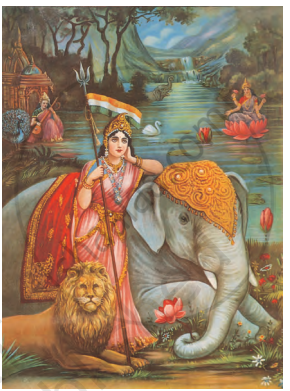
Look at the figures. Do you think these images will appeal to all castes and communities? Explain your views briefly.

NCERT solutions for सोशल सायन्स इंडिया अँड ध कॉनटेंपोरारी वर्ल्ड २ [इंग्रजी] इयत्ता १० II Nationalism in India Exercises [Page 50]
Write in brief
Explain why the growth of nationalism in the colonies is linked to an anti-colonial movement.
Explain how the First World War helped in the growth of the National Movement in India.
Explain why Indians were outraged by the Rowlatt Act.
Explain why Gandhiji decided to withdraw the Non-Cooperation Movement.
What is meant by the idea of satyagraha?
Write a newspaper report on:
The Jallianwala Bagh massacre
Write a newspaper report on:
The Simon Commission
Compare the images of Bharat Mata with the image of Germania.

Discuss
List all the different social groups which joined the Non-Cooperation Movement of 1921. Then choose any three and write about their hopes and struggles to show why they joined the movement.
Discuss the Salt March to make clear why it was an effective symbol of resistance against colonialism.
Imagine you are a woman participating in the Civil Disobedience Movement. Explain what the experience meant to your life.
Why did political leaders differ sharply over the question of separate electorates?
Project
Find out about the anti-colonial movement in Indo-China. Compare and contrast India’s national movement with the ways in which Indo-China became independent.
Solutions for II: Nationalism in India
NCERT solutions for सोशल सायन्स इंडिया अँड ध कॉनटेंपोरारी वर्ल्ड २ [इंग्रजी] इयत्ता १० chapter II - Nationalism in India
Shaalaa.com has the CBSE Mathematics सोशल सायन्स इंडिया अँड ध कॉनटेंपोरारी वर्ल्ड २ [इंग्रजी] इयत्ता १० CBSE solutions in a manner that help students grasp basic concepts better and faster. The detailed, step-by-step solutions will help you understand the concepts better and clarify any confusion. NCERT solutions for Mathematics सोशल सायन्स इंडिया अँड ध कॉनटेंपोरारी वर्ल्ड २ [इंग्रजी] इयत्ता १० CBSE II (Nationalism in India) include all questions with answers and detailed explanations. This will clear students' doubts about questions and improve their application skills while preparing for board exams.
Further, we at Shaalaa.com provide such solutions so students can prepare for written exams. NCERT textbook solutions can be a core help for self-study and provide excellent self-help guidance for students.
Concepts covered in सोशल सायन्स इंडिया अँड ध कॉनटेंपोरारी वर्ल्ड २ [इंग्रजी] इयत्ता १० chapter II Nationalism in India are Growth of Nationalism in Europe After the 1830s., Ideas of Giuseppe Mazzini, Characteristics of the Movements in Poland, Hungary,Italy, Germany and Greece, Factors Leading to Growth of Nationalism in Indo-china, French Colonialism in Indo-china, Phases of Struggle Against the French, The Ideas of Phan Chu Trinh, The Ideas Phan Boi Chau, Ho Chi Minh, Second World War and the Liberation Struggle., America and the Vietnam War, Impact of First World War, Khilafat, Non- Cooperation, Differing Strands Within the Movement, The Limits of Civil Disobedience, The Sense of Collective Belonging, Salt Satyagraha, Movements of Peasants, Workers, Tribals., Quit India Movement and Conclusion, Introduction to Nationalism in India, The Sense of Collective Belonging, The First World War, Khilafat and Non-cooperation, The Idea of Satyagraha, The Rowlatt Act, Need for Non-Cooperation, Differing Strands Within the Movement, The Movement in the Towns, Rebellion in the Countryside, Swaraj in the Plantations, Towards Civil Disobedience, The Salt March and the Civil Disobedience Movement, How Participants Saw the Civil Disobedience Movement, The Limits of Civil Disobedience, Overview of Nationalism in India, Growth of Nationalism in Europe After the 1830s., Ideas of Giuseppe Mazzini, Characteristics of the Movements in Poland, Hungary,Italy, Germany and Greece, Factors Leading to Growth of Nationalism in Indo-china, French Colonialism in Indo-china, Phases of Struggle Against the French, The Ideas of Phan Chu Trinh, The Ideas Phan Boi Chau, Ho Chi Minh, Second World War and the Liberation Struggle., America and the Vietnam War, Impact of First World War, Khilafat, Non- Cooperation, Differing Strands Within the Movement, The Limits of Civil Disobedience, The Sense of Collective Belonging, Salt Satyagraha, Movements of Peasants, Workers, Tribals., Quit India Movement and Conclusion, Introduction to Nationalism in India, The Sense of Collective Belonging, The First World War, Khilafat and Non-cooperation, The Idea of Satyagraha, The Rowlatt Act, Need for Non-Cooperation, Differing Strands Within the Movement, The Movement in the Towns, Rebellion in the Countryside, Swaraj in the Plantations, Towards Civil Disobedience, The Salt March and the Civil Disobedience Movement, How Participants Saw the Civil Disobedience Movement, The Limits of Civil Disobedience, Overview of Nationalism in India.
Using NCERT सोशल सायन्स इंडिया अँड ध कॉनटेंपोरारी वर्ल्ड २ [इंग्रजी] इयत्ता १० solutions Nationalism in India exercise by students is an easy way to prepare for the exams, as they involve solutions arranged chapter-wise and also page-wise. The questions involved in NCERT Solutions are essential questions that can be asked in the final exam. Maximum CBSE सोशल सायन्स इंडिया अँड ध कॉनटेंपोरारी वर्ल्ड २ [इंग्रजी] इयत्ता १० students prefer NCERT Textbook Solutions to score more in exams.
Get the free view of Chapter II, Nationalism in India सोशल सायन्स इंडिया अँड ध कॉनटेंपोरारी वर्ल्ड २ [इंग्रजी] इयत्ता १० additional questions for Mathematics सोशल सायन्स इंडिया अँड ध कॉनटेंपोरारी वर्ल्ड २ [इंग्रजी] इयत्ता १० CBSE, and you can use Shaalaa.com to keep it handy for your exam preparation.
