Advertisements
Chapters
2: Cell: The Building Block of Life
3: Tissues in Action
4: Describing Motion Around Us
5: Exploring Mixtures and their Separation
6: How Forces Affect Motion
▶ 7: Work, Energy, and Simple Machines
Chapter 8: Journey Inside the Atom
Chapter 9: Atomic Foundations of Matter
Chapter 10: Sound Waves: Characteristics and Applications
Chapter 11: Reproduction: How Life Continues
Chapter 12: Patterns in Life: Diversity and Classification
Chapter 13: Earth as a System: Energy, Matter, and Life
![NCERT solutions for इंग्लिश एक्स्प्लॉरैशन [इंग्रजी] इयत्ता ९ chapter 7 - Work, Energy, and Simple Machines - Shaalaa.com](/images/science-exploration-english-class-9_6:fe60d22a299f466891137f05891ccc52.jpg "NCERT solutions for इंग्लिश एक्स्प्लॉरैशन [इंग्रजी] इयत्ता ९ chapter 7 - Work, Energy, and Simple Machines")
Advertisements
Solutions for Chapter 7: Work, Energy, and Simple Machines
Below listed, you can find solutions for Chapter 7 of CBSE NCERT for इंग्लिश एक्स्प्लॉरैशन [इंग्रजी] इयत्ता ९.
NCERT solutions for इंग्लिश एक्स्प्लॉरैशन [इंग्रजी] इयत्ता ९ 7 Work, Energy, and Simple Machines Intext Questions [Pages 116 - 135]
Think It Over
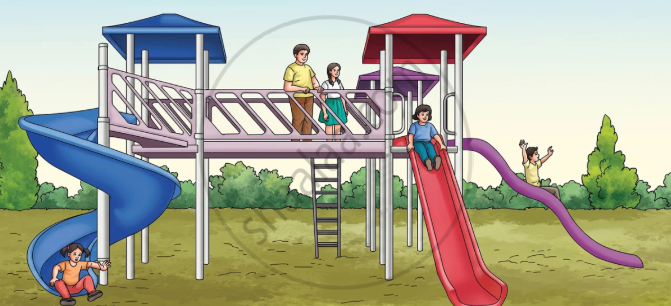
- What will be the magnitude of velocity of the child at the bottom of the blue slide?
- Will two children of different masses reach the bottom of the same slide with the same velocity?
- Which of the slides will result in the largest magnitude of velocity for the child at its bottom?
Pause and Ponder
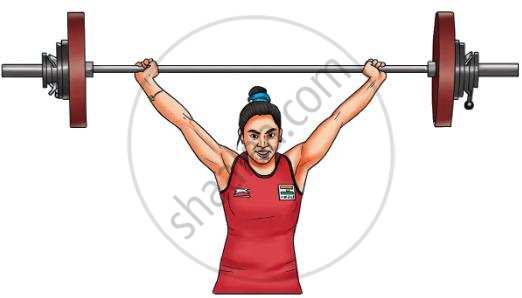
In the previous chapter, a weightlifter is shown holding a barbell steady in her hands (Fig.). Is she doing any work on the barbell while holding it steady?
Is the work done by friction on the stack of coins that travels on a rough surface positive, negative or zero?
When you pedal a bicycle on a flat road, your muscles supply energy. In what forms does this muscular energy appear as you ride?
Two objects A and B of mass m and 4 m have the same kinetic energy. What is the ratio of the magnitude of velocities of A and B?
Does the kinetic energy of an object which moves with constant velocity change with its position?
Does the potential energy of an object near the surface of the Earth change if it moves with constant velocity in the horizontal direction? What if the object is gradually raised in the vertical direction?
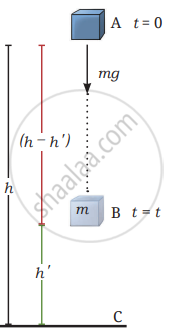
For the situation depicted in the Fig, calculate the mechanical energy of the ball just before it hits the ground and show that even at this position, it is mgh.
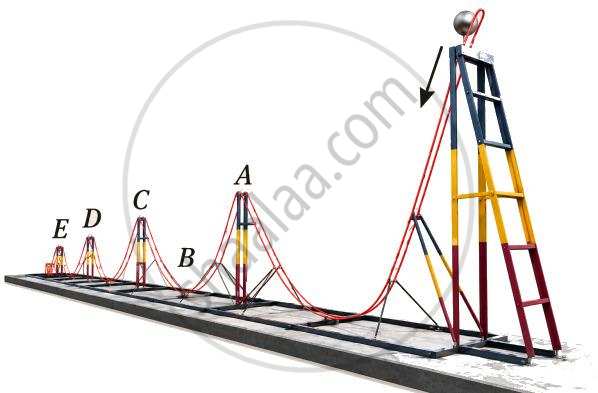
You may have seen an exhibit like that in the Fig. in a science park, where a ball is released from the highest point. Describe how the kinetic energy and potential energy change at points A, B and C. Why do subsequent points, such as C, D and E, usually have lower heights compared to the previous ones? Could it have anything to do with the energy lost due to friction?
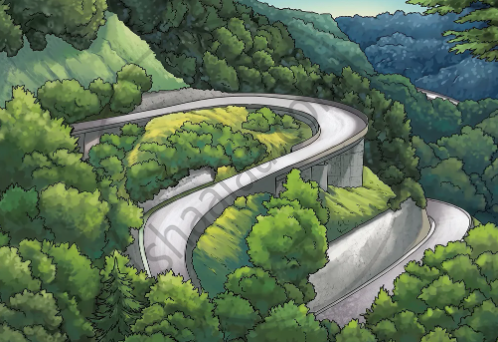
Explain why roads on hills are built to wind around in gentle slopes rather than going straight up (Fig.).
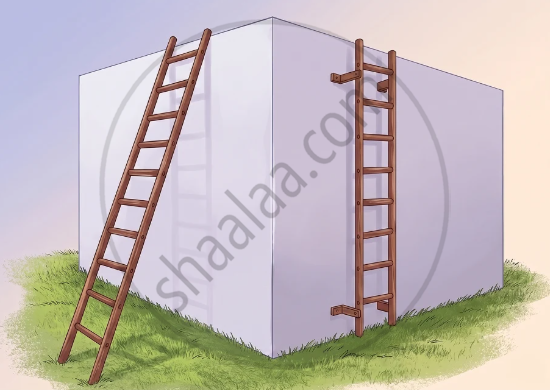
To reach a higher floor, we find climbing an inclined ladder easier in comparison to climbing a vertical ladder (Fig.). Explain why.
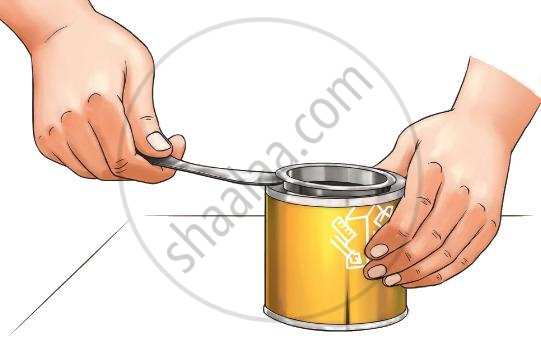
Why is it easier to open the lid of a can by using a spoon as shown in the Fig.?
Why do you push an object closer to scissors (fulcrum) when you want to cut an object which is hard?
Throughout history, many designs of perpetual machines (using wheels, weights or magnets) have been proposed but none actually work. Why do all real machines eventually slow down and stop? Explain in terms of work and energy.
NCERT solutions for इंग्लिश एक्स्प्लॉरैशन [इंग्रजी] इयत्ता ९ 7 Work, Energy, and Simple Machines Revise, Reflect, Refine [Pages 136 - 138]
State whether True or False.
Work is said to be done when a force is applied, even if the object does not move.
State whether True or False.
Lifting a bucket vertically upward results in positive work done on the bucket.
State whether True or False.
The SI unit for both work and energy is joule (J).
State whether True or False.
A motionless stretched rubber band has kinetic energy.
State whether True or False.
Energy can change from one form to another.
Fill in the blanks.
Work done = ______ × ______ (in the direction of force).
1 joule of work is done when a force of ______ newton displaces an object by 1 metre in the direction of the force.
The expression for kinetic energy of a body of mass m and velocity v is ______.
The potential energy of an object of mass m at a small height h from the Earth’s surface is ______.
Power is defined as the ______ at which work is done.
When a ball thrown upwards reaches its highest point, tick which of the following statement(s) are correct?
The force acting on the ball is zero.
The acceleration of the ball is zero.
Its kinetic energy is zero.
Its potential energy is maximum.
For the following situation, identify the energy transformation that takes place:
A truck moving uphill.
For the following situation, identify the energy transformation that takes place:
Unwinding of a watch spring.
For the following situation, identify the energy transformation that takes place:
Photosynthesis in green leaves.
For the following situation, identify the energy transformation that takes place:
Water flowing from a dam.
For the following situation, identify the energy transformation that takes place:
Burning of a matchstick.
For the following situation, identify the energy transformation that takes place:
Explosion of a fire cracker.
For the following situation, identify the energy transformation that takes place:
Speaking into a microphone.
For the following situation, identify the energy transformation that takes place:
A glowing electric bulb.
For the following situation, identify the energy transformation that takes place:
A solar panel.
A student is slowly lifted straight up in an elevator from the ground level to the top floor of a building. Later, the same student climbs the staircase, all the way to the top. Given that the height of the building is h = 72.5 m, acceleration due to gravity is g = 10 m s–2, and student’s mass is m = 50 kg.
- Find the gain in the potential energy if the student is lifted straight up to the top.
- Find the gain in the potential energy when the student climbs the stairs to the same top.
- What do you conclude about the dependence of the potential energy on the path taken?
A crane lifts a mass m to the 10th floor of a building in a certain time. It then raises the same mass to the 20th floor of the same building in double the time. How much more energy and power are required? Assume that the height of all floors is equal.
Which factors determine the energy required to raise a flag from the ground to the top of a tall flagpole using a pulley? Does raising the flag slowly or quickly change the amount of work done? If the speed at which the flag is raised is doubled, how does the power requirement change? Explain your answers.
A man of mass 60 kg rides a scooter of mass 100 kg. He accelerates the scooter to a velocity v. The next day, his son with a mass of 40 kg joins him as a passenger. If the scooter reaches the same speed on both days in the same time interval, what is the ratio of the fuel of the tank used on the two days? Assume that the energy transfer to the scooter happens entirely due to fuel, and no other losses occur due to air resistance and friction.
On a seesaw with sliding seats, a child is sitting on one side and an adult on the other side. The adult weighs twice that of the child. The seesaw however is balanced. Draw a figure which depicts this situation showing the distances from the fulcrum where the child and the adult are seated.
A ball of mass 2 kg is thrown up with a velocity of 20 m s–1.
- Identify the sign of the work done by gravity on the ball during its upward motion and its downward motion.
- If the ball reaches a height of 19.4 m, how much work was done by air resistance (assume g = 10 m s–2).
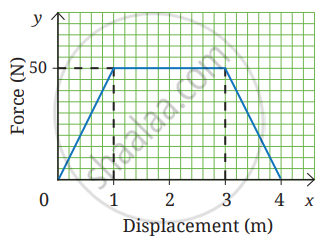
A 10.0 kg block is moving on horizontal floor with negligible friction. As shown in the Fig., a variable force is applied on the block in its direction of motion from its position at 0 m till 4 m. If the block had a kinetic energy of 180 J when it was at 0 m, find the block’s speed (i) at 0 m, and (ii) at 4 m. Does the block have negative acceleration in any portion of its motion?
The gravitational attraction on the surface of the Moon (lunar surface) is about `1/6`th of that on the surface of the Earth. An astronaut can throw a ball up to a height of 8 m from the surface of the Earth. How far up will the ball thrown with the same upward velocity travel from the surface of the Moon?
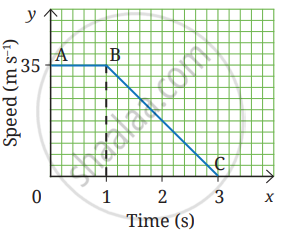
A 1000 kg car is moving along a road at a constant speed. Suddenly, the driver notices some obstruction ahead and applies the brakes to come to a complete stop. The graphical representation of motion of the car starting from the instant the driver spots the traffic ahead is shown in the Fig.
- Describe how the car moves between positions A and B.
- Calculate the kinetic energy of the car at A.
- State the work done by the brakes in bringing the car to a halt between B and C.
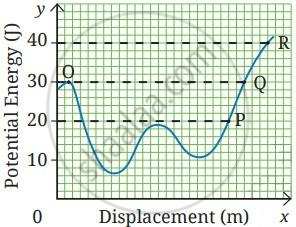
The potential energy-displacement graph of a 0.5 kg ball moving along a frictionless track is shown in the Fig. At O, the velocity of the ball is 0 m s–1 and potential energy is 30 J. Calculate the velocity of the ball at P, Q and R.
A coconut of mass 1.5 kg falls from the top of a coconut tree onto the wet sand on a beach. The height of the tree is 10 m. On impact, the coconut comes to rest by making a depression in the sand.
- Calculate the velocity of the coconut just before it hits the sand.
- Assume that the average resistive force of sand is 3000 N and all of the coconut’s energy is used to create the depression in the sand. Calculate the depth of the depression the coconut makes in the sand. Assume g = 10 m s–2.
NCERT solutions for इंग्लिश एक्स्प्लॉरैशन [इंग्रजी] इयत्ता ९ 7 Work, Energy, and Simple Machines The Journey Beyond [Page 139]
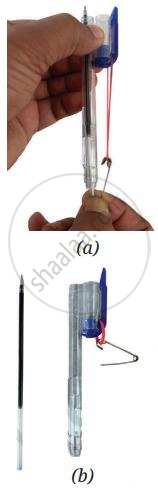
Remove both the ends from a pen so that the refill can slide freely through the barrel (Fig.). Fix the pen cap to the side of the barrel and attach a rubber band to the clip of the cap. Connect the free end of the rubber band to the refill using a safety pin. Stretch and release the rubber band. The refill shoots out, showing the conversion of elastic potential energy into kinetic energy. Repeat with different amounts of stretch, and observe how the distance travelled changes. Is there a relationship between the stretch and the distance travelled?
Construct one or more simple machines, or a combination of them (lever, pulley and inclined plane) using easily available materials, such as cardboard, wooden strips or rulers, pencils or bolts (to act as a fulcrum), thread or rope, small pulleys (or two bottle caps stuck together), and paper cups to hold small weights. Be imaginative in your design. Use your model to lift or move a small load, measure the effort and the load, and calculate the mechanical advantage.
Computer simulations can help in visualising physical quantities that are difficult to observe directly. The PhET simulations (https:// phet.colorado.edu) provide interactive models, such as Energy Skate Park, Energy Forms and Changes, Pendulum Lab, and Masses and Springs. Use these to explore how different forms of energy change as parameters, such as mass, height and friction are varied.
Solutions for 7: Work, Energy, and Simple Machines
NCERT solutions for इंग्लिश एक्स्प्लॉरैशन [इंग्रजी] इयत्ता ९ chapter 7 - Work, Energy, and Simple Machines
Shaalaa.com has the CBSE Mathematics इंग्लिश एक्स्प्लॉरैशन [इंग्रजी] इयत्ता ९ CBSE solutions in a manner that help students grasp basic concepts better and faster. The detailed, step-by-step solutions will help you understand the concepts better and clarify any confusion. NCERT solutions for Mathematics इंग्लिश एक्स्प्लॉरैशन [इंग्रजी] इयत्ता ९ CBSE 7 (Work, Energy, and Simple Machines) include all questions with answers and detailed explanations. This will clear students' doubts about questions and improve their application skills while preparing for board exams.
Further, we at Shaalaa.com provide such solutions so students can prepare for written exams. NCERT textbook solutions can be a core help for self-study and provide excellent self-help guidance for students.
Concepts covered in इंग्लिश एक्स्प्लॉरैशन [इंग्रजी] इयत्ता ९ chapter 7 Work, Energy, and Simple Machines are .
Using NCERT इंग्लिश एक्स्प्लॉरैशन [इंग्रजी] इयत्ता ९ solutions Work, Energy, and Simple Machines exercise by students is an easy way to prepare for the exams, as they involve solutions arranged chapter-wise and also page-wise. The questions involved in NCERT Solutions are essential questions that can be asked in the final exam. Maximum CBSE इंग्लिश एक्स्प्लॉरैशन [इंग्रजी] इयत्ता ९ students prefer NCERT Textbook Solutions to score more in exams.
Get the free view of Chapter 7, Work, Energy, and Simple Machines इंग्लिश एक्स्प्लॉरैशन [इंग्रजी] इयत्ता ९ additional questions for Mathematics इंग्लिश एक्स्प्लॉरैशन [इंग्रजी] इयत्ता ९ CBSE, and you can use Shaalaa.com to keep it handy for your exam preparation.
