Advertisements
Advertisements
प्रश्न
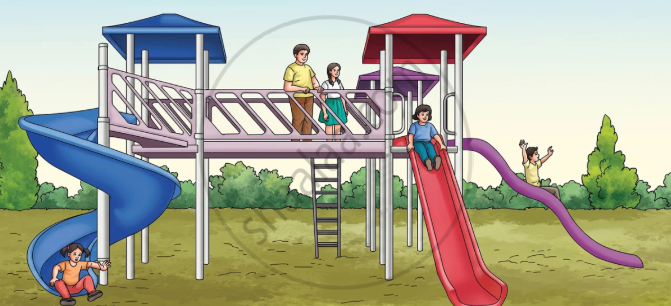
- What will be the magnitude of velocity of the child at the bottom of the blue slide?
- Will two children of different masses reach the bottom of the same slide with the same velocity?
- Which of the slides will result in the largest magnitude of velocity for the child at its bottom?
सविस्तर उत्तर
Advertisements
उत्तर
Potential energy at the top is converted into kinetic energy at the bottom when the youngster slides down, ignoring friction.
So,
`1/2 "mv"^2 = mgh`
`v = sqrt(2gh)`
(i) The child's velocity at the bottom of the blue slide is equal to `v = sqrt(2gh)`, where h is the blue slide's height. Only the slide's height determines its value.
(ii) Yes. Two children of different masses will travel at the same speed to the bottom of the same slide because the velocity `v = sqrt(2gh)` depends only on the height h and not on the mass.
(iii) The slide with the highest height has the highest velocity since `v = sqrt(2gh)`. The child will experience the greatest magnitude of velocity at the bottom of the slide that begins at the highest point.
shaalaa.com
या प्रश्नात किंवा उत्तरात काही त्रुटी आहे का?
